

From
Live Event Content
Dr. Krysta Sutyak - Best of the Best in Pediatric Surgery 2025
With Dr. Krysta Sutyak
Part of
Appendicitis 29 items
Educational content from recorded physician discussions — not medical advice. Talk to your (or your child's) care team about your situation.
Video
Appendicitis Management & APPY Trial: Update Course 2016
31 min · Published Oct 2018
Podcast
Update Course Rewind: Perforated Appendicitis 2019
12 min · Published Apr 2021
Video
Update Course Rewind: Management of Appendicitis 2022
Published May 2023
Podcast
Journal of Pediatric Surgery Article Review: May 2023, CAPS Issue
11 min · Published Aug 2023
Video
Non-Operative Management of Appendicitis: 2018 Pediatric Surgery Practice Gap #2
Dr. Todd Ponsky · 1 min · Published Jun 2019
Video
Update Course 2021: DEI – CONCORDANCE AND POST OP COMPLICATION STUDIES
Published May 2022
Only a few other public items share this expert — go deeper there →
Video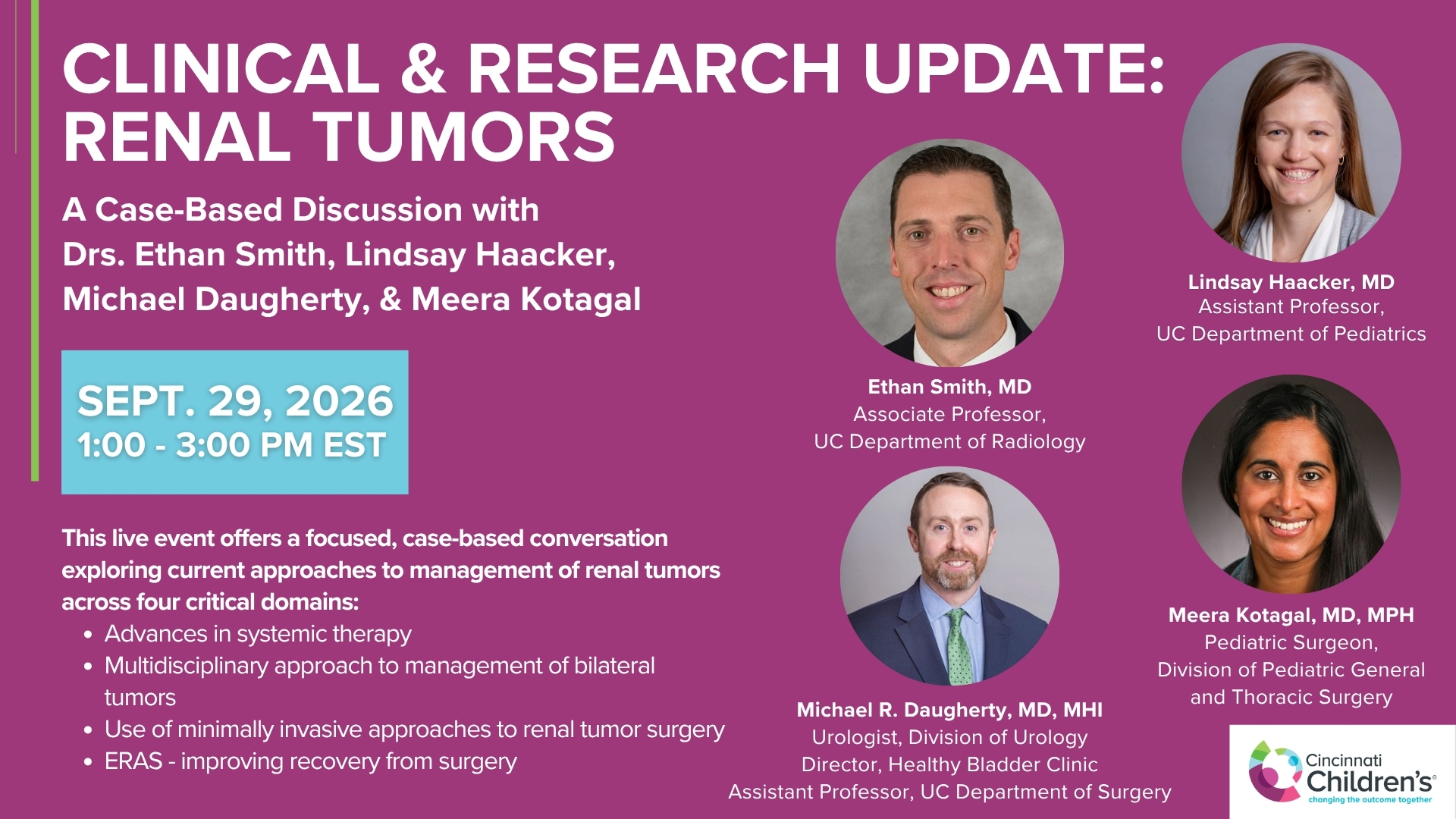
Clinical & Research Update: Renal Tumors with Drs. Ethan Smith, Lindsay Haacker, Michael Daugherty, and Meera Kotagal
71 min · Published Sep 2026
Video
Clinical & Research Update: Neuroblastoma with Drs. Katherine Somers, Cara Morin, Juan Gurria, and Meera Kotagal
67 min · Published Sep 2026
Video
Clinical & Research Update: Sarcoma w/ Drs. Roshni Dasgupta, Joseph Pressey, Arthur Meyer, Luke Pater
66 min · Published Sep 2026
Video
2026 Laparoscopic Pediatric Hernia Repair
123 min · Published Jun 2026
Video
Beyond the Spectrum: Diagnosis, Myths & Management - Caitlin Couch & Leslie Lopez - APP Conference 2026
50 min · Published May 2026
Video
Dysautonomia: Navigating the Journey - Martha Willis - APP Conference 2026
55 min · Published May 2026
What the experts said
Appendicitis is the most common diagnosis requiring urgent surgical treatment in the pediatric population.
34% of almost 34,000 children who underwent appendectomy in the United States from 2019 to 2021 were found to have perforation.
Perforated appendicitis increases the risk for post-operative intraabdominal abscess with 10 to 30% of patients with perforation developing an abscess.
At their institution from 2013 to 2019, development of post-operative abscess was associated with a length of stay increase of 6.1 days and an estimated incremental cost increase of $11,809 US per patient.
Providone iodine has bactericidal properties, matching the pathogen profile seen most commonly in perforated appendicitis and abscess formation.
In the 2016 pilot RCT, patients in the intervention arm received irrigation of the right lower quadrant and pelvis with PVI solution containing 0.1% available iodine compared to usual care in the control arm.
The 2016 trial resulted in an 89% probability that PVI reduced the rate of abscess and a 96% probability of decreased length of stay.
In secondary cost analysis of the 2016 trial, there was a mean cost difference between the PVI group and usual care group of $1,954 US, reflecting a 95% based in probability of reduced 30-day hospital costs.
For all 50 participants in the 2016 trial, this was an estimated hospital cost savings of $98,000.
Theoretical concerns about PVI use intraabdominally include potential adhesive disease, gastrointestinal effects or thyroid dysfunction.
Of the 100 trial participants reviewed, 60% were male with a median age at the time of surgery of 9.5 years.
51% of trial participants had subsequent encounters within the electronic medical record, including 50% of those who received PVI therapy and 52% of those who received usual care.
The median follow-up time was 7.3 years.
Only seven of the 100 patients had an ED visit related to their appendicitis diagnosis with five in the usual care group and two in the PVI group.
Three patients had a related readmission, all from the usual care group.
Zero patients were identified as being diagnosed with chronic abdominal pain, diarrhea or small bowel obstruction.
Five patients had encounters related to constipation with one from the usual care group and four from the PVI group.
Two patients were identified as having thyroid related diagnosis since the time of surgery.
For the most part the usual care in the trial was no irrigation, though it was defined as usual care within their practice.
One patient from the PVI group was diagnosed with thyroiditis after positive TPO antibodies were identified in the initial screening for the trial, which was determined by pediatric endocrinology to be unrelated to the PVI use.
One patient from the usual care group was diagnosed with papillary thyroid carcinoma 7.5 years later at the age of 22.
Children after PVI irrigation for perforated appendicitis did not demonstrate any adverse events, unexpected outcomes or differences in rates of biologically plausible conditions related to PVI.
A major limitation of the safety study is the retrospective nature and that data was only available for 50% of patients, though this was equal between groups.
Both thyroid conditions identified were unrelated to the use of PVI.