

From
StayCurrentMD
Thoracoscopic Right Lower Lobe Cystic Lesion Excision: Update Course 2014
With Dr. Steven Rothenberg
Educational content from recorded physician discussions — not medical advice. Talk to your (or your child's) care team about your situation.
Video
Quick Literature Updates Episode 18
4 min · Published Mar 2025
Podcast
Journal of Pediatric Surgery Article Review: October 2023
12 min · Published Apr 2024
Video
Clinical Symptoms Affect Treatment and Prognosis in Pediatric Patients with Congenital Pulmonary Airway Malformation
55 s · Published Dec 2023
Video
Update Course Rewind: Congenital Lung Lesions 2022
4 min · Published Aug 2023
Video
Update Course 2022 - APSA PDC UPDATES - Mary Edwards, Paul Jeziorczak, Craig Lillehei, and Charles Snyder,
64 min · Published Sep 2022
Podcast
Case Based Journal Review - CPAM in 2022
12 min · Published Apr 2022
Video
Ladd Medal Award Presentation Honoring Dr. Steven Rothenberg's Pioneering Minimally Invasive Pediatric Surgery
Dr. Steve Rothenberg · 33 min · Published May 2026
Video
PDA ligation by Dr. Steven Rothenberg
Dr. Steve Rothenberg · 6 min · Published Jun 2023
Video
Update Course Rewind: Pectus Excavatum 2021
Dr. Todd Ponsky · 11 min · Published Aug 2022
Podcast
Update Course Rewind: Magnet Therapy for Esophageal Atresia
10 min · Published Dec 2021
Video
Update Course Rewind: Thoracotomy vs VATS for Lung Metastases
Dr. Todd Ponsky · 9 min · Published Dec 2021
Video
Thoracoscopic TEF Repair, Is It Really Better Than Open? Update Course 2018
18 min · Published Aug 2018
Video
Intestinal Atresia Types Explained: Grossfeld Classification for Pediatric Surgery
1 min · Published Sep 2026
Video
Derivation and validation of the Pediatric Community-Acquired Pneumonia Severity (PedCAPS) score: A prospective cohort study
50 s · Published Sep 2026
Video
FETO for Late-Diagnosed Severe Congenital Diaphragmatic Hernia (CDH) at Cincinnati Children's with Dr. Beth Rymeski
4 min · Published Sep 2026
Video
Severe Congenital Diaphragmatic Hernia (CDH) Case: FETO Management & Unexpected Findings with Dr. Beth Rymeski
3 min · Published Sep 2026
Video
Fetoscopic Endoluminal Tracheal Occlusion (FETO) Procedure: Step-by-Step Guide with Dr. Beth Rymeski
4 min · Published Sep 2026
Video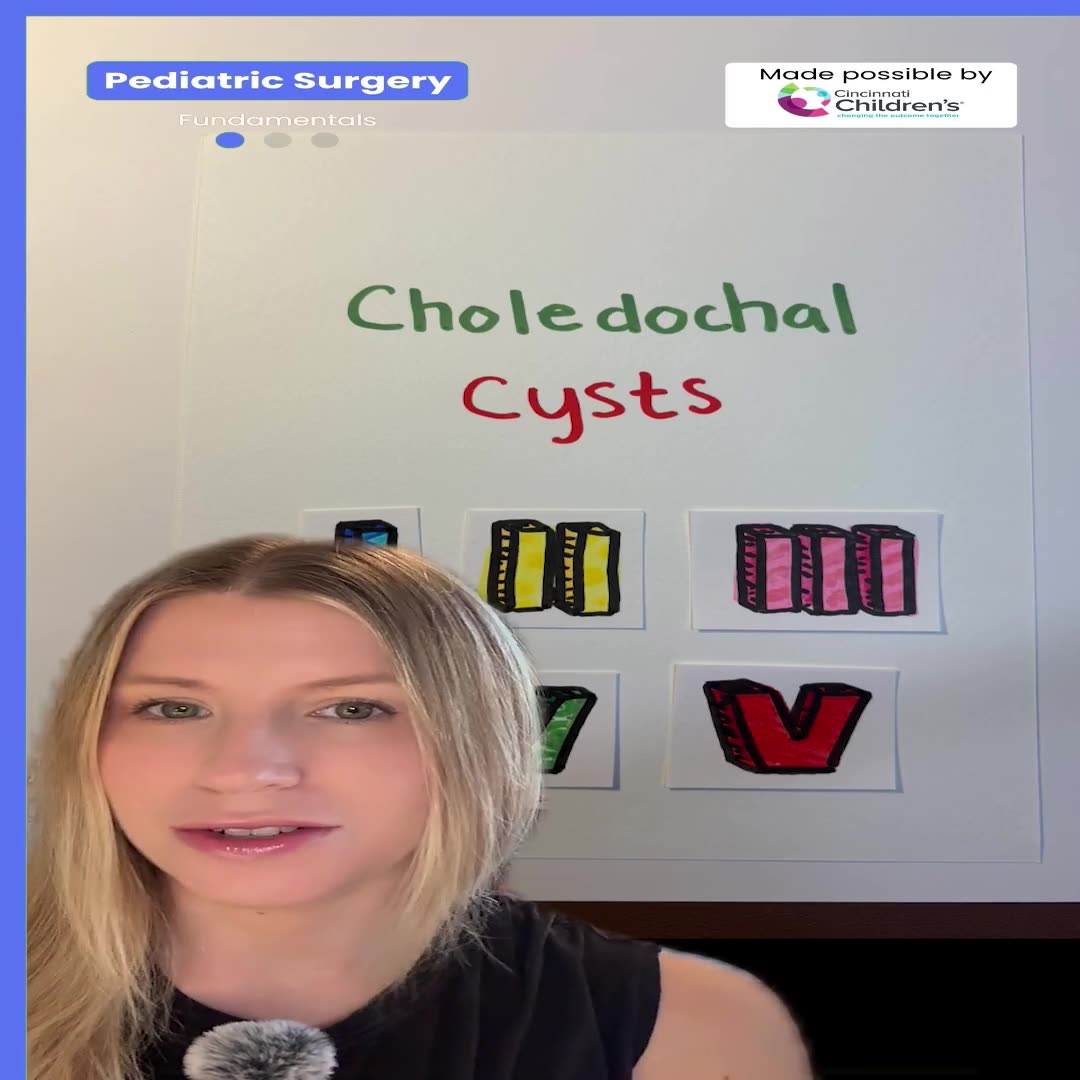
Choledochal Cyst Types Explained: Pediatric Surgery Fundamentals
1 min · Published Sep 2026
What the experts said
The patient is a 3-month-old, 5 kg infant undergoing thoracoscopic right lower lobectomy for a cystic lesion with an unseen sequestration.
Three-millimeter instruments are used for the procedure, and space is not an issue in a 3-month-old infant.
At 3 months of age, enlarged lymph nodes are already visible in the major fissure.
In asymptomatic children aged 9 months to 1 year, lymph nodes are often massive and inflammation in the fissure is extensive, making the operation more difficult.
The operation with a fellow assisting took approximately 90 minutes.
A 3 mm sealer can safely take vessels up to 5 mm in diameter.
When asymptomatic children are operated on around 1 year of age, dissection becomes much tougher due to inflammation, even in children who have never had a cold or chest infection.
At 3 months of age, clips can be safely used at the segmental level.
The specimen is morcellated through the trocar site and removed piecemeal because it is difficult to use a bag with a large specimen in a small infant.
At 3 months, thoracoscopic lobectomy does not feel like a limited-space operation; lung collapse is good and the dissection is easy.
In Europe, attitudes toward timing of surgery vary; the Netherlands is more conservative, while in Germany (and the speaker's institution) operations are performed at 3–6 months of age for any cystic lesion due to potential malignancy.
If cystic disease is seen in the lower part of the upper lobe, an anatomic segmental resection should be performed.
One child who had a segmental resection that appeared limited to an anatomic segment on CT and at surgery has shown evidence of recurrent cystic disease.
One child with no fissure (one giant lobe) required a bi-segmental resection and subsequently developed recurrent cystic disease because an anatomic resection could not be performed.
The chest tube was removed on postoperative day 2 and could have been removed on postoperative day 1; the child went home on postoperative day 3.
Pathology showed lung tissue with CPAM type 1 and type 2 changes with exuberant neoplastic mucinous proliferations; bronchial margin was negative. This is a finding not previously reported by the speaker.
In a personal series of over 300 lobectomies for cystic lung disease, the speaker has identified two pulmonary blastomas and one adenocarcinoma.
The neoplastic mucinous proliferations may be associated with KRAS mutation, which is also a marker in adult small cell carcinoma and colon cancer.
At Columbia, pathologists reviewing cases have found four others with exuberant neoplastic mucinous proliferations.
Once cystic lesions become infected, they are much more difficult to resect.
All lobectomies for cystic lung disease should be done thoracoscopically, and if a center cannot perform them thoracoscopically, patients should be referred to a center that can.
Good long-term pulmonary function studies are needed to document that if a lobe is removed in infancy, the rest of the lung will grow and compensate without significant disability.
In the speaker's personal series, the incidence of malignancy is almost 2%, certainly 1%, but may be 2%.
It is difficult to place a large specimen in a bag in young infants undergoing early lobectomy.
Three tumors in 300 cases represents a 1% incidence of cancer.
The three malignancies (blastomas and adenocarcinoma) were all diagnosed at 1 year of age.
The literature shows that 30–40% of children with cystic lung disease will have a significant pulmonary infection at some point during their life.
Hematologist-oncologists have stated that morcellating the specimen does not upgrade the tumor, does not change treatment, and no patient has received chemotherapy, but these children are being watched.