

From
StayCurrentMD
Laparoscopic Duhamel: Pediatric Surgery Difficult Cases 2013
Part of
Constipation 10 items
Educational content from recorded physician discussions — not medical advice. Talk to your (or your child's) care team about your situation.
Video
Tricks - New Duhamel - Laparoscopic Trans-rectal Rectosigmoidectomy
10 min · Published Nov 2018
Video
Colorectal Quiz: Episode 44 - HD Frozen Section
Marc Levitt · 18 min · Published Feb 2025
Podcast
The Colorectal Quiz Episode 4
Marc Levitt · 19 min · Published Feb 2021
Video
The use of postoperative calibrations in Hirschsprung disease
59 s · Published Nov 2024
Video
Does Delayed Diagnosis of Hirschsprung Disease Impact Post-operative and Functional Outcomes? A Multi-Center Review From the Pediatric Colorectal and Pelvic Learning Consortium
1 min · Published Oct 2024
Video
Hirschsprung Disease: Update Course 2015
CCHMC Pediatric Surgery · 7 min · Published Nov 2015
Video
Intestinal Atresia Types Explained: Grossfeld Classification for Pediatric Surgery
1 min · Published Sep 2026
Video
Derivation and validation of the Pediatric Community-Acquired Pneumonia Severity (PedCAPS) score: A prospective cohort study
50 s · Published Sep 2026
Video
FETO for Late-Diagnosed Severe Congenital Diaphragmatic Hernia (CDH) at Cincinnati Children's with Dr. Beth Rymeski
4 min · Published Sep 2026
Video
Severe Congenital Diaphragmatic Hernia (CDH) Case: FETO Management & Unexpected Findings with Dr. Beth Rymeski
3 min · Published Sep 2026
Video
Fetoscopic Endoluminal Tracheal Occlusion (FETO) Procedure: Step-by-Step Guide with Dr. Beth Rymeski
4 min · Published Sep 2026
Video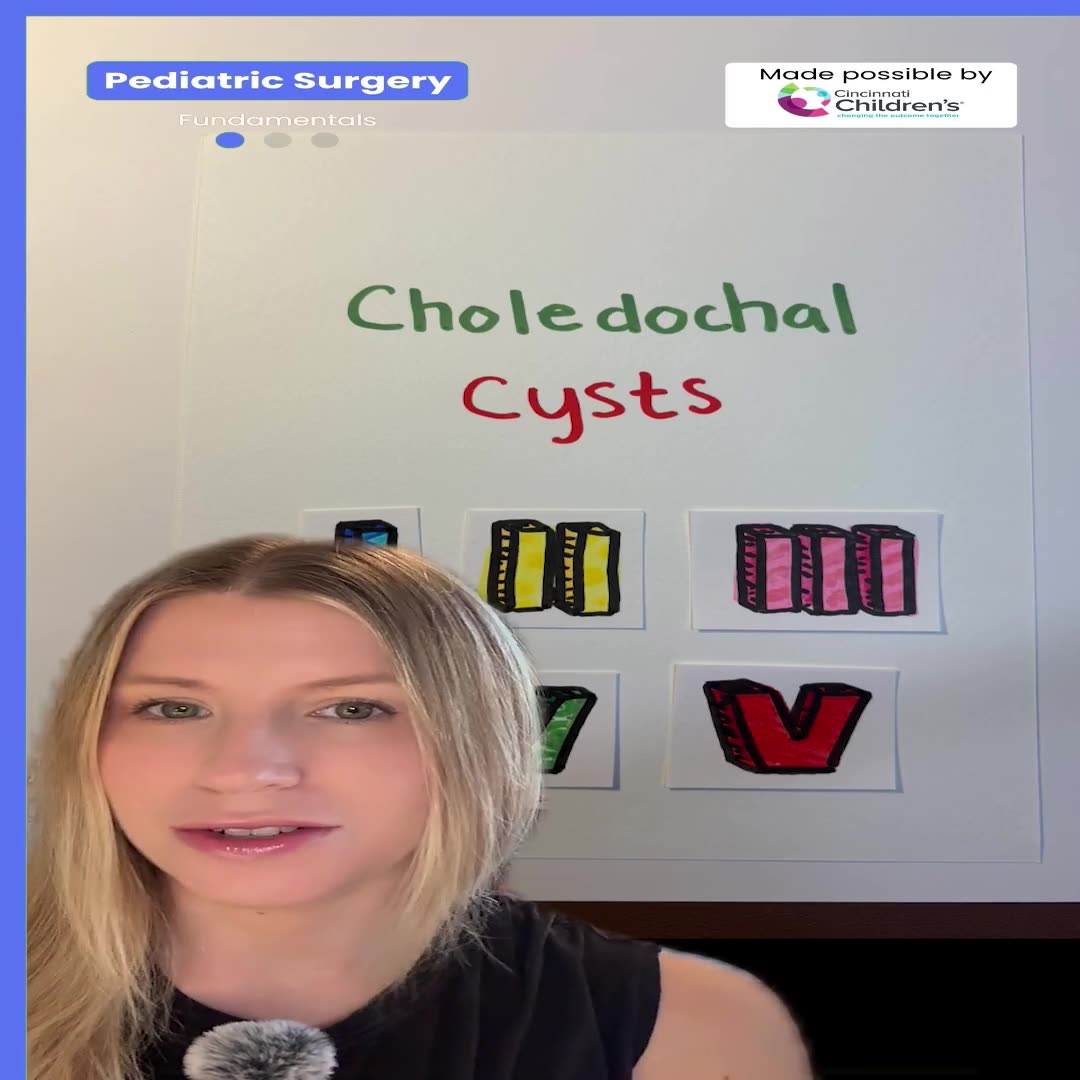
Choledochal Cyst Types Explained: Pediatric Surgery Fundamentals
1 min · Published Sep 2026
What the experts said
Doing everything extraperitoneally is a nice feature of the technique.
All of these techniques are good adjuncts to the armamentarium for Hirschsprung's disease, and knowing more techniques allows tailoring to appropriate patients.
One of the mistakes people make when doing a transanal pull-through is to stretch the sphincters and do the operation on the inside; it should be done by pulling everything out and doing it on the outside without stretching the sphincters.
Aggressive sphincter stretching during the transanal approach may damage the sphincters.
In early experience with laparoscopic Duhamel, the colon was brought outside to transect it and then put back, but with increased experience this is no longer done and a pretty short stump is left.
Even if more stump is left, it can be trimmed later before closing the stump down.
By doing all dissection from the inside, overstretching of the anus can be avoided.
The end of a GIA stapler can be used for making the side-to-side anastomosis, allowing the procedure to be performed even in neonates at a very early age.
A real pouch does not have to be left behind with this technique.
The new Duhamel pull-through was designed to eliminate the septic intraabdominal step, avoid intraabdominal sutures, determine the length of the residual stump, and assure a more secure colorectal anastomosis.
The first incision is made with electrocautery on the posterior wall of the rectum 1.5 centimeters from the dentate line.
The retrorectal tissue is easily dissected digitally, allowing access to the retrorectal space to the sacral promontory.
Dissection is performed along the lateral walls of the rectum approximately 50% of the circumference of the posterior rectal wall.
The sigmoid colon is mobilized laparoscopically and pulled through the retrorectal space using a clamp placed transanally.
The distal rectal segment is stapled transversely with a GIA stapler 75 millimeters, which can be reinforced with PDS or Vicryl invaginating sutures.
The level at which to cut is defined by pathologic markers intraoperatively by frozen section or by mapping a transition zone with previous suction biopsies.
The anastomosis is completed using the Martin technique and modification, leaving a very ample window with minimal chance of stenosis.
At 6 months postoperatively, colonoscopy showed a residual pouch of approximately 3 centimeters in an asymptomatic patient.
Problems that can occur include accumulation of feces, constipation, and fecal impaction when the stump is left too long.
The residual stump can be divided if necessary using endoscopic techniques.
The technique is recommended for all pediatric patients, including patients with very dilated colons, and is reproducible, easy, and fast with minimal incidence of constipation and stenosis.