

From
Live Event Content
Laparoscopic Pediatric Hernia Repair 2025
With Dr. Victor Andrade & Dr. Mark Wulkan · hosted by Dr. Todd Ponsky
Part of
Incarcerated Hernia 3 items
Educational content from recorded physician discussions — not medical advice. Talk to your (or your child's) care team about your situation.
Video
2024 Laparoscopic Hernia Event
102 min · Published Jun 2024
Video
Focus on Technique- Laparoscopic Pediatric Hernia Repair 2015
Dr. Todd Ponsky · 140 min · Published Mar 2014
Video
2026 Laparoscopic Pediatric Hernia Repair
123 min · Published Jun 2026
Video
Laparoscopic Pediatric Hernia Repair: Online Course 2017
Dr. Todd Ponsky · 102 min · Published Aug 2017
Video
Pediatric Hernia: Update Course 2013
52 min · Published Jul 2017
Video
Groin Controversies - Todd Ponsky: Update Course 2014
Dr. Todd Ponsky · 28 min · Published Nov 2018
Video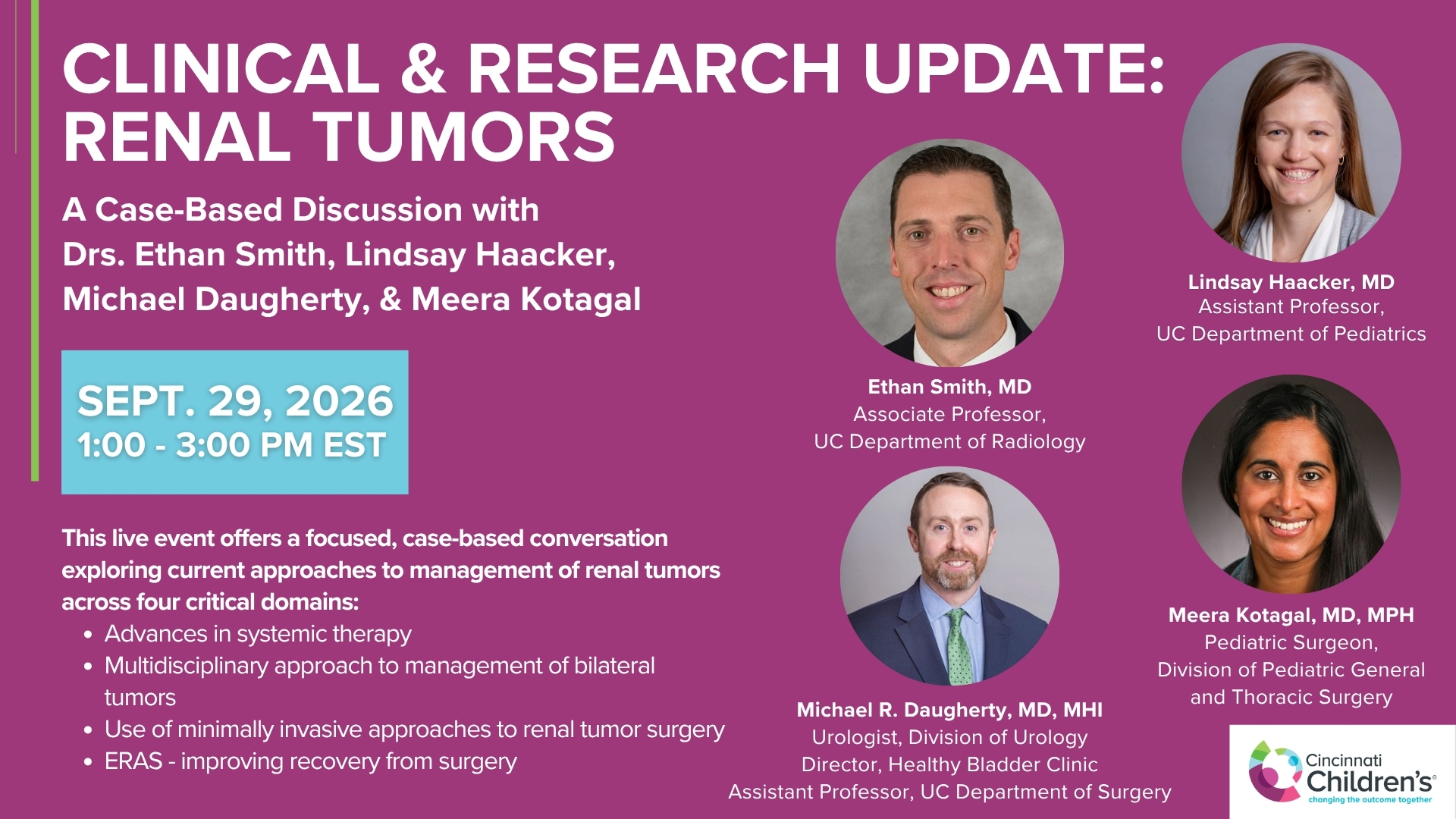
Clinical & Research Update: Renal Tumors with Drs. Ethan Smith, Lindsay Haacker, Michael Daugherty, and Meera Kotagal
71 min · Published Sep 2026
Video
Clinical & Research Update: Neuroblastoma with Drs. Katherine Somers, Cara Morin, Juan Gurria, and Meera Kotagal
67 min · Published Sep 2026
Video
Clinical & Research Update: Sarcoma w/ Drs. Roshni Dasgupta, Joseph Pressey, Arthur Meyer, Luke Pater
66 min · Published Sep 2026
Video
Beyond the Spectrum: Diagnosis, Myths & Management - Caitlin Couch & Leslie Lopez - APP Conference 2026
50 min · Published May 2026
Video
Dysautonomia: Navigating the Journey - Martha Willis - APP Conference 2026
55 min · Published May 2026
Video
Everything You Ever Wanted to Know About G-tubes But Were Afraid to Ask - Betsy Gerrein - APP Conference 2026
30 min · Published May 2026
What the experts said
After 1 or 2 years of age, the chance of hernia incarceration is very low
In laparoscopic repair, no matter how inflamed the external groin appears, the internal anatomy is always calm
For incarcerated hernias, immediate laparoscopic reduction and repair is preferable to manual reduction followed by delayed repair
The edema from incarceration actually facilitates laparoscopic repair by auto-hydrodissecting the peritoneum from the cord structures
Hydrodissection with local anesthetic lifts the peritoneum off the cord structures, making needle passage safer
In rabbit studies, repairs with anterior peritoneal injury plus suture had 87% remain closed after cutting the stitch at 2 weeks, versus 25% with suture alone
At 4 weeks in rabbit studies, 100% of repairs with injury remained closed after stitch removal, versus 17% with suture alone
Braided sutures cause more durable scar formation than monofilament sutures in rabbit models
Absorbable sutures do not work as well for laparoscopic hernia repair, possibly because they absorb too quickly or because they are monofilament
In babies, single ligation rather than double ligation reduces the risk of suture granulomas because there is minimal tissue between the knot and skin
The percutaneous laparoscopic technique is only appropriate for indirect hernias, not for direct or femoral hernias which require muscle repair
Multi-center trial data show less than 1% confirmed recurrence and 2% suspected recurrence when high ligation is used in adolescents
Combined pediatric and adult center data show a statistical inflection point in the proportion of direct versus indirect hernias around late adolescence
In Norway trial of laparoscopic high ligation in adults, there have been zero recurrences reported
If hydrodissection is too aggressive over the vas deferens, it can cause the vas to disappear from view, but this is acceptable because the goal is to see the needle clearly without overlying structures
Over 600 cases using prolene suture with the percutaneous technique resulted in only 2 recurrences, both within 3 months and both due to defective rebranded suture
Ilioinguinal nerve block can be performed under laparoscopic visualization by injecting just lateral to the internal ring defect
The external oblique aponeurosis provides no structural support to the inguinal floor
In premature infants, the internal and external rings almost overlap, allowing hernia repair without opening the external oblique aponeurosis
The laparoscopic technique can be performed under deep sedation without endotracheal intubation, as demonstrated by groups at Akron Children's
Patent processus vaginalis can close over time, documented in three studies
There is a 3 to 11% chance of developing a contralateral hernia if a patent processus vaginalis is left unrepaired
Studies in rabbits show that simply grabbing the vas deferens with pickups can cause obliteration of the vas
Ben Zendejas fifty-year follow-up study of 213 patients found 5% were infertile after open hernia repair
Most recurrences after open indirect hernia repair are actually direct hernias, not failures of the high ligation
Recurrence rates for laparoscopic hernia repair range from 0.2% to 1.5% in large series
In girls, cauterization alone of the hernia sac without suture ligation can achieve durable closure
Mario Roelme demonstrates that simple resection of the sac without ligation can work, supporting the theory that scar formation is the key mechanism