

From
Live Event Content
2025 Pediatric Surgery Update Course - Updates in Colorectal: Debunking Dogma
With Dr. Jamie Harris · hosted by Dr. Nelson Rosen
Educational content from recorded physician discussions — not medical advice. Talk to your (or your child's) care team about your situation.
Only a few other public items share this diagnosis — go deeper there →
Video
Validation of an anorectal malformation trainer - Can a high-fidelity model simulate real life?
1 min · Published Jun 2026
Video
Complications and Long-Term Outcomes of Patients With Cloacal Malformation After Bowel Neovagina...
1 min · Published Jun 2026
Video
Safety and utility of long-acting steroid injection for management of post-operative stricture...
1 min · Published Jun 2026
Video
Association Between Social Determinants of Health and Choice of Urinary Reconstruction in Children
1 min · Published Jun 2026
Video
The Perineal Body Preserving PSARP (PPP)
11 min · Published Jun 2026
Video
Update Course Rewind 2025: Hirschsprung + ARM: Rare but Real
1 min · Published May 2026
Video
Clinical & Research Update: Renal Tumors with Drs. Ethan Smith, Lindsay Haacker, Michael Daugherty, and Meera Kotagal
71 min · Published Sep 2026
Video
Clinical & Research Update: Neuroblastoma with Drs. Katherine Somers, Cara Morin, Juan Gurria, and Meera Kotagal
67 min · Published Sep 2026
Video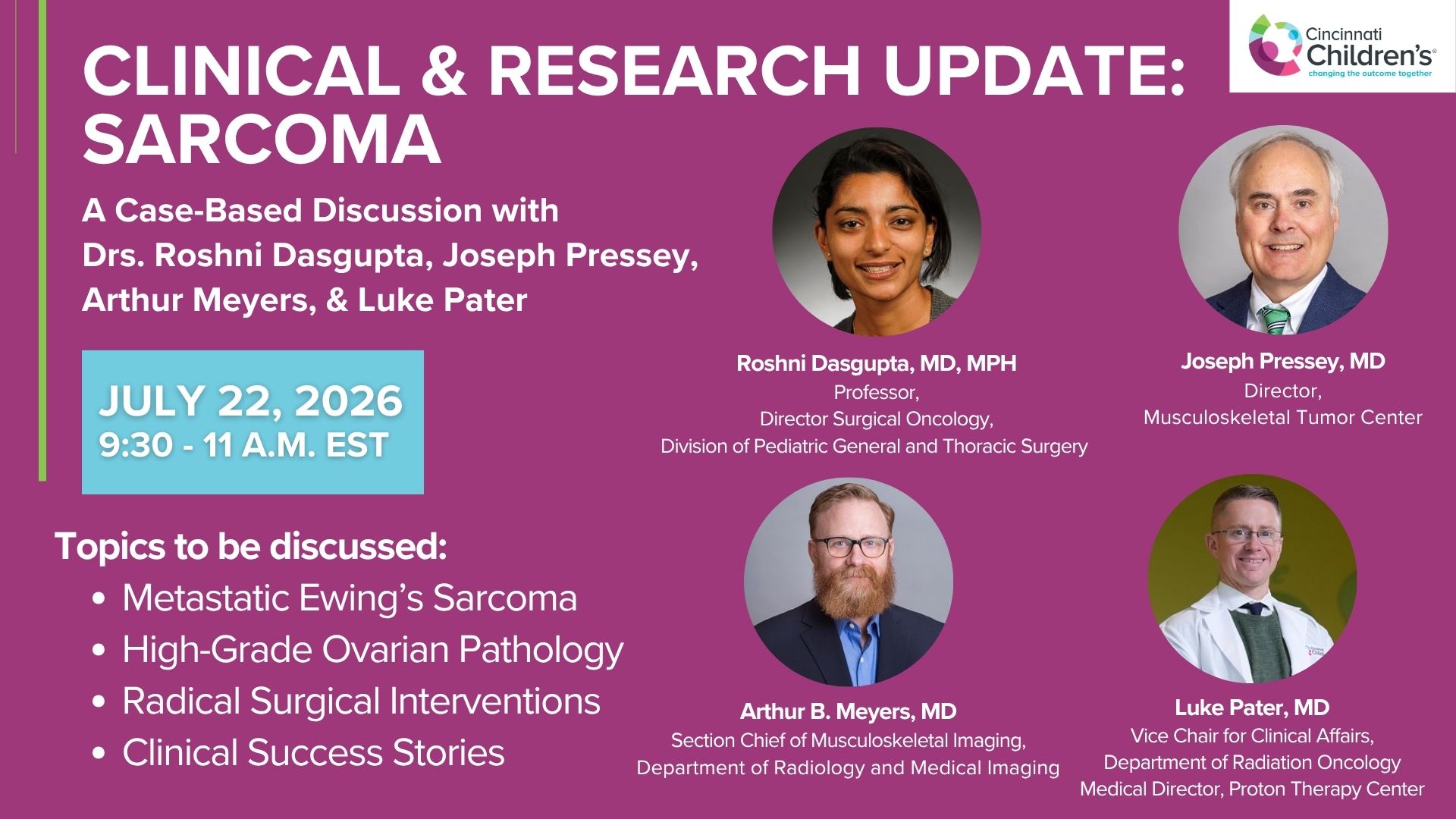
Clinical & Research Update: Sarcoma w/ Drs. Roshni Dasgupta, Joseph Pressey, Arthur Meyer, Luke Pater
66 min · Published Sep 2026
Video
2026 Laparoscopic Pediatric Hernia Repair
123 min · Published Jun 2026
Video
Beyond the Spectrum: Diagnosis, Myths & Management - Caitlin Couch & Leslie Lopez - APP Conference 2026
50 min · Published May 2026
Video
Dysautonomia: Navigating the Journey - Martha Willis - APP Conference 2026
55 min · Published May 2026
What the experts said
When dilating a recto-vestibular fistula preoperatively, dilate only to 7 Hegar to decrease potential scarring along the tract for future PSARP.
Preoperative fistula dilation is a controlled tear when the fistula starts as a pinhole, not true stretching; dilate only as big as needed and then leave it alone until definitive repair.
Perineal body-preserving PSARP is basically the same technique one would use for a bulbar fistula but applied to a vestibular fistula.
For perineal body-preserving PSARP, the key is to really clean up the lateral planes before coming around the front, mobilizing the sides and staying on the bowel wall before deciding to come through the common plane.
When starting perineal body-preserving PSARP, it is acceptable to go a little bit into the perineal body on the front and a little bit behind it in the back to make the working incision not the tightest pinhole, while still keeping the perineal body largely intact.
If lost in the anatomy during perineal body-preserving PSARP, it is easy to convert to a standard PSARP by extending the incision.
Preoperative dilations seem to be more tolerated than postoperative dilations; families are worried they will hurt their babies and the repair.
Heineke-Mikulicz stricturoplasty is a minimally invasive surgical backup option for neo-anal stricture if not performing routine postoperative dilations.
Families who are competent with rectal irrigations before Hirschsprung pull-through will be more comfortable performing irrigations after pull-through, which can save the baby's life by treating enterocolitis early.
Families who are really good at irrigations start treatment for enterocolitis before they ever call the surgeon.
Longer aganglionic segments in Hirschsprung disease affect timing of pull-through; patients who cannot be adequately decompressed at home may require earlier intervention to prevent enterocolitis or perforation.
Absent ganglion cells in fistula tissue does not necessarily mean Hirschsprung disease, as fistula tissue is not physiologic tissue.
Complex anorectal malformation patients with chromosomal anomalies who are not responding to laxatives or enemas are worth working up for Hirschsprung disease.
Two 2021 studies (one NISQIP, one PCPLC) showed no difference in wound complications, re-operations, or readmissions between early PSARP (less than 7-14 days) and delayed PSARP (6 weeks to 8 months) for female perineal or recto-vestibular fistulas.
Perineal body-preserving PSARP first publication in 2023 showed at one-year follow-up no dehiscence, no prolapse, only 13% of patients required revision of anal stenosis, and two-thirds of patients went home on postoperative day one.
Perineal body-preserving PSARP does not add operative time compared to standard PSARP, which is important in neonates to minimize anesthetic time.
Postoperative anal dilations after PSARP are associated with parental anxiety, PTSD for both patients and caregivers, and post-traumatic stress symptoms in families.
Spanish single-center study showed that children adequately sized at initial post-PSARP appointment did not receive dilations, while undersized children did; outcomes were similar between groups.
Single-center review in children under 2 years showed half received dilations and half did not; 2 children in each group required re-operation for neo-anal stricture, and about 15% in each group required Heineke-Mikulicz stricturoplasty.
2021 PCPLC retrospective study of Hirschsprung pull-through showed no difference in preoperative enterocolitis, postoperative enterocolitis, or fecal incontinence between neonatal pull-through (median 11 days) and delayed primary pull-through (median 98 days).
Some data suggests maybe better continence in the delayed Hirschsprung pull-through group, but studies have been underpowered.
Multi-center retrospective study published in 2022 showed 24% of Hirschsprung patients received at least one Botox injection.
Cincinnati Children's prospective study (2020-2024, unpublished) found decreased risk of enterocolitis within 31 days after pull-through in patients who received Botox (30% vs 50%).
Cincinnati Children's prospective study found patients who received Botox at time of pull-through had higher risk of diaper rash (60%).
Early work from Sam Nurko's group in Boston used weight-based Botox dosing up to a maximum of 100 units for Hirschsprung patients.
The rate of co-occurrence of Hirschsprung disease and anorectal malformation is approximately 2% based on Pena's series, though some papers show as high as 3-4% and others less than 1%.
Single-center PCPLC study found ganglion cells in 90% of rectal fistula specimens taken during PSARP, with hypoganglionosis or absent ganglion cells in the rest.
PCPLC database review of approximately 1700 patients showed that patients with both anorectal malformation and Hirschsprung disease tend to have chromosomal anomalies, particularly trisomy 21.