

From
Live Event Content
2025 Pediatric Surgery Update Course - Nerve Monitoring and Stimulation in Pediatric Surgery
With Dr. Ben Ham
Educational content from recorded physician discussions — not medical advice. Talk to your (or your child's) care team about your situation.
Only a few other public items share this diagnosis — go deeper there →
Video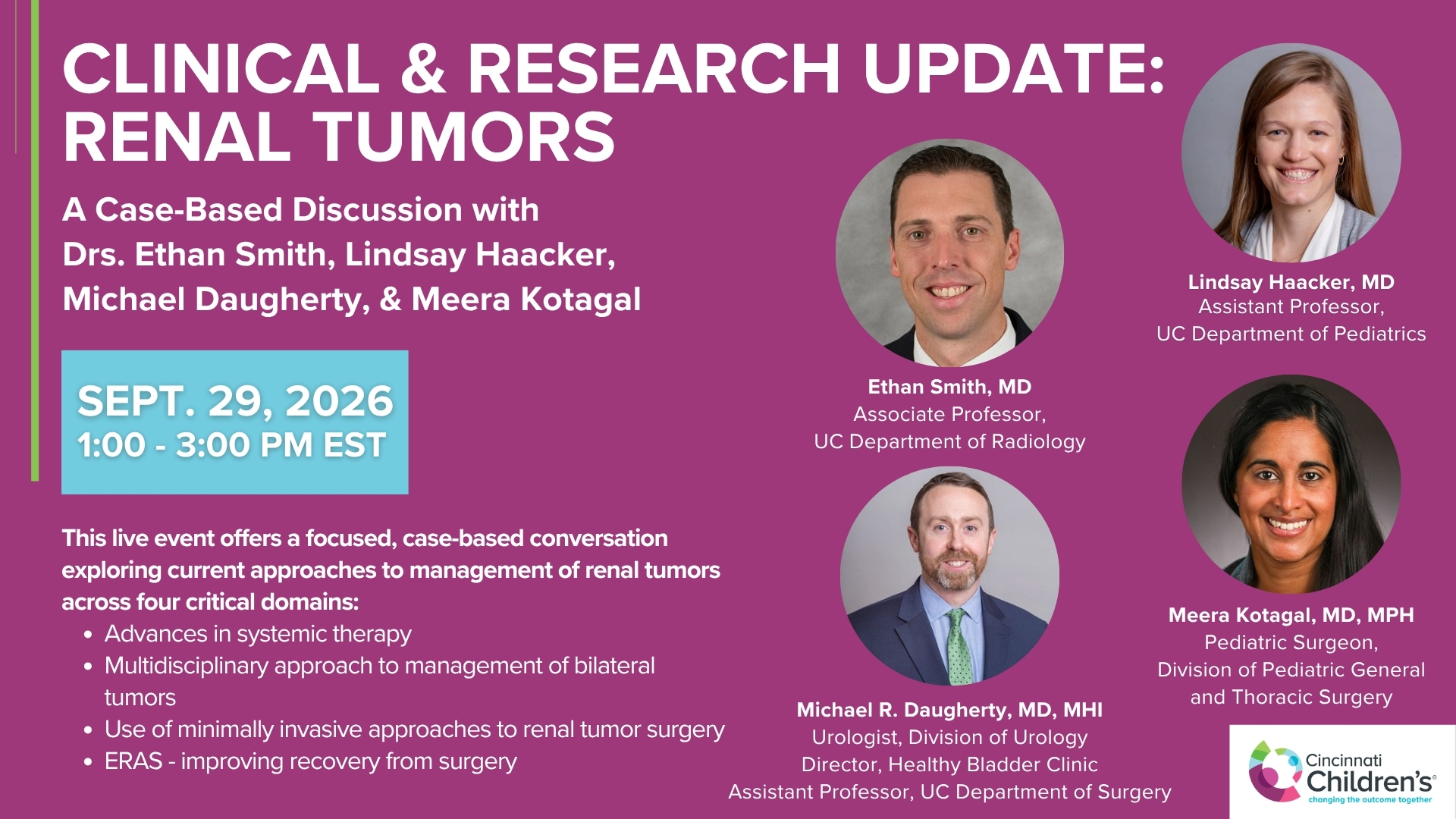
Clinical & Research Update: Renal Tumors with Drs. Ethan Smith, Lindsay Haacker, Michael Daugherty, and Meera Kotagal
71 min · Published Sep 2026
Video
Clinical & Research Update: Neuroblastoma with Drs. Katherine Somers, Cara Morin, Juan Gurria, and Meera Kotagal
67 min · Published Sep 2026
Video
Clinical & Research Update: Sarcoma w/ Drs. Roshni Dasgupta, Joseph Pressey, Arthur Meyer, Luke Pater
66 min · Published Sep 2026
Video
2026 Laparoscopic Pediatric Hernia Repair
123 min · Published Jun 2026
Video
Beyond the Spectrum: Diagnosis, Myths & Management - Caitlin Couch & Leslie Lopez - APP Conference 2026
50 min · Published May 2026
Video
Dysautonomia: Navigating the Journey - Martha Willis - APP Conference 2026
55 min · Published May 2026
What the experts said
A 1.1 centimeter thyroid nodule that is TIRADS 4 with Bethesda 3 FNA (atypia of undetermined significance) has approximately 30% risk of cancer
The 2015 pediatric thyroid guidelines recommend surgery be performed by a high volume thyroid surgeon, defined as performing 30 thyroid surgeries per year
Lobectomy for pediatric thyroid nodules is recommended rather than molecular testing or repeat FNA currently because there is a higher rate of malignancy in pediatric populations compared to adults
One recent study showed recurrent laryngeal nerve injury rates decreased from 8% to 1.5% with nerve monitoring
In a recent survey, approximately 80% of pediatric thyroid surgeons use nerve monitoring
Studies in adults have shown nerve monitoring may help identify the nerve but may not change injury rates
The rate of recurrent laryngeal nerve injury in children is 9% versus about 6% in adults
Expense is one consideration for not using nerve monitoring, and some argue if it doesn't change injury rates there may be no reason to use it
In pediatric patients, devices may not have been small enough to monitor nerves, with some publications showing monitoring attempted down to age 4-5, and recent adhesive electrode publications showing use down to age zero
Adhesive electrodes can now be placed on a 3.0 ET tube, making intraoperative nerve monitoring available for almost all pediatric thyroid surgeries
Nerve monitoring may be most beneficial when doing total thyroidectomy where the contralateral cord is paralyzed, to help decrease risk of tracheostomy with bilateral paralysis
If nerve monitoring shows changes on one side during total thyroidectomy, this might lead the surgeon to delay and do the other side later
TIRADS was developed for adults to risk stratify nodules based on ultrasound imaging characteristics, and there has been caution against using it for pediatrics
If a child is too small for a 5.0 tube, the electrodes come separately and can be placed via direct laryngoscopy directly into the vocalis muscle for monitoring
The modified PEDS TIRADS recommends biopsy for every TIRADS 3 nodule over 1.5 centimeters, and using these restricted criteria based on size relative to patient size, no malignancies were missed
In a sacral nerve stimulator trial for children with fecal incontinence, the rate of wearing a diaper during the day decreased from 19% to 2%, and at nighttime decreased from 33% to 11%
Sacral nerve stimulation is not FDA approved in children
A Cochrane Review in adults suggests sacral nerve stimulation can help with fecal incontinence
A retrospective cohort study with 70 patients showed improvement in involuntary daytime and nighttime bowel movement rates with sacral nerve stimulation
Side effects of sacral nerve stimulation include pain and neurological symptoms, and about 40% required re-operation within about three years for dead battery or replacement
The sacral nerve stimulator is placed through the third sacral foramen and sends signals to the sacral nerves, with a trial period of a couple weeks before permanent implantation
Kids with urinary incontinence tend to respond pretty well to sacral nerve stimulation, learning from adults where urologists place these for urologic indications
For children with hypoventilation due to central hypoventilation syndromes, spinal cord injury, ALS, or metabolic disorders, diaphragm pacing is an option that has been able to avoid tracheostomy in some patients or help wean patients off ventilation
Diaphragm pacing can be done via phrenic nerve stimulation or direct diaphragm stimulation with leads implanted in the diaphragm
Diaphragm pacing was invented by Ray Anders in Cleveland and was used on Christopher Reeve
A recent paper suggested that if you adjust TIRADS size criteria, it performs better than the 2015 pediatric guidelines