

From
StayCurrentMD
Update Course Rewind 2025: Do We Still Need Routine Anal Dilations After PSARP?
hosted by Dr. Jill Knepprath
Educational content from recorded physician discussions — not medical advice. Talk to your (or your child's) care team about your situation.
Video
Intestinal Atresia Types Explained: Grossfeld Classification for Pediatric Surgery
1 min · Published Sep 2026
Video
Derivation and validation of the Pediatric Community-Acquired Pneumonia Severity (PedCAPS) score: A prospective cohort study
50 s · Published Sep 2026
Video
FETO for Late-Diagnosed Severe Congenital Diaphragmatic Hernia (CDH) at Cincinnati Children's with Dr. Beth Rymeski
4 min · Published Sep 2026
Video
Severe Congenital Diaphragmatic Hernia (CDH) Case: FETO Management & Unexpected Findings with Dr. Beth Rymeski
3 min · Published Sep 2026
Video
Fetoscopic Endoluminal Tracheal Occlusion (FETO) Procedure: Step-by-Step Guide with Dr. Beth Rymeski
4 min · Published Sep 2026
Video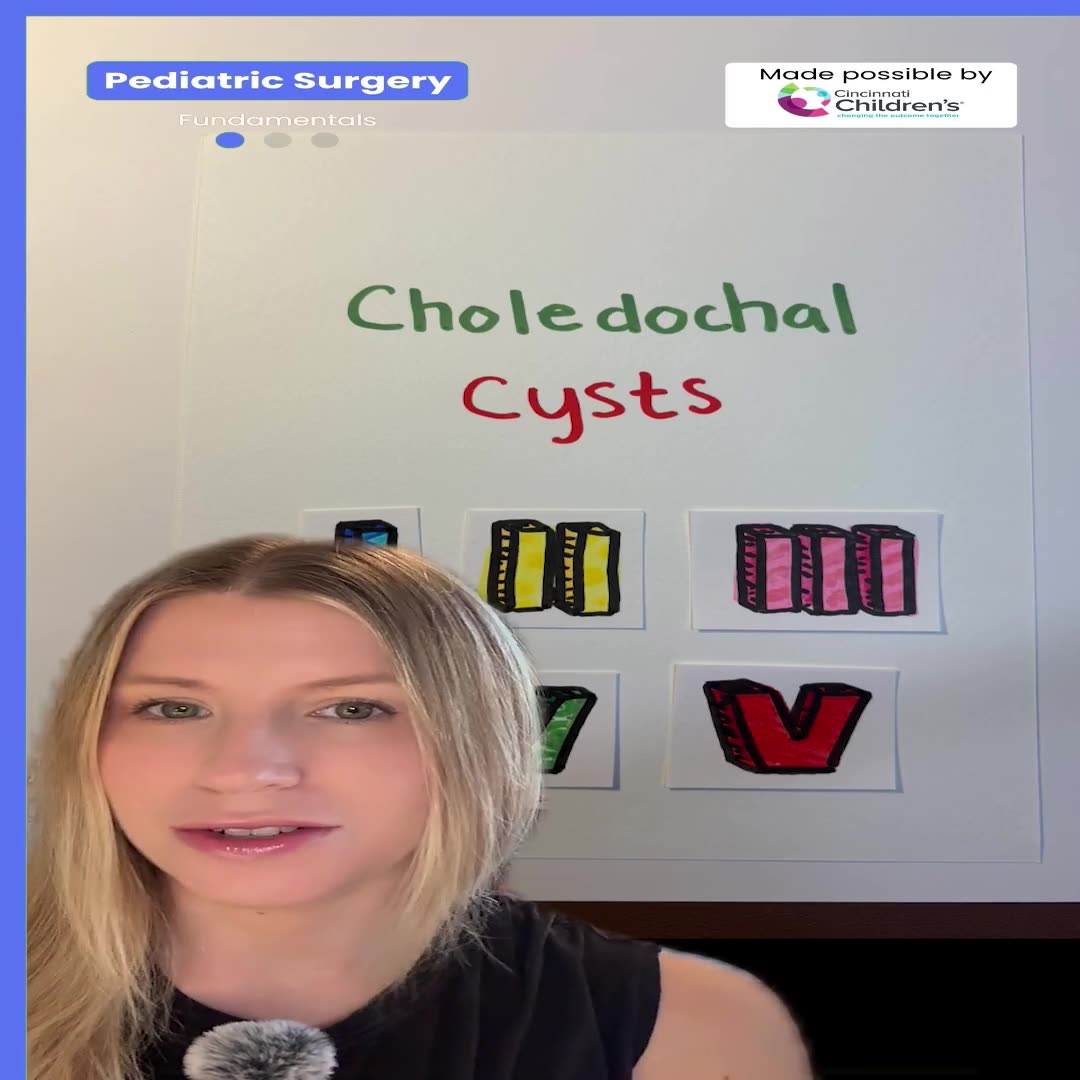
Choledochal Cyst Types Explained: Pediatric Surgery Fundamentals
1 min · Published Sep 2026
What the experts said
There are data that support parental anxiety and PTSD for both the patients and the caregivers related to anal dilations.
Families are worried that they're going to hurt their babies and they're going to hurt the PSARP repair.
A single institution review in kids under 2 years of age compared dilations versus no dilations, with two kids in each group requiring re-operation for neoanal stricture.
About 15% of the kids in both the dilation and no-dilation groups required a Heineke-Mikulicz anoplasty.
One panelist dilates neonates but holds off on dilations for older kids, redo cases, or ambulatory patients where the process would be traumatic.
One panelist usually dilates for neonatal cases.
In Canada, lack of easy access to schedule elective cases is a reason to prefer dilating all PSARP cases up front.
For decades, every child received anal dilations after PSARP.
A study from Spain followed the historical dilation protocol starting two weeks after PSARP, performing dilations twice a day, with the Hagar size increased by 1 millimeter each week until reaching the optimal size.
The Heineke-Mikulicz anoplasty is a procedure for skin-level strictures in PSARP patients.
Heineke-Mikulicz anoplasty is done by making incisions at the 12, 3, 6, and 9 o'clock positions, making a rhomboid shape that opens up the strictured area.
Heineke-Mikulicz anoplasty does not require flaps or any mobilization of the rectum.
Heineke-Mikulicz anoplasty is safe, effective, and minimally invasive.
Heineke-Mikulicz anoplasty can be done outpatient as an alternative to long-term dilations after PSARP.
There isn't strong evidence to support mandatory anal dilation after PSARP.
Anal dilation after PSARP can cause stress for families.
Age of the patient and access to returning for an outpatient procedure are things to consider when making decisions about anal dilation after PSARP.