

From
Live Event Content
Mental Health and Gun Safety in Pediatrics - Catherine Neyer - APP Conference 2026
With Dr. Kathy Meyer
Part of
Depression 3 items
Educational content from recorded physician discussions — not medical advice. Talk to your (or your child's) care team about your situation.
Video
ERNICA Research Collaboration - Mental health of parents in the context of EA/TOF
50 min · Published Dec 2023
Video
Psychosocial Outcomes: New Horizons in Medical and Surgical Fontan Management...
CCHMC Pediatric Surgery · 22 min · Published Jul 2017
Video
Surgeon Wellness & Medical Errors: Practice Gap discussion at Update Course 2018
10 min · Published Aug 2018
Video
Weight Bias: Child & Adolescent Obesity 2015
34 min · Published Jul 2017
Podcast
IFMSS 2019 Clinical Studies
19 min · Published Nov 2022
Video
Everyday Stress: Child & Adolescent Obesity 2015
27 min · Published Jul 2017
Only a few other public items share this expert — go deeper there →
Video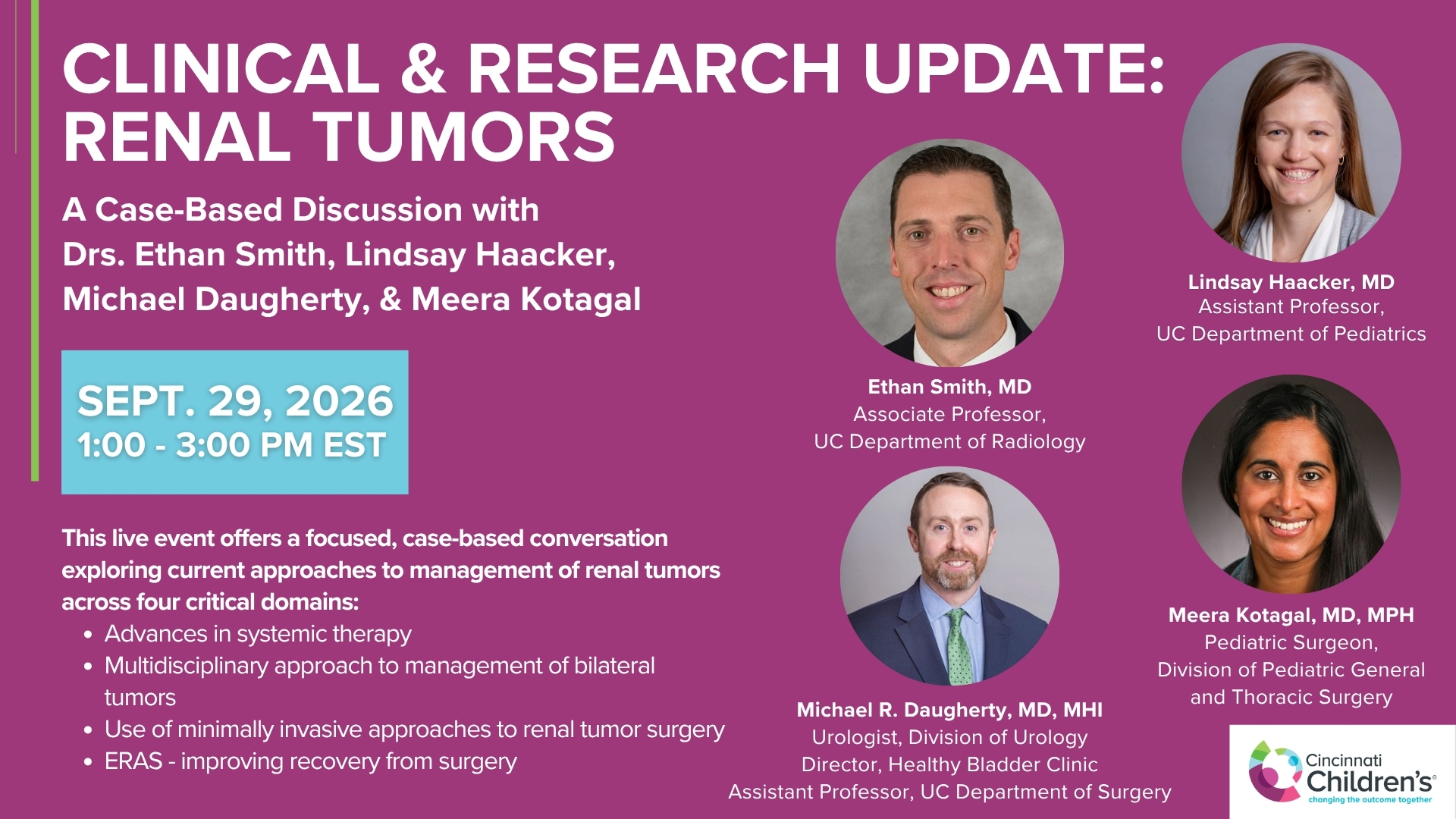
Clinical & Research Update: Renal Tumors with Drs. Ethan Smith, Lindsay Haacker, Michael Daugherty, and Meera Kotagal
71 min · Published Sep 2026
Video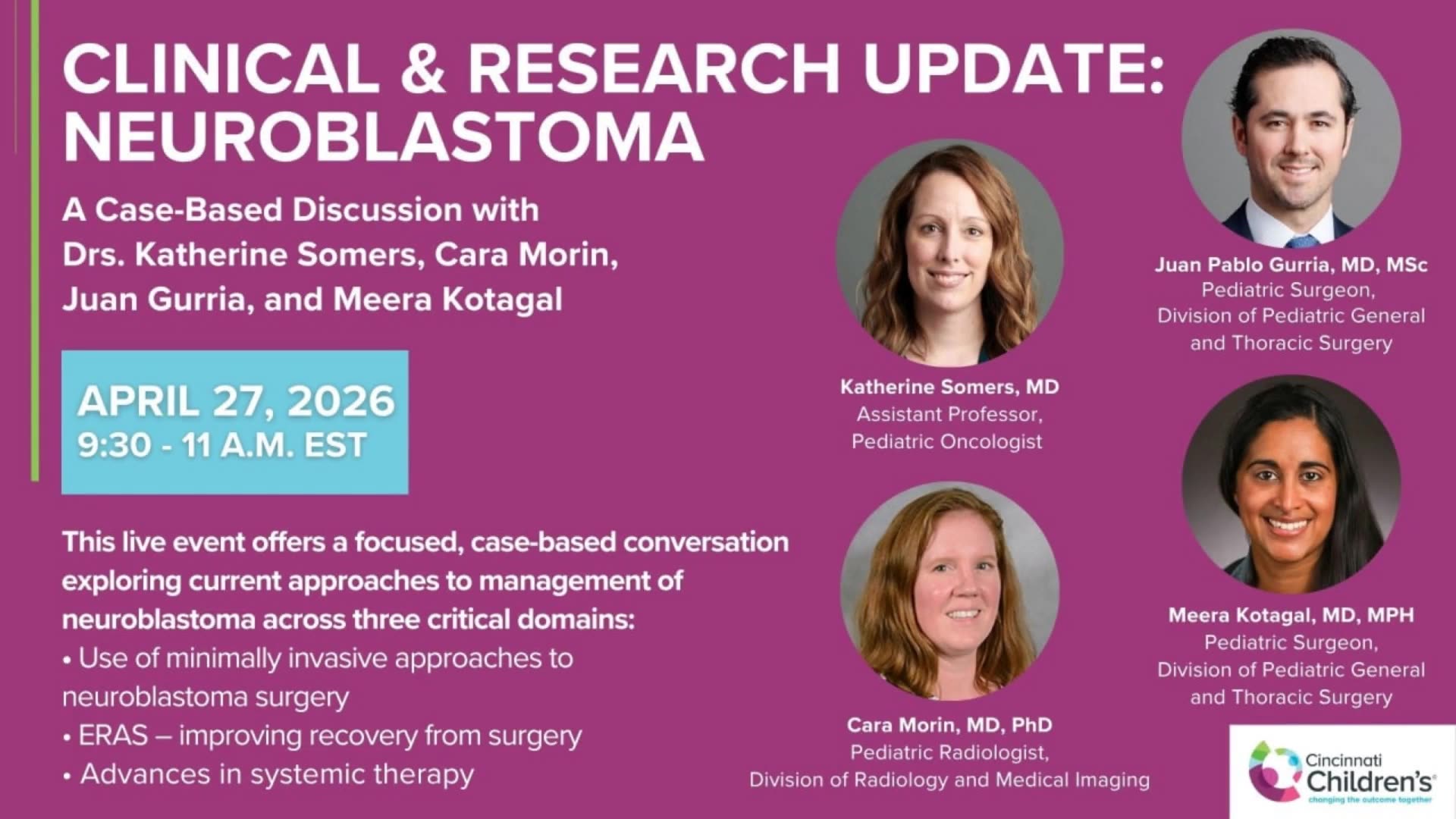
Clinical & Research Update: Neuroblastoma with Drs. Katherine Somers, Cara Morin, Juan Gurria, and Meera Kotagal
67 min · Published Sep 2026
Video
Clinical & Research Update: Sarcoma w/ Drs. Roshni Dasgupta, Joseph Pressey, Arthur Meyer, Luke Pater
66 min · Published Sep 2026
Video
2026 Laparoscopic Pediatric Hernia Repair
123 min · Published Jun 2026
Video
Beyond the Spectrum: Diagnosis, Myths & Management - Caitlin Couch & Leslie Lopez - APP Conference 2026
50 min · Published May 2026
Video
Dysautonomia: Navigating the Journey - Martha Willis - APP Conference 2026
55 min · Published May 2026
What the experts said
Asking about firearms should be as routine as asking about medications, substances, or seatbelt use in healthcare settings.
Risk factors for firearm-related harm include untreated mental health conditions, trauma exposure, adverse childhood experiences, bullying, family conflict, and social isolation.
Access to an unsecured firearm is a risk factor all on its own, and firearm access is a modifiable risk factor.
Firearm injuries are now the leading cause of death for children and adolescents in the United States, surpassing motor vehicle accidents.
According to CDC data, homicide is the leading category of firearm death for younger adolescents, while suicide dominates among older teens.
Black youth experience disproportionately high rates of firearm homicide, while rural youth have higher rates of firearm suicide.
When mental health symptoms increase and access to lethal means is present, risk escalates quickly.
Youth exposed to gun violence may develop PTSD symptoms such as hypervigilance, avoidance, and intrusive memories, and may struggle with grief after losing peers or community members.
Even witnessing violence online or hearing about violent acts such as school shootings can create chronic fear and emotional dysregulation that shape brain development, behavior, and long-term mental health outcomes.
Over 90% of fatal suicide attempts involving youth occur with a firearm, with 9 out of 10 firearm suicide attempts resulting in death.
Most youth suicide attempts are impulsive, occurring within minutes of a triggering event.
Safe storage and lethal means counseling are powerful evidence-based strategies to help prevent suicide.
Protective factors include strong caregiver relationships, consistent supervision, supportive school environments, safe firearms storage, and access to mental health services.
Passive suicidal ideation still requires a safety assessment; we cannot assume low risk.
Means assessment does not increase suicidal thoughts; instead it increases safety.
The American Academy of Pediatrics states that 39% of parents erroneously believe their children do not know where their gun is stored, and 22% wrongly believe their child has never handled their guns.
Even in fast-paced clinical environments like urgent care or emergency rooms, mental health screening should not be deferred, as youth often disclose depressive or anxiety symptoms when presenting for physical injuries.
Routine screening normalizes mental health conversations and creates a natural opening to ask about safety, including access to firearms and medications.
Trauma-informed care is not a specialty, it is a universal precaution; we should assume that many youth and caregivers have experienced trauma.
Lethal means counseling is a brief evidence-based intervention that reduces suicide risk by increasing the time and distance between a person in crisis and a lethal method.
CALM (Counseling on Access to Lethal Means) is a nationally recognized training framework to help healthcare providers have effective collaborative conversations about firearm safety.
Parents who received education and counseling on safe firearm storage were more likely to report adopting one or more safe gun storage practices, according to the American Academy of Pediatrics.
Safe storage includes three core elements: firearms unloaded, locked in a secured device, and ammunition stored separately.
When firearms are stored securely, youth firearm injuries drop dramatically.
Trauma-informed care reduces defensiveness and increases the likelihood that families will engage in safety planning.
The six trauma-informed care principles for firearm safety conversations are safety, trustworthiness, choice, collaboration, empowerment, and cultural humility.
Inpatient care becomes necessary when the youth cannot be safely supported at home or in the community, whether due to imminent risk, inability to restrict access to firearms or other lethal means, or inability of the caregiver to provide adequate supervision.
Transitions between levels of care are some of the highest risk moments for suicide, relapse, and safety lapses.
A handoff between inpatient and outpatient providers should include direct communication, sharing the updated safety plan, recent risk assessments, triggers identified during hospitalization, interventions trialed, and concerns about firearm access or supervision.
Confirming that firearms in the home remain secured is not a one-time conversation; it must be revisited at every transition and clinical visit.
Each day, 111 Americans die of gun-related injuries, of which 65 are suicides.
Gun-related suicides increased from 15,045 in 2000 to 24,292 in 2020.
Suicide attempts with a firearm result in death nearly 85% of the time, while for other common methods the success rate is less than 3%.
Nearly 20% of high school students have had serious thoughts of suicide and 9% have made an attempt, according to the National Alliance on Mental Illness.
Suicide rates among teens increased by as much as 50% during the COVID-19 pandemic, on top of a 57% increase in the decade before.
Among adults, the depression rate hit 32.8% in 2021, up from 8.5% before the pandemic began.
In 2018, only 43% of Americans with some form of mental illness received mental health services.
Among those with serious mental illness, only 64% received mental health services.
Penn Medicine Children's Hospital of Philadelphia research shows that proximity to violence and multiple exposures increased the risk of pediatric mental health distress, with nearly 1 in 3 mental health-related juvenile emergency room visits during weeks after a neighborhood shooting linked to the event.
Those living with mental illness are 23 times more likely to be victims of domestic violence, according to Angela Kimble of the National Alliance of Mental Illness.