

From
Live Event Content
Clinical & Research Update: Renal Tumors with Drs. Ethan Smith, Lindsay Haacker, Michael Daugherty, and Meera Kotagal
With Dr. Ethan Smith & Dr. Lindsay Haacker & Dr. Meera Kotagal & Dr. Michael Daugherty · hosted by Dr. Megan Haney
Educational content from recorded physician discussions — not medical advice. Talk to your (or your child's) care team about your situation.
Video
Wilms Tumor Protocol Violations: Practice Gap discussion at Update Course 2018
9 min · Published Aug 2018
Video
2025 Pediatric Surgery Update Course - Updates in Oncology
21 min · Published Aug 2025
Podcast
Wilms Tumor: Audio Chapter
64 min · Published Jun 2017
Podcast
Topics in 10: Wilms Tumor
12 min · Published Aug 2019
Video
Wilms Tumor
Published May 2020
Video
Updated Favorable histology Wilms tumor risk stratification: Rationale for future Children’s Oncology Group clinical trials
53 s · Published Apr 2026
Video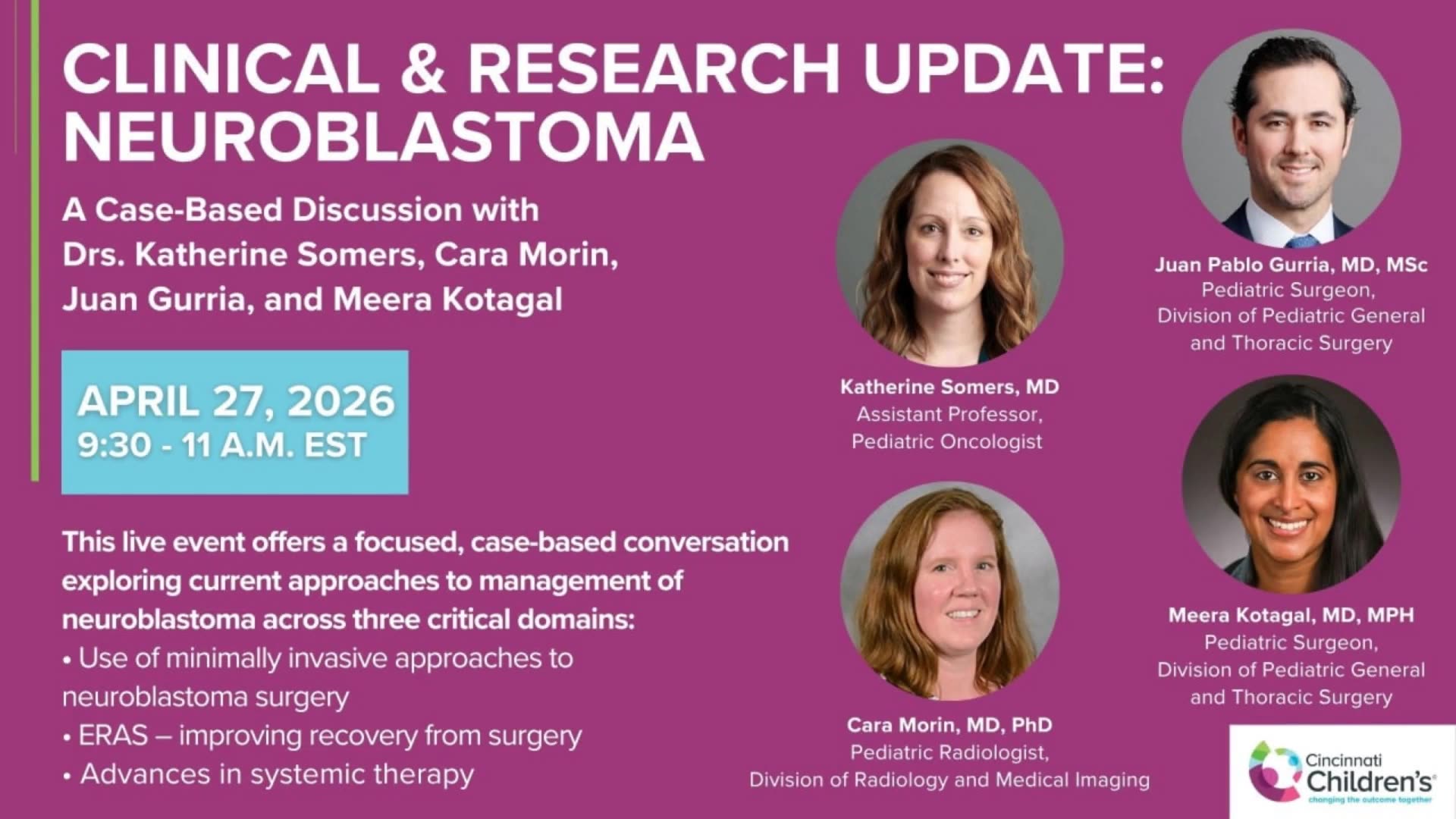
Clinical & Research Update: Neuroblastoma with Drs. Katherine Somers, Cara Morin, Juan Gurria, and Meera Kotagal
67 min · Published Sep 2026
Video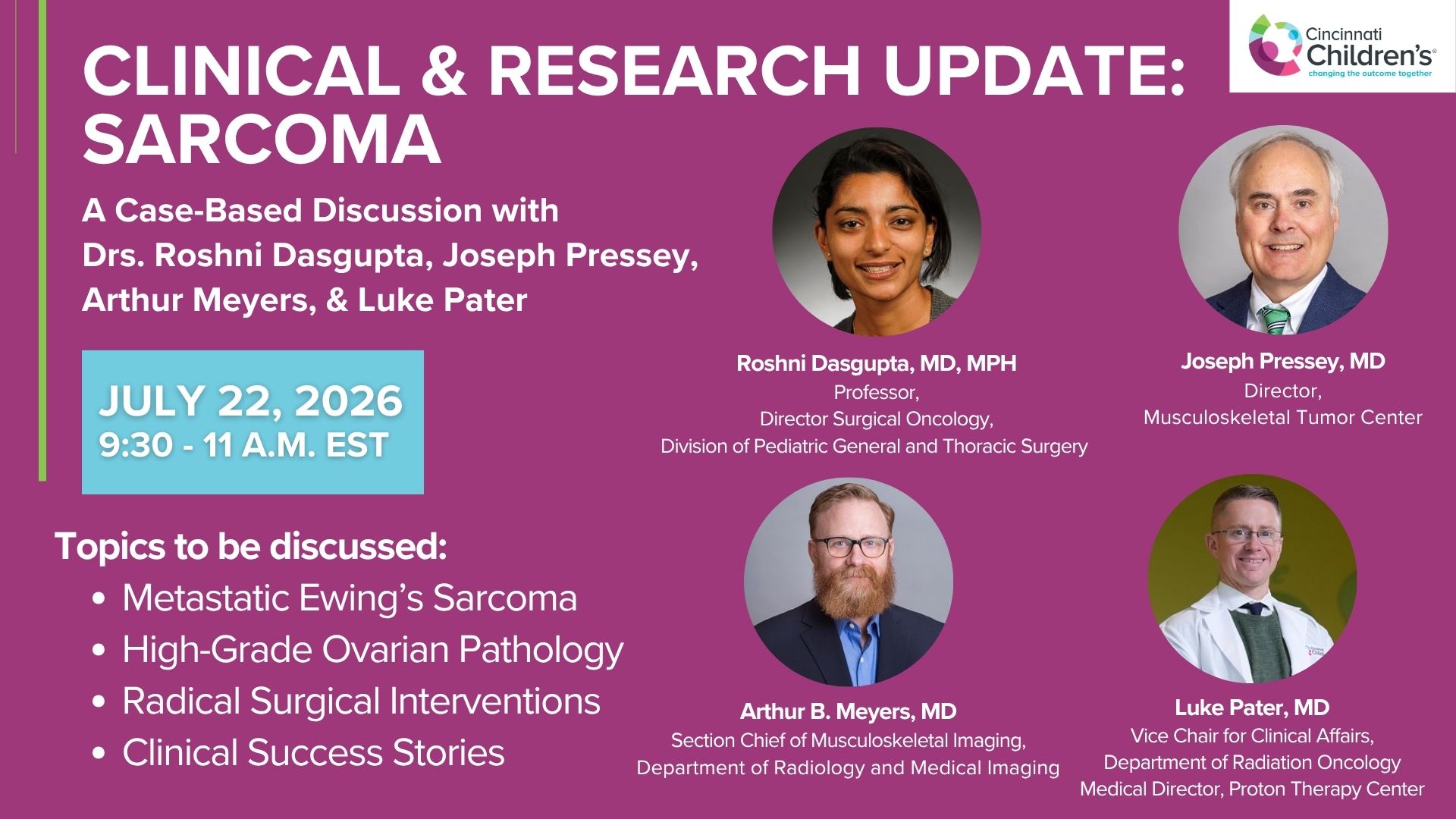
Clinical & Research Update: Sarcoma w/ Drs. Roshni Dasgupta, Joseph Pressey, Arthur Meyer, Luke Pater
66 min · Published Sep 2026
Video
Update Course Rewind 2025: Nerve Monitoring in Pediatric Thyroid Surgery
6 min · Published Jul 2026
Video
Journal of Pediatric Surgery Article Review: June 2023, AAP Issue
Todd Ponsky · 13 min · Published Jul 2026
Video
Pediatric Surgical Oncology Research Collaborative (PSORC): Studying Rare Pediatric Tumors
56 s · Published May 2026
Video
Pooling Patients to Study Rare Pediatric Tumors: An Introduction to PSORC
56 s · Published May 2026
Only a few other public items share this expert — go deeper there →
Video
2026 Laparoscopic Pediatric Hernia Repair
123 min · Published Jun 2026
Video
Beyond the Spectrum: Diagnosis, Myths & Management - Caitlin Couch & Leslie Lopez - APP Conference 2026
50 min · Published May 2026
Video
Dysautonomia: Navigating the Journey - Martha Willis - APP Conference 2026
55 min · Published May 2026
Video
Everything You Ever Wanted to Know About G-tubes But Were Afraid to Ask - Betsy Gerrein - APP Conference 2026
30 min · Published May 2026
Video
Take My Breath Away - Carolyn Grad, Mark Washam, & Katie Holtman - APP Conference 2026
58 min · Published May 2026
Video
Central Lines...WHAT? - Richelle Guinigundo - APP Conference 2026
26 min · Published May 2026
What the experts said
Biopsy can upstage the patient and change treatment down the line, including radiation that may otherwise not have been necessary.
Tumors larger than 12 centimeters have an increased risk of intraoperative spill.
The lymph node stations important for Wilms tumor include left renal hilar, periaortic, and aortic cable window.
At least one lymph node must be sampled to be eligible for the current COG trial (AREN 2231).
Enhanced recovery protocol includes preoperative carbohydrate load, regional anesthesia, no drains, early feeding (clears on post-op day 0, regular diet on post-op day 1), and IV fluids off on post-op day 1.
Length of stay with ERAS protocol is 3 to 4 days shorter than historical practice.
NG tube placement post-operatively is rare with ERAS; only one or two patients required it over 4-5 years.
AREN 2231 expands very low risk criteria to include any child less than 4 years old and eliminates the tumor weight threshold.
Patients with one copy number gain (1q gain) are considered to have adverse biology on AREN 2231 and require chemotherapy.
Imaging is not sensitive or specific for lymph node involvement when nodes are in the intermediate size range.
Standard neoadjuvant chemotherapy for bilateral renal tumors is vincristine, dactinomycin, and doxorubicin (3-drug induction).
Patients with bilateral disease need definitive surgery by week 12 because no ongoing tumor shrinkage is expected from chemotherapy alone beyond that point.
Preoperative ureteral stenting is done for all partial nephrectomies to optimize drainage and reduce urine leak risk, which can delay chemotherapy.
Partial nephrectomy for Wilms tumor often requires entering the collecting system because tumors sit deeper than typical RCC.
In bilateral Wilms tumor, each side gets its own local stage, which impacts long-term management.
Focal anaplasia must be a clearly defined focus within the renal parenchyma, not in vascular spaces, with only one or two foci and none greater than 15 millimeters.
Cold (sharp) dissection without cautery around the renal pelvis and calyces reduces post-operative urine leak risk.
Partial nephrectomy is performed without vascular clamping; kidney compression provides adequate hemostasis and avoids ischemia.
Drains are not routinely used after partial nephrectomy; active suction can induce urine leak.
Foley catheter is left in place for 3 to 4 days post-partial nephrectomy to allow mucosal healing.
Bilateral focal anaplasia Wilms tumor (stage 5, local stage 2 and 1) is treated with bilateral flank radiation and regimen DD4A (vincristine, dactinomycin, doxorubicin over 24-25 weeks).
Renal transplant candidacy requires a two-year cancer-free interval.
Surgery is a mainstay of management for TFE RCC and provides meaningful survival benefit even in metastatic disease.
TFE3-rearranged RCC shows widely disproportionate metastatic lymph nodes compared to primary tumor size; lymph nodes can be bigger than the tumor itself.
In TFE3 RCC, node-positive patients who undergo resection may still be considered cured or have active disease treated.
RCCs are resistant to conventional chemotherapy; backbone of therapy is immune checkpoint inhibition, often combined with VEGF TKI.
Pembrolizumab and axitinib (based on Keynote 426 study) showed superiority over sunitinib for RCC.
IVC thrombus below the level of the hepatic veins should be resected upfront; intrahepatic extension warrants neoadjuvant chemotherapy.
Thrombectomy must be performed in continuity with the nephrectomy specimen; transecting the thrombus upstages the patient to stage 3.
Patients with slow pulmonary response (persistent nodules at week 6) require intensification to regimen M (cyclophosphamide and etoposide added to vincristine, dactinomycin, doxorubicin) due to worse outcomes without intensification.
Tumor thrombus is more adherent to the vessel wall after chemotherapy than in upfront resection.
For IVC thrombus extending above the diaphragm, a thoracoabdominal approach with cardiac surgery support and potential bypass is used.