
From
Live Event Content
Cervical Spine Clearance - APSA Practice Gaps 2019
With Dr. Meera Kotagal · hosted by Dr. Todd Ponsky
Part of
Cervical Spine Injury 4 items
Educational content from recorded physician discussions — not medical advice. Talk to your (or your child's) care team about your situation.
Video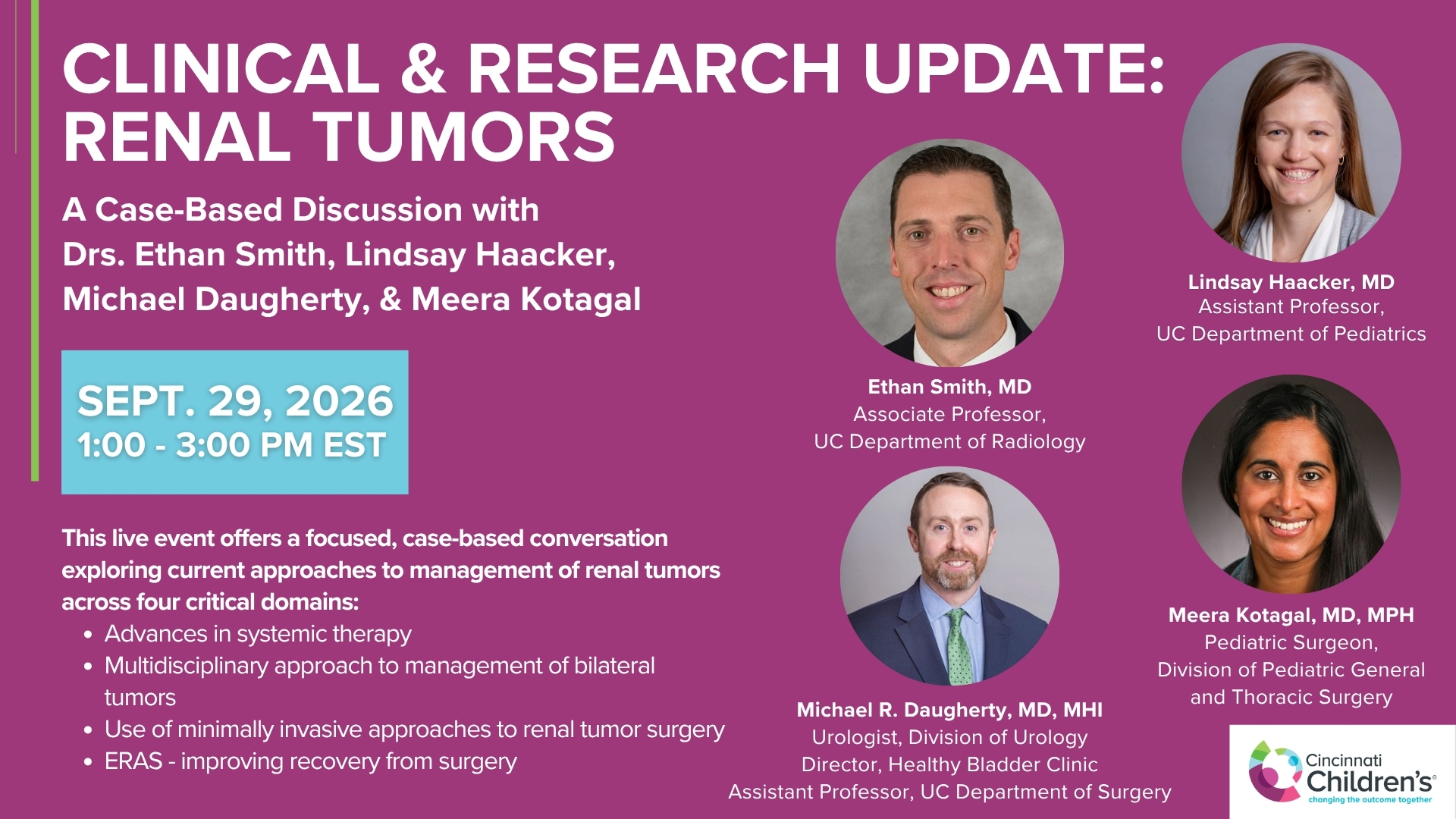
Clinical & Research Update: Renal Tumors with Drs. Ethan Smith, Lindsay Haacker, Michael Daugherty, and Meera Kotagal
71 min · Published Sep 2026
Video
Neuroblastoma with Dr. Meera Kotagal
14 min · Published Sep 2024
Video
Update Course Rewind: 2023 Top Ten Key Takeaways
16 min · Published Jun 2024
Podcast
Inguinal Hernias: Diagnosis and Management
16 min · Published Apr 2021
Video
7th Annual Pediatric Surgery Update Course 2019 - FULL SHOW
285 min · Published Jul 2020
Video
Suspected Hirschsprung's-associated enterocolitis (HAEC) Treatment Guideline...
CCHMC Pediatric Surgery · Published Jul 2019
Video
Clinical & Research Update: Neuroblastoma with Drs. Katherine Somers, Cara Morin, Juan Gurria, and Meera Kotagal
67 min · Published Sep 2026
Video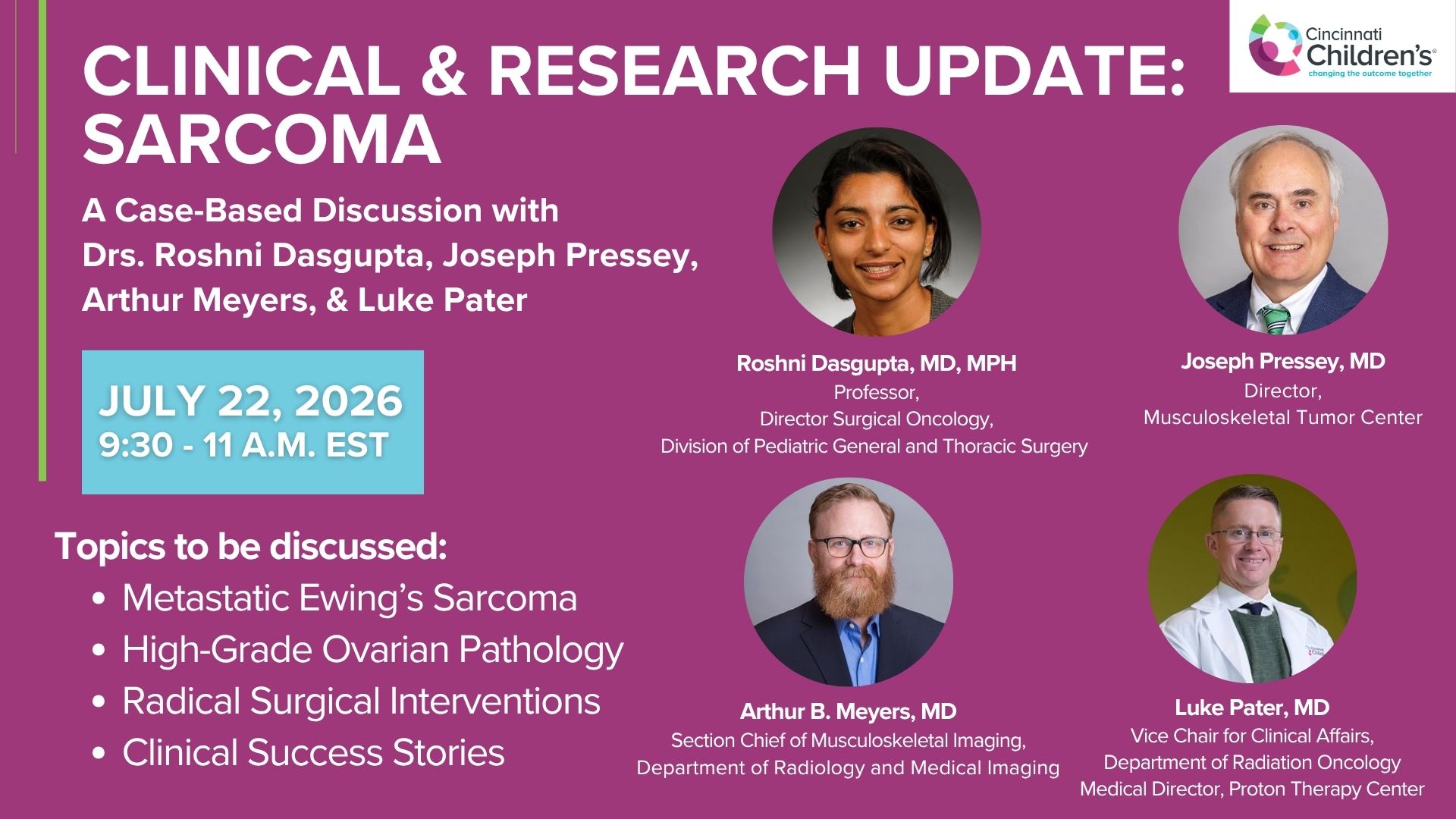
Clinical & Research Update: Sarcoma w/ Drs. Roshni Dasgupta, Joseph Pressey, Arthur Meyer, Luke Pater
66 min · Published Sep 2026
Video
2026 Laparoscopic Pediatric Hernia Repair
123 min · Published Jun 2026
Video
Beyond the Spectrum: Diagnosis, Myths & Management - Caitlin Couch & Leslie Lopez - APP Conference 2026
50 min · Published May 2026
Video
Dysautonomia: Navigating the Journey - Martha Willis - APP Conference 2026
55 min · Published May 2026
Video
Everything You Ever Wanted to Know About G-tubes But Were Afraid to Ask - Betsy Gerrein - APP Conference 2026
30 min · Published May 2026
What the experts said
In a 2-year-old, their most likely injury is going to be ligamentous
About 50% of injuries in children under eight are bony and about 50% are ligamentous or spinal cord injury without radiological abnormality
If you can clinically clear the patient, that would be the best way to do it
In older children, mechanism of injury should not play a role in cervical spine clearance decisions
In younger patients, particularly those with suspected non-intentional trauma (child abuse), there is a higher risk of cervical injury
The CDC has transitioned to calling non-accidental trauma 'child abuse' in the past year
The APSA position statement on child abuse was released last month in the Journal of Pediatric Surgery
Children where you're concerned about child abuse need a skeletal survey as part of their evaluation, and as part of that skeletal survey, you need at least a single view of the cervical spine
At one institution, neurosurgeons have a protocol where any child three and under gets cleared by the neurosurgeons
46% of institutions don't have a protocol for cervical spine clearance in children
Cervical spine injury occurs in 1 to 2% of all pediatric traumas
In older children, 70 to 80% of cervical spine injuries are bony injuries
In children less than or equal to eight years old, about 50% will have isolated fractures and 50% will have ligamentous injury, dislocations or spinal cord injury without radiologic abnormality
60 to 80% of vertebral injuries in kids will be in their cervical spine compared to 34 to 40% of vertebral injuries in adults
The AAST study looked at over 12,000 kids who'd undergone blunt trauma and found 87 cervical spine injuries (0.6%)
Four independent predictors of cervical spine injury in children under three were identified: GCS less than 14, GCS eye of one, involvement in motor vehicle crash, and age greater than or equal to two years
Patients with cervical spine injury score of zero to one points had a negative predictive value for cervical spine injury of over 99% and did not need imaging
Five patients in the AAST study had a cervical spine injury score less than two but actually had injury; these patients had concurrent significant traumatic injuries including facial fracture, skull fracture, long bone fractures, loss of consciousness, and neck pain or splinting
Patients with neck pain and splinting need imaging and would automatically fall out of the no imaging category
For skeletal survey in suspected child abuse, a lateral view is used as the single cervical spine view
If using imaging to clear cervical spine (not just for skeletal survey), you need two views at least: an AP and lateral
CT is not commonly done in kids for cervical spine injury because most injuries are not bony but ligamentous, so MRI is preferred if cross-sectional imaging is needed
In unreliable patients, you can leave them in a collar, wait till they calm down or pain is under control, then reexamine and may be able to clinically clear them at that point
Patients with abnormal neurologic exam cannot be clinically cleared and need an MRI