

Educational content from recorded physician discussions — not medical advice. Talk to your (or your child's) care team about your situation.
Video
ERNICA Research Collaboration Webinar on Quality of Life
61 min · Published Nov 2023
Video
Error Traps and Culture of Safety in Abdominal Wall Defects
CCHMC Pediatric Surgery · Published Oct 2019
Video
7th Annual Pediatric Surgery Update Course 2019 - FULL SHOW
285 min · Published Jul 2020
Video
Gastroschisis - Clinical Practice Updates
Published Sep 2020
Video
Staged Closure of Gastroschisis with Spring-loaded Silo
27 min · Published Feb 2020
Video
Update Course 2021: UPDATE COURSE 2020: REVIEW OF LAST YEAR'S IMPORTANT T OPICS
23 min · Published May 2022
Only a few other public items share this expert — go deeper there →
Video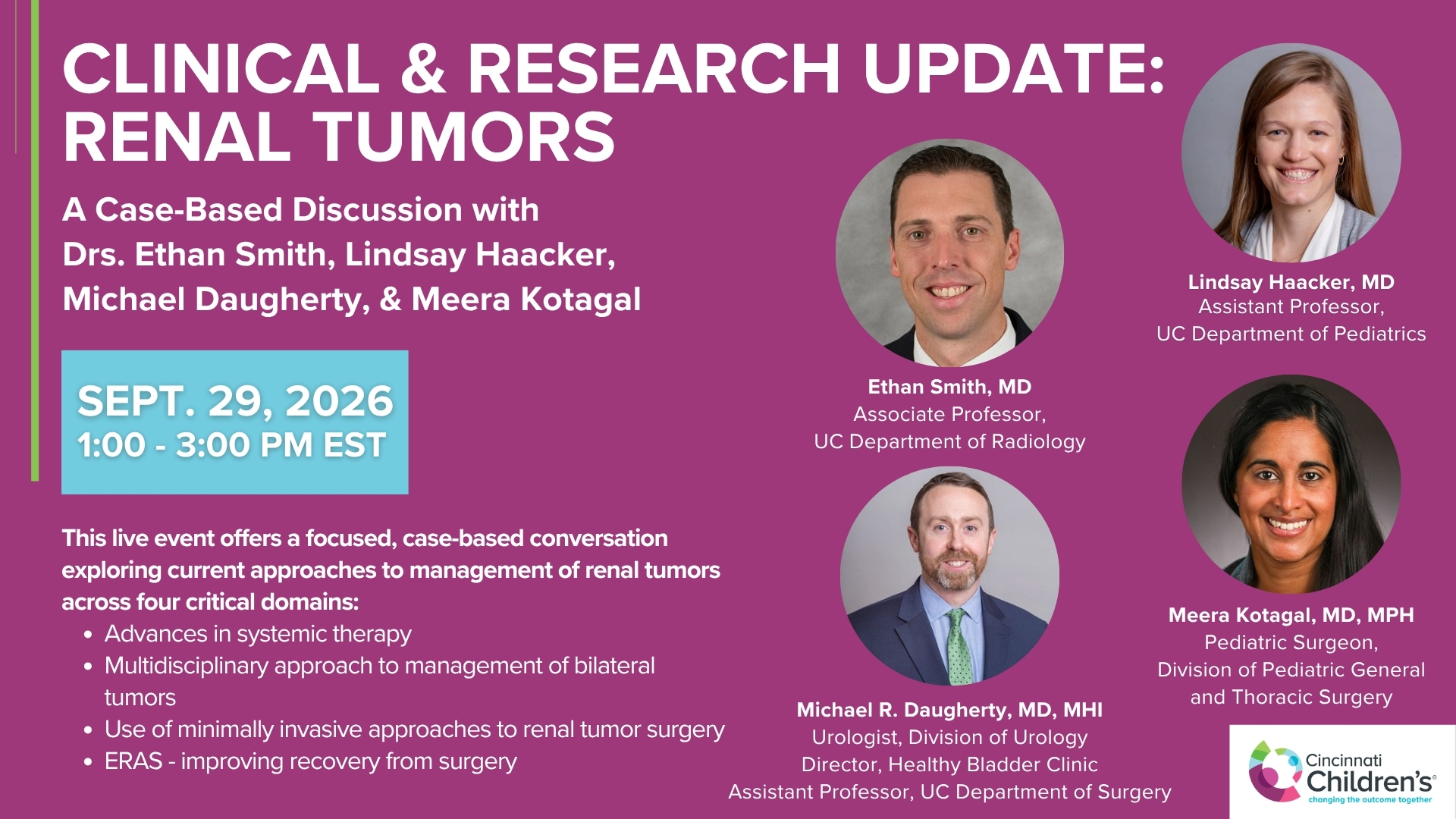
Clinical & Research Update: Renal Tumors with Drs. Ethan Smith, Lindsay Haacker, Michael Daugherty, and Meera Kotagal
71 min · Published Sep 2026
Video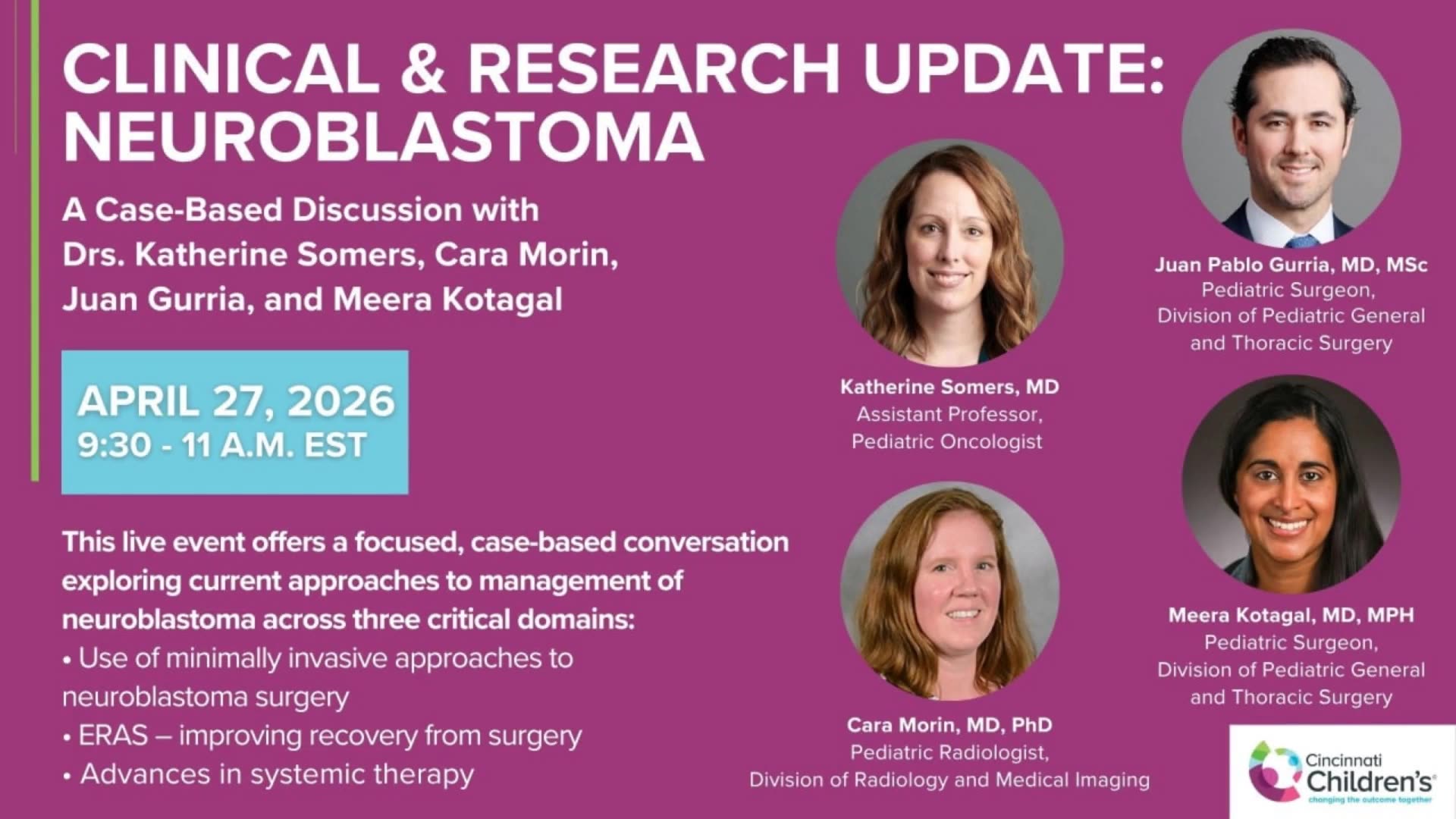
Clinical & Research Update: Neuroblastoma with Drs. Katherine Somers, Cara Morin, Juan Gurria, and Meera Kotagal
67 min · Published Sep 2026
Video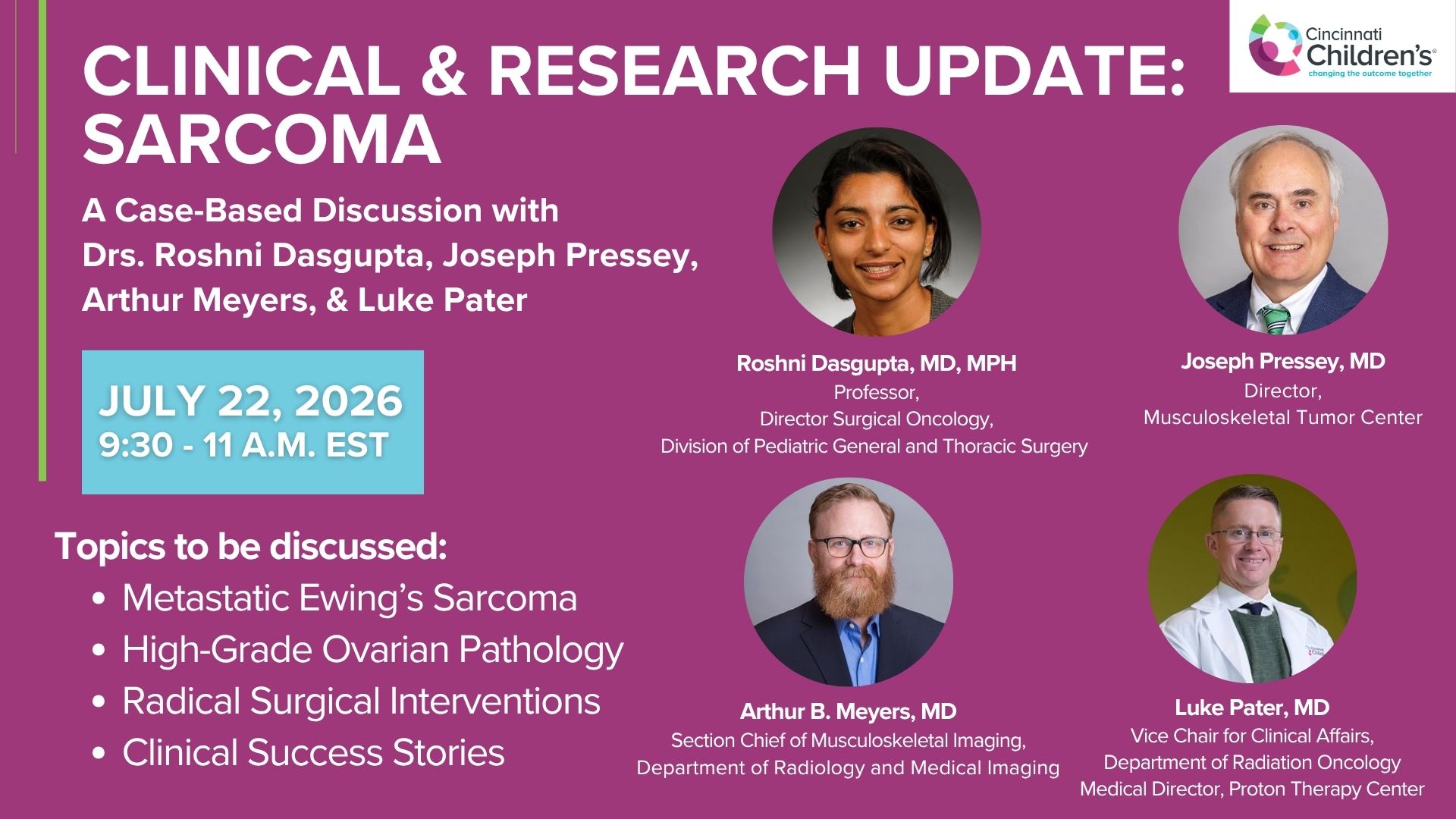
Clinical & Research Update: Sarcoma w/ Drs. Roshni Dasgupta, Joseph Pressey, Arthur Meyer, Luke Pater
66 min · Published Sep 2026
Video
2026 Laparoscopic Pediatric Hernia Repair
123 min · Published Jun 2026
Video
Beyond the Spectrum: Diagnosis, Myths & Management - Caitlin Couch & Leslie Lopez - APP Conference 2026
50 min · Published May 2026
Video
Dysautonomia: Navigating the Journey - Martha Willis - APP Conference 2026
55 min · Published May 2026
What the experts said
For a well-appearing neonate with intact omphalocele and no maternal risk factors, the most appropriate antibiotic management is preoperative antibiotic given one hour before incision and discontinued within 72 hours.
Neonates with intact omphalocele do not need antibiotics just because they are in the NICU.
Neonates with ruptured omphalocele or gastroschisis (open abdomen) should receive antibiotics.
Neonates with duodenal atresia probably do not need antibiotics if they are going to the operating room within 24 to 48 hours.
For paint-and-wait management of omphalocele, no antibiotics are given as long as the mother did not have chorioamnionitis and the baby does not have a fever.
Neonatology colleagues may start empiric antibiotic therapy based on elevated inflammatory markers like CRP or procalcitonin in postoperative neonates.
Inflammatory markers go up after taking a baby to the operating room.
A randomized trial may be needed to determine whether inflammatory markers should guide antibiotic use in postoperative neonates.
Antibiotic stewardship is a hot topic and was considered important enough by the PDC to bring to the forum.
Some institutions have pediatrician advocates for antibiotic stewardship with programs and committees.
At some institutions, pediatric colleagues accuse surgeons of giving too many antibiotics for patients with tracheoesophageal fistulas and gastroschisis.
Multidisciplinary conferences and pathways for conditions like abdominal wall defects help keep all teams aligned on antibiotic stewardship.
Engaging pediatricians in the NICU and PICU to develop protocols and pathways helps streamline antibiotic use and ensure adherence.
Well-appearing neonates with closed abdominal defects do not need antibiotics until they go to the OR, and only need standard prophylactic antibiotics.
AAP and neonatology recommendations state that as long as the baby is well and the mother has no signs of sepsis or chorioamnionitis, antibiotics are not needed for children without an open abdomen.