

From
StayCurrentMD
Duodeno-duodenostomy for Duodenal Atresia
Educational content from recorded physician discussions — not medical advice. Talk to your (or your child's) care team about your situation.
Video
Technique: Laparoscopic Repair of Duodenal Atresia, Ladd's Procedure, and...
Dr. Steve Rothenberg · 15 min · Published Nov 2018
Video
Peritoneal Access
Published Mar 2020
Video
Enhanced Recovery After Surgery (ERAS) Program: Update Course 2016
44 min · Published Jul 2017
Video
Antibiotic Stewardship - APSA Practice Gaps 2019
Published Mar 2020
Video
BOB in Ped Surg 2023 - CIPESUR Winner - Georgina Falcioni, MD
Published Feb 2023
Video
John Carey, MD - 2024 Fetal Care Center Navigating Perinatal Care for Trisomy 13 & 18
31 min · Published Dec 2024
Video
Impact of social determinants of health on outcomes in pediatric short bowel syndrome...
43 s · Published Aug 2026
Video
Advancements in Pediatric Intestinal Failure: Innovative Therapies and Improved Outcomes
17 min · Published Aug 2026
Podcast
Update Course Rewind: Omphalocele & Gastroschisis 2020
Miguel Guelfand · 15 min · Published Jul 2026
Video
Update Course Rewind 2025: Updates in NEC Management
11 min · Published Jul 2026
Video
Availability, utilization, and barriers to bowel ultrasound for necrotizing enterocolitis...
55 s · Published Jul 2026
Video
Malrotation and Volvulus with Trinity
Dr. Steve Rothenberg · 8 min · Published May 2026
Video
Intestinal Atresia Types Explained: Grossfeld Classification for Pediatric Surgery
1 min · Published Sep 2026
Video
Derivation and validation of the Pediatric Community-Acquired Pneumonia Severity (PedCAPS) score: A prospective cohort study
50 s · Published Sep 2026
Video
FETO for Late-Diagnosed Severe Congenital Diaphragmatic Hernia (CDH) at Cincinnati Children's with Dr. Beth Rymeski
4 min · Published Sep 2026
Video
Severe Congenital Diaphragmatic Hernia (CDH) Case: FETO Management & Unexpected Findings with Dr. Beth Rymeski
3 min · Published Sep 2026
Video
Fetoscopic Endoluminal Tracheal Occlusion (FETO) Procedure: Step-by-Step Guide with Dr. Beth Rymeski
4 min · Published Sep 2026
Video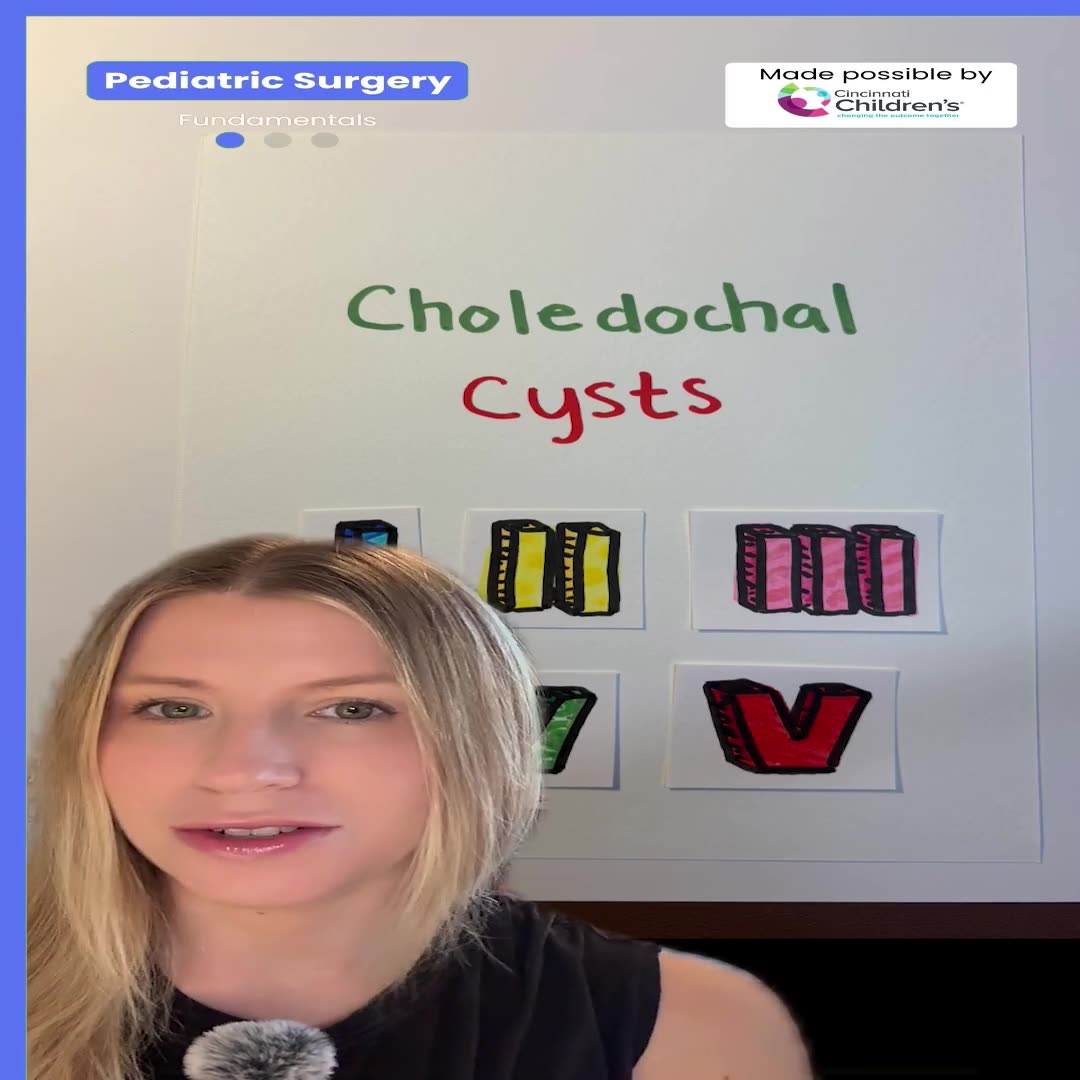
Choledochal Cyst Types Explained: Pediatric Surgery Fundamentals
1 min · Published Sep 2026
What the experts said
The patient is a two-day-old boy with duodenal atresia.
A transverse right abdominal incision allows access to the duodenum and small intestine.
Malrotation is present in this case.
Duodenal atresia type III is present in this case.
The proximal duodenal opening is made at the most dependent part.
The distal limb is opened on the anterolateral surface to avoid injury to the opening of the common bile and pancreatic ducts.
Bile coming out on opening of the distal limb confirms patency to that point.
The diamond-shaped technique creates two openings with perpendicular axes.
Distal patency is checked by injecting saline and observing its filling to the whole bowel.
The anastomosis technique uses two opposing borders of the diamonds to make the posterior wall and the far-facing borders to make the anterior wall.
The posterior wall is sutured from the inside with full-thickness sutures.
The anterior wall is sutured from the outside.
5-0 absorbable sutures are used for the anastomosis.
Suturing starts with the middle of the posterior wall and advances toward the angles with interrupted sutures.
The angle suture is placed from the outside in an extramucosal fashion.
The anterior wall sutures are placed in an extramucosal fashion starting from the angles and working towards the middle.
The proximal dilated pouch is brought downwards to meet the distal limb during anterior wall closure.
Widening of the root of the mesentery is performed after completing the anastomosis.
The superior mesenteric vessels should be visualized during mesenteric root widening.
The peritoneal covering is carefully dissected to allow adequate widening of the mesenteric root.
Appendectomy is performed as part of the procedure.
The bowel is returned to the abdomen with the colon in the left side and the duodenojejunal junction in a straight direction.