

From
Live Event Content
Update Course 2021: TOP PUBLICATIONS IN NON - PED SURG JOURNALS
hosted by Dr. Todd Ponsky
Educational content from recorded physician discussions — not medical advice. Talk to your (or your child's) care team about your situation.
Video
Clinical & Research Update: Renal Tumors with Drs. Ethan Smith, Lindsay Haacker, Michael Daugherty, and Meera Kotagal
71 min · Published Sep 2026
Video
Clinical & Research Update: Neuroblastoma with Drs. Katherine Somers, Cara Morin, Juan Gurria, and Meera Kotagal
67 min · Published Sep 2026
Video
Clinical & Research Update: Sarcoma w/ Drs. Roshni Dasgupta, Joseph Pressey, Arthur Meyer, Luke Pater
66 min · Published Sep 2026
Video
Update Course Rewind 2025: Nerve Monitoring in Pediatric Thyroid Surgery
6 min · Published Jul 2026
Video
Journal of Pediatric Surgery Article Review: June 2023, AAP Issue
Todd Ponsky · 13 min · Published Jul 2026
Video
Pediatric Surgical Oncology Research Collaborative (PSORC): Studying Rare Pediatric Tumors
56 s · Published May 2026
Video
2026 Laparoscopic Pediatric Hernia Repair
123 min · Published Jun 2026
Video
Beyond the Spectrum: Diagnosis, Myths & Management - Caitlin Couch & Leslie Lopez - APP Conference 2026
50 min · Published May 2026
Video
Dysautonomia: Navigating the Journey - Martha Willis - APP Conference 2026
55 min · Published May 2026
Video
Everything You Ever Wanted to Know About G-tubes But Were Afraid to Ask - Betsy Gerrein - APP Conference 2026
30 min · Published May 2026
Video
Take My Breath Away - Carolyn Grad, Mark Washam, & Katie Holtman - APP Conference 2026
58 min · Published May 2026
Video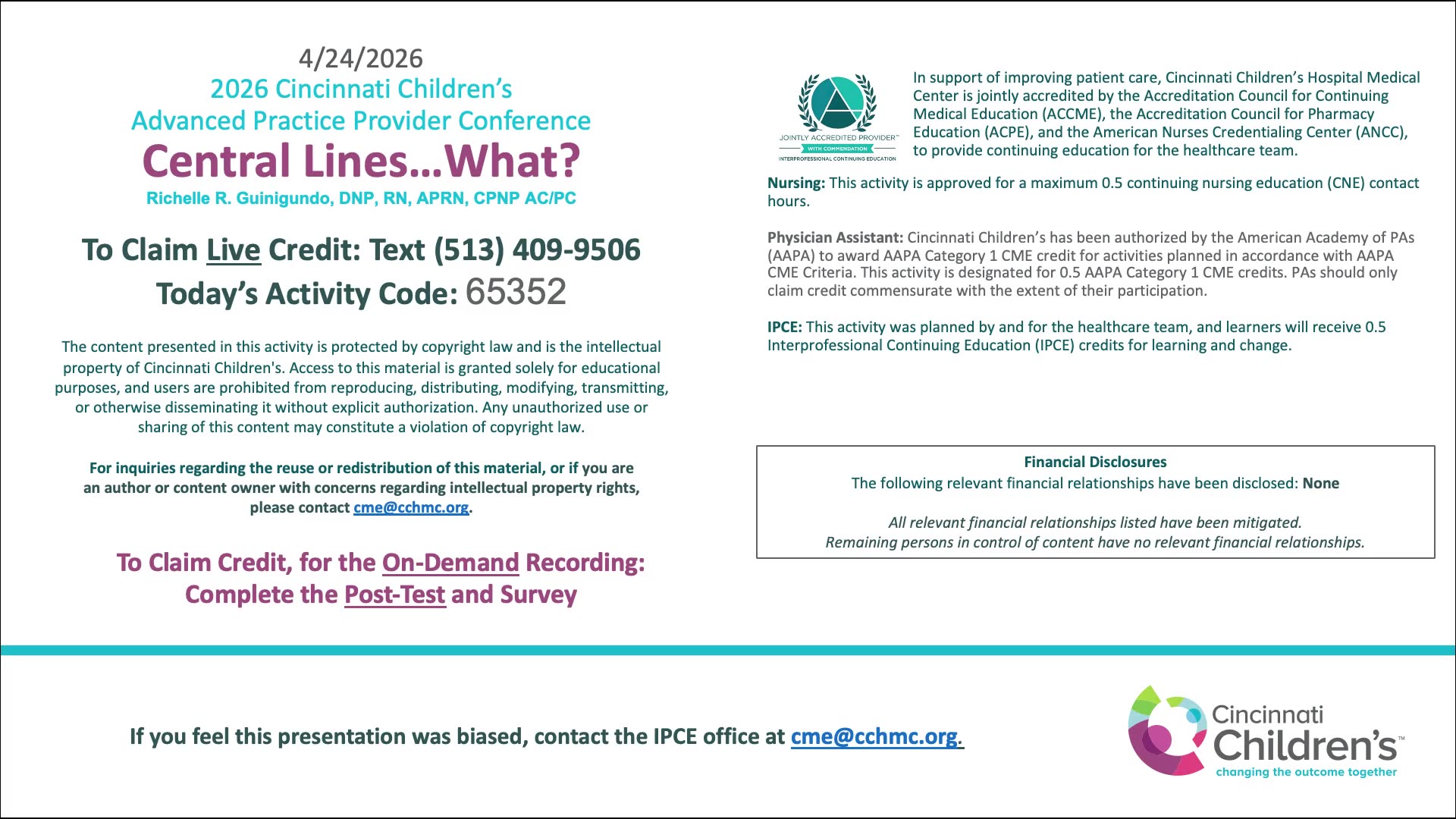
Central Lines...WHAT? - Richelle Guinigundo - APP Conference 2026
26 min · Published May 2026
What the experts said
Upper GI contrast study is operator-dependent and requires direct communication with radiologist, readily available at high-volume centers but requires more coordination at community hospitals.
Ultrasound for malrotation diagnosis is very dependent on the person who performs the ultrasound, making it less reliable than upper GI contrast study.
Reversal of vessels at the root of the mesentery on ultrasound is not a very reliable way to make the diagnosis of malrotation.
The presence of an appendicolith in appendicitis has about a 50% failure rate with non-operative management, making it a contraindication for non-surgical treatment.
Current ATLS protocols recommend initial bolus with normal saline or crystalloid solution before moving to blood products in pediatric trauma.
Nationwide in adults, ambulance rigs are starting to travel with whole blood capabilities and people are using whole blood even earlier in trauma resuscitation.
The challenge for whole blood in pediatrics is availability, and thankfully for children, we don't use a lot of massive transfusion protocols compared to adults.
Some centers are limiting whole blood use to males and some to children older than 15, depending on institutional protocols and blood bank partnerships.
The curation process filters approximately 1200 articles per month from 33 pediatric and general surgical journals plus 3 top clinical journals (NEJM, Lancet, JAMA) down to 25-50 relevant pediatric surgery articles, then further narrows to 10-15 through specialty filtering, quality ranking, methodology assessment, and popularity polling among general surgeons.
In the Annals of Surgery 5-year follow-up study of non-operative appendicitis management, 46% of patients randomized to non-surgical management required appendectomy during follow-up, while the surgical group had no complications or readmissions.
Half of the non-surgical appendicitis management group presented to the emergency room during 5-year follow-up.
In the Journal of Clinical Oncology study of 1,531 patients with stage 4 high-risk neuroblastoma, 5-year event-free survival and overall survival were significantly higher with complete resection compared to incomplete microscopic resection.
Local progression in stage 4 neuroblastoma was lower with complete resection when compared with incomplete resection.
In the New England Journal of Medicine randomized controlled trial of 80 women carrying fetuses with severe isolated left-sided congenital diaphragmatic hernia, fetal endoscopic tracheal occlusion (FETO) at 27-29 weeks resulted in 40% survival to discharge versus 15% with expectant care.
At 6 months of age, survival was the same between FETO and expectant care groups in severe CDH.
FETO was associated with an increased risk of pre-labor rupture of membranes and preterm labor.
In the Journal of Trauma study of 135 children aged 1-17 years who received whole blood as adjunct to component therapy, matched to 270 children receiving only component therapy, the whole blood group had decreased transfusion volume at 24 hours and required fewer ventilation days, though mortality, length of stay, and major complications were the same.