

From
Live Event Content
Update Course 2021: UPDATE COURSE 2020: REVIEW OF LAST YEAR'S IMPORTANT T OPICS
hosted by Dr. Todd Ponsky
Educational content from recorded physician discussions — not medical advice. Talk to your (or your child's) care team about your situation.
Video
Jingying Jiang, MD - Best of the Best in Pediatric Surgery 2024
Dr. Todd Ponsky · 6 min · Published Feb 2024
Video
ERNICA Research Collaboration Webinar on Quality of Life
61 min · Published Nov 2023
Podcast
Journal of Pediatric Surgery Article Review: 2nd Quarter (Apr-Jun) 2024
17 min · Published Sep 2024
Video
Clinical Characteristics and Prognosis of Biliary Atresia with Low Serum Matrix Metalloproteinase-7 Levels
55 s · Published Jul 2024
Video
Heat 3 Winner: Shruthi Srinivas, MD - Best of the Best in Pediatric Surgery 2024
1 min · Published Feb 2024
Video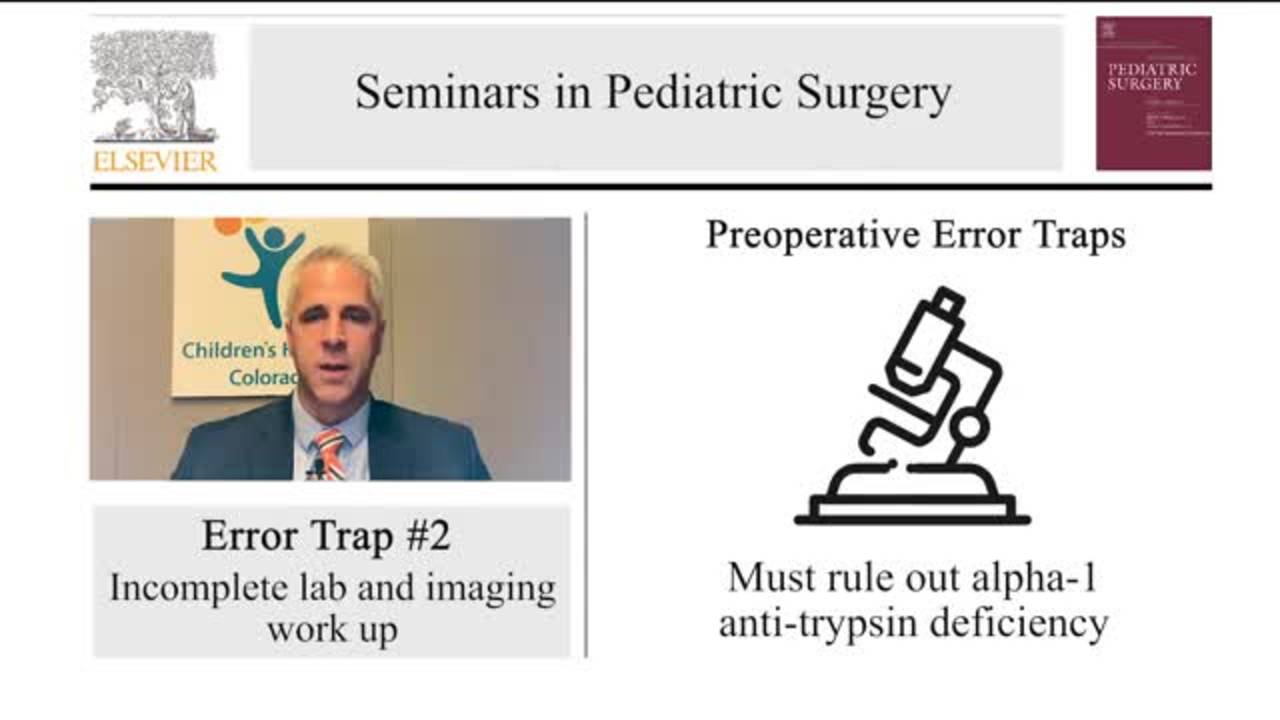
Error Traps and Culture of Safety in Biliary Atresia
CCHMC Pediatric Surgery · 4 min · Published Nov 2019
Video
Impact of social determinants of health on outcomes in pediatric short bowel syndrome...
43 s · Published Aug 2026
Video
Advancements in Pediatric Intestinal Failure: Innovative Therapies and Improved Outcomes
17 min · Published Aug 2026
Podcast
Update Course Rewind: Omphalocele & Gastroschisis 2020
Miguel Guelfand · 15 min · Published Jul 2026
Video
Update Course Rewind 2025: Updates in NEC Management
11 min · Published Jul 2026
Video
Availability, utilization, and barriers to bowel ultrasound for necrotizing enterocolitis...
55 s · Published Jul 2026
Video
Malrotation and Volvulus with Trinity
Dr. Steve Rothenberg · 8 min · Published May 2026
Video
Clinical & Research Update: Renal Tumors with Drs. Ethan Smith, Lindsay Haacker, Michael Daugherty, and Meera Kotagal
71 min · Published Sep 2026
Video
Clinical & Research Update: Neuroblastoma with Drs. Katherine Somers, Cara Morin, Juan Gurria, and Meera Kotagal
67 min · Published Sep 2026
Video
Clinical & Research Update: Sarcoma w/ Drs. Roshni Dasgupta, Joseph Pressey, Arthur Meyer, Luke Pater
66 min · Published Sep 2026
Video
2026 Laparoscopic Pediatric Hernia Repair
123 min · Published Jun 2026
Video
Beyond the Spectrum: Diagnosis, Myths & Management - Caitlin Couch & Leslie Lopez - APP Conference 2026
50 min · Published May 2026
Video
Dysautonomia: Navigating the Journey - Martha Willis - APP Conference 2026
55 min · Published May 2026
What the experts said
26% of respondents use intraoperative ICG to visualize the biliary tree, 23% use it in select patients, and 51% do not use it.
MMP7 is a send-out test at many non-freestanding children's hospitals, limiting its clinical utility for time-sensitive biliary atresia diagnosis in children presenting at five weeks of age.
For a hypotensive, tachycardic pediatric blunt trauma patient who has received 20 cc/kg crystalloid, the next steps should be early blood therapy and potentially massive transfusion protocol with balanced resuscitation, consistent with ATLS guidelines.
There is currently no great definition of what constitutes a massive transfusion protocol (MTP) in pediatric patients; approximately 40 cc/kg blood triggers consideration of balanced resuscitation.
For rectal prolapse sclerotherapy, 46% of respondents use hypertonic saline, while 10-16% use phenol, ethyl alcohol, or dextrose in water.
Getting phenol into the operating room for sclerotherapy is not always easy due to institutional and pharmacy restrictions.
3% sotradecal is used as a sclerotherapy agent for rectal prolapse.
D50 (dextrose 50% from the code cart) is used as a hypertonic sclerotherapy agent and may be easier to acquire in the operating room than 3% saline.
Approximately 50% of respondents always use sutureless abdominal closure for large abdominal wall defects, 40% use it in select patients, and only 11% do not use it.
The adoption of sutureless closure for abdominal wall defects represents a major practice change over nine years, with 90% now using it always or selectively compared to much lower rates previously.
ERAS (Enhanced Recovery After Surgery) is a bundle of interventions to help patients get through the hospital faster with less pain and fewer narcotics, including early mobilization.
ERAS protocols include giving patients a carbohydrate drink two hours before surgery, replacing traditional NPO requirements.
Implementing ERAS requires team buy-in, particularly from anesthesiologists, because of practice changes like allowing oral intake two hours preoperatively.
ERAS protocols are difficult to implement because they require the whole hospital to adopt a different culture and philosophy, unlike single-procedure changes like sutureless gastroschisis closure.
Starting ERAS implementation with surgical pathways standardizes care and has led to decreased cost, antibiotic utilization, and length of stay; hospitalists and pediatric residents use surgical pathways more than other pathways.
A strategy for ERAS implementation is to chip away at individual components (such as decreasing opioid use intraoperatively and perioperatively) before building a larger protocol.
For bleeding from a pulmonary vessel during thoracoscopic lobectomy, start with an energy/sealing device (effective in low-pressure systems), then escalate to clips or sutures if needed.
Multiple hemostasis options (energy, clips, sutures) should be available during thoracoscopic procedures.
Most institutions are either taking steps to address social determinants of health or working on it; few report no action.
MMP7 could be used to distinguish biliary atresia from other cholestatic diseases.
Intraoperative ICG can be used to determine biliary flow or identify a transaction in biliary atresia surgery.
There are case reports showing mucosal sloughing with phenol sclerotherapy.
Deflux, a compound used by urology for vesicoureteral reflux, has been reported in case reports for rectal prolapse sclerotherapy.