

From
Live Event Content
Update Course 2021: THORACOTOMY VS VATS FOR OSTEO METS
With Dr. Chiro Esposito & Dr. Roshni Das Gupta
Educational content from recorded physician discussions — not medical advice. Talk to your (or your child's) care team about your situation.
Video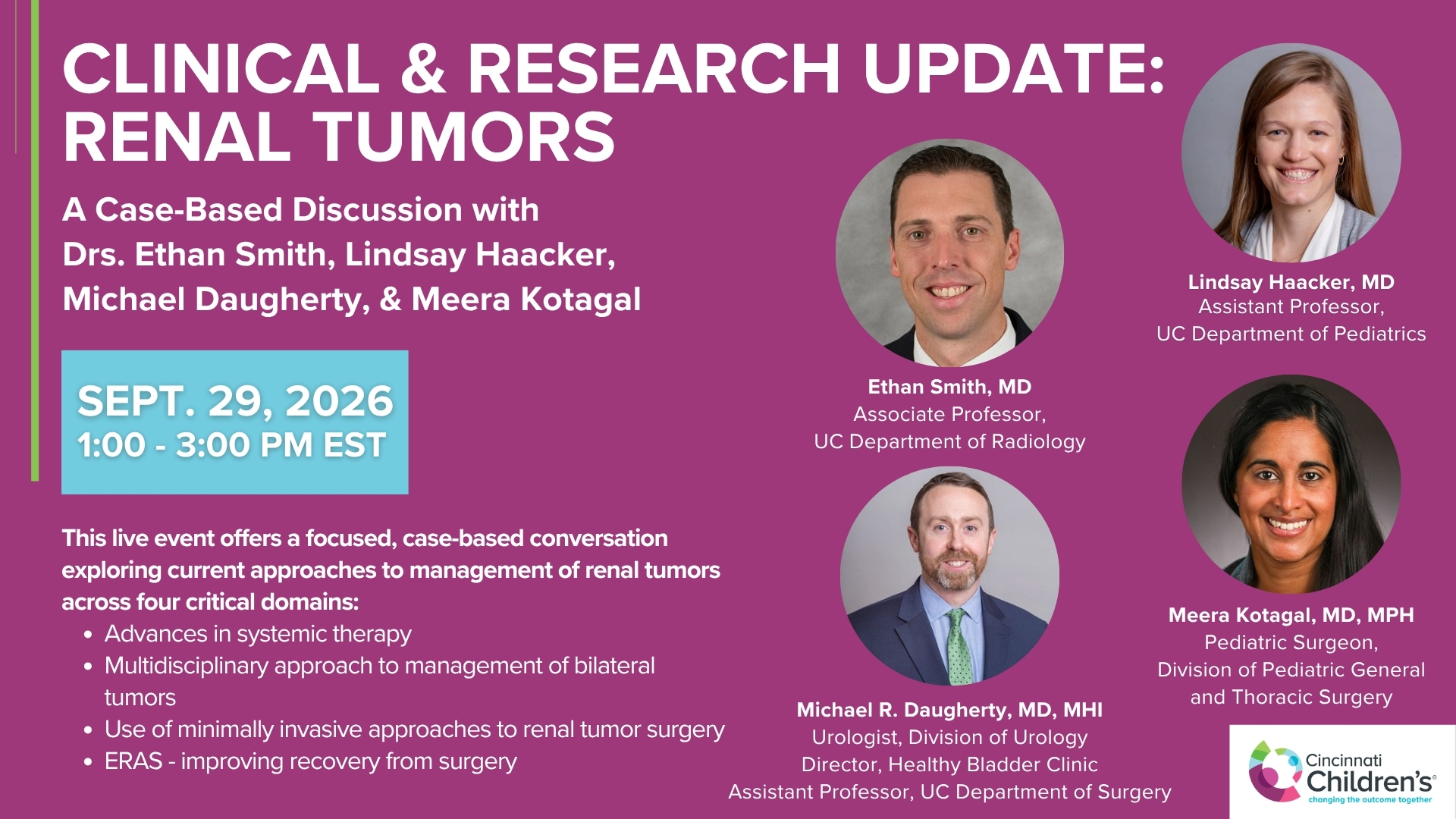
Clinical & Research Update: Renal Tumors with Drs. Ethan Smith, Lindsay Haacker, Michael Daugherty, and Meera Kotagal
71 min · Published Sep 2026
Video
Clinical & Research Update: Neuroblastoma with Drs. Katherine Somers, Cara Morin, Juan Gurria, and Meera Kotagal
67 min · Published Sep 2026
Video
Clinical & Research Update: Sarcoma w/ Drs. Roshni Dasgupta, Joseph Pressey, Arthur Meyer, Luke Pater
66 min · Published Sep 2026
Video
Update Course Rewind 2025: Nerve Monitoring in Pediatric Thyroid Surgery
6 min · Published Jul 2026
Video
Journal of Pediatric Surgery Article Review: June 2023, AAP Issue
Todd Ponsky · 13 min · Published Jul 2026
Video
Pediatric Surgical Oncology Research Collaborative (PSORC): Studying Rare Pediatric Tumors
56 s · Published May 2026
Only a few other public items share this expert — go deeper there →
Video
2026 Laparoscopic Pediatric Hernia Repair
123 min · Published Jun 2026
Video
Beyond the Spectrum: Diagnosis, Myths & Management - Caitlin Couch & Leslie Lopez - APP Conference 2026
50 min · Published May 2026
Video
Dysautonomia: Navigating the Journey - Martha Willis - APP Conference 2026
55 min · Published May 2026
Video
Everything You Ever Wanted to Know About G-tubes But Were Afraid to Ask - Betsy Gerrein - APP Conference 2026
30 min · Published May 2026
Video
Take My Breath Away - Carolyn Grad, Mark Washam, & Katie Holtman - APP Conference 2026
58 min · Published May 2026
Video
Central Lines...WHAT? - Richelle Guinigundo - APP Conference 2026
26 min · Published May 2026
What the experts said
ICG is a soluble molecule that rapidly binds to albumin and is removed from circulation by the liver into bile juice
ICG technology can be used in both laparoscopy (requiring special camera and optic) and robotic surgery with Da Vinci XI Firefly system
In adult centers, surgeons perform 100 to 300 cholecystectomies per year compared to 10 to 30 per year in pediatric centers
ICG technology helps reduce complications in laparoscopic cholecystectomy, particularly beneficial for trainees and in centers with longer learning curves due to lower case volumes
ICG vial contains 25 mg in 4 ml, diluted with 10 ml sterile water, with 6 ml injected intravenously for cholecystectomy
The newer Rubin ICG system allows visualization in color with biliary tree appearing green, compared to older systems showing black and white images
For cholecystectomy, ICG must be injected 12 to 15 hours preoperatively to allow secretion into bile juice for selective biliary tree visualization
If ICG is injected intraoperatively for cholecystectomy, the liver takes up the dye and appears green, making gallbladder identification difficult
For all ICG indications except cholecystectomy (kidney, varicocele, lymphoma, tumors), the injection is given intraoperatively
For elective cholecystectomy cases, patients are hospitalized the day before surgery for ICG injection in the late afternoon if surgery is scheduled early morning
For partial nephrectomy in duplex kidney, ICG is injected three times: via ureteral catheter to identify normal ureter, intravenously to visualize kidney vasculature, and intravenously again after vessel clipping to show devascularization line
In duplex kidney with reflux, the two ureters are attached to each other, making identification of the normal ureter difficult without ICG
For varicocele repair, intratesticular injection of 2 ml ICG solution allows intraoperative fluorescence lymphography to identify and spare lymphatic vessels
Palomo varicocele repair has success rate of more than 97-98% but ligating lymphatics in the spermatic bundle causes postoperative hydrocele in about 20% of cases
The spermatic bundle contains three to four lymphatic vessels
In a series of more than 150 varicocele patients using ICG lymphatic sparing technique, there were zero postoperative hydroceles
ICG vial remains usable for six hours after preparation
No adverse effects of ICG were observed in the presenter's experience
There is no maximum dose limit for ICG based on adult surgery studies