

Educational content from recorded physician discussions — not medical advice. Talk to your (or your child's) care team about your situation.
Video
Update Course Rewind: Spontaneous Pneumothorax 2021
Dr. Todd Ponsky · Published Oct 2021
Video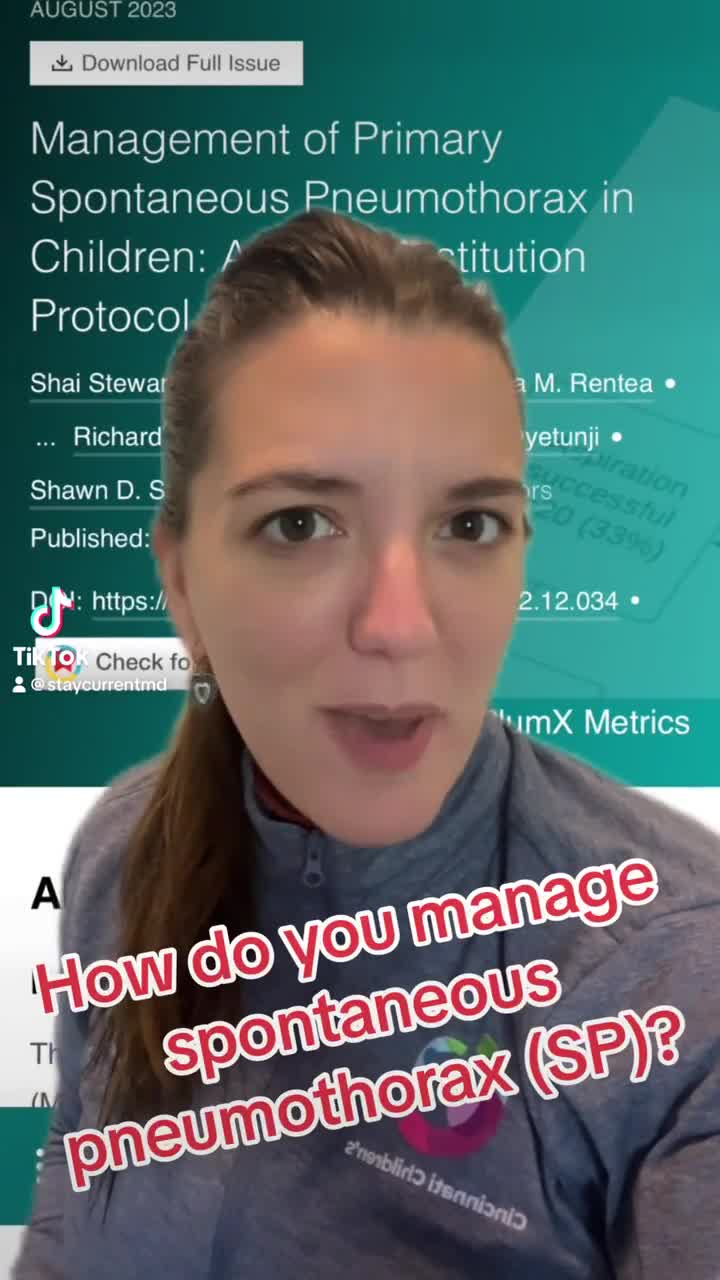
Management of Primary Spontaneous Pneumothorax in Children
Published Sep 2023
Video
Aspiration Test Predicts Need for Operation in Pediatric Spontaneous...
Published Feb 2020
Video
Spontaneous Pneumothorax Rapid Fire: Update Course 2015
9 min · Published Nov 2015
Video
Manejo del neumotórax primario espontáneo en niños
Published Sep 2023
Podcast
Spontaneous Pneumothorax
33 min · Published Aug 2019
Video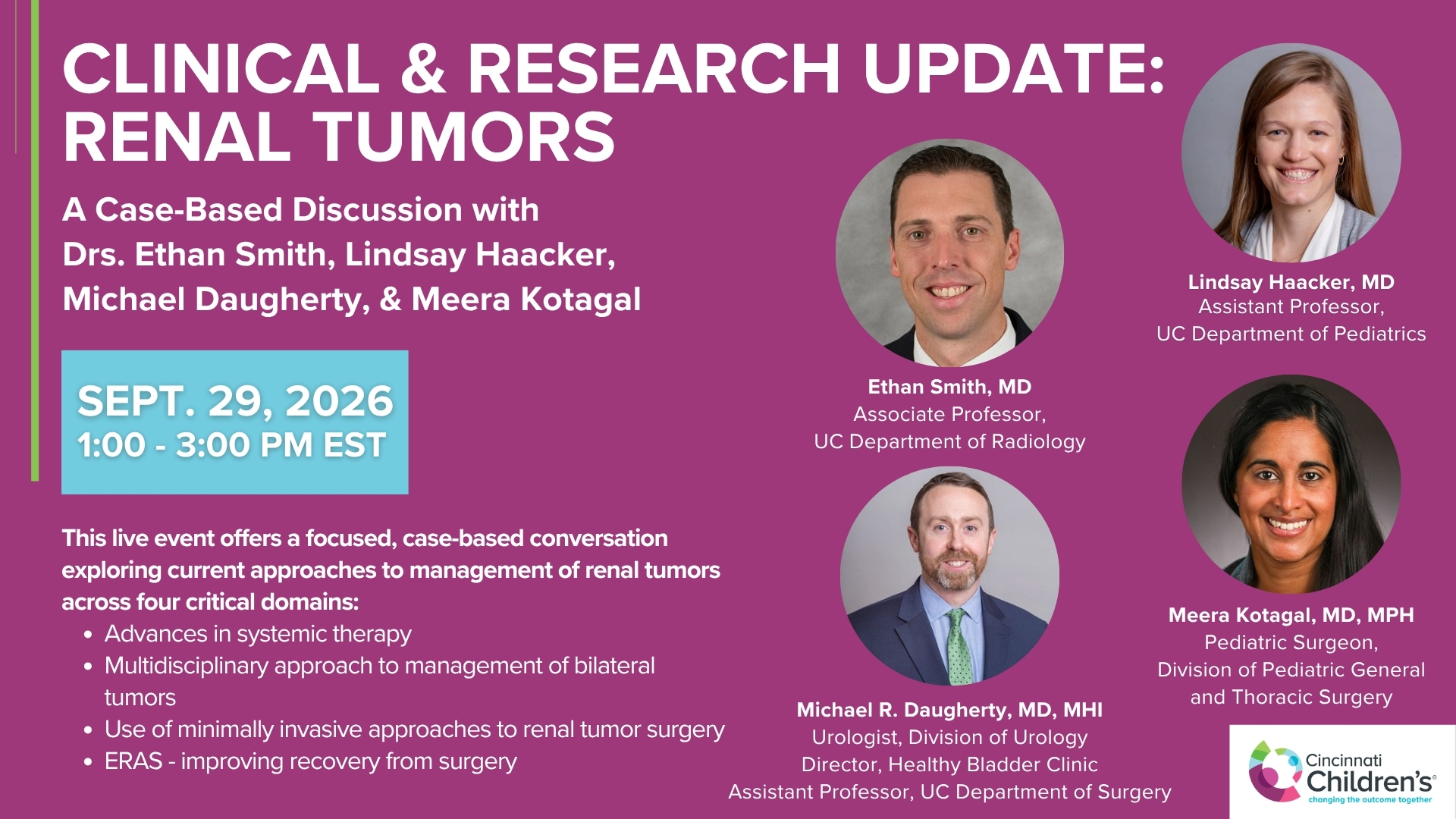
Clinical & Research Update: Renal Tumors with Drs. Ethan Smith, Lindsay Haacker, Michael Daugherty, and Meera Kotagal
71 min · Published Sep 2026
Video
Clinical & Research Update: Neuroblastoma with Drs. Katherine Somers, Cara Morin, Juan Gurria, and Meera Kotagal
67 min · Published Sep 2026
Video
Clinical & Research Update: Sarcoma w/ Drs. Roshni Dasgupta, Joseph Pressey, Arthur Meyer, Luke Pater
66 min · Published Sep 2026
Video
2026 Laparoscopic Pediatric Hernia Repair
123 min · Published Jun 2026
Video
Beyond the Spectrum: Diagnosis, Myths & Management - Caitlin Couch & Leslie Lopez - APP Conference 2026
50 min · Published May 2026
Video
Dysautonomia: Navigating the Journey - Martha Willis - APP Conference 2026
55 min · Published May 2026
What the experts said
If aspiration doesn't work perfectly, proceeding straight to VATS that day can turn cases into a maximum two or three day hospital stay instead of four, five, or six days while alternating between water seal and suction.
The real discernment in spontaneous pneumothorax is whether you're treating somebody who has a leak or somebody who had a leak.
Primary VATS for spontaneous pneumothorax has a recurrence rate of 15%.
If you offer primary VATS right off the bat to people, you're actually doing surgery on people who may not necessarily need it.
Even with a 44% recurrence rate, performing an operation upfront means operating on 56% of patients who may not need it, and that in itself has associated complications.
The speaker has never seen a patient in extremis from a spontaneous pneumothorax, distinguishing it from traumatic pneumothorax.
For bilateral surgery consideration, CT scan stratification of the contralateral side shows no blebs correlates with zero recurrence, while blebs on the other side correlates with 20% recurrence.
Apical pneumothorax post-operatively is almost 100% because volume was removed and space was taken out.
The consequences of talc pleurodesis are so bad should a patient ever need a chest operation on that side that there's no justification for it.
Going back into one chest that's been talced is an awful experience.
Endobronchial valves work really well for persistent air leak post-surgery.
The British Thoracic Society has been advocating for aspiration since 2003.
In the Midwest Consortium study, 48% of patients with first-presentation spontaneous pneumothorax were successfully managed with aspiration alone through a pigtail catheter ≤12 French, and 52% failed.
In patients who failed initial aspiration in the Midwest Consortium study, recurrence was 83% versus 44% in those who passed the first aspiration test.
The Midwest Consortium study proposed changing the algorithm to proceed directly to VATS if the initial aspiration fails.
The 2020 New England Journal of Medicine study was a multicenter non-inferiority trial enrolling 316 patients aged 14 to 50 years with moderate to large pneumothoraces (approximately 32% collapse).
In the NEJM trial, 84.6% of patients in the observation group did not have any interventions, whereas 15.4% did have interventions.
In the NEJM trial, 98.5% were managed successfully in the intervention group versus 94.4% in the observation group, with no significant difference.
Median time to reexpansion was 16 days for the intervention group versus 30 days for the observation group in the NEJM trial.
Median time to symptom resolution was approximately the same between intervention and observation groups in the NEJM trial.
Recurrences in the first 12 months were 8.8% in the observation group versus 16.8% in the intervention group in the NEJM trial.
The observation group had fewer days of chest tubes, fewer CT scans, fewer hospital revisits, fewer adverse events and serious adverse events, fewer chest x-rays, and fewer hospital days in the first eight weeks compared to the intervention group.
Studies have shown that pleurodesis is not needed for spontaneous pneumothorax.
The presence or absence of a bleb on CT scan did not correlate with the presence or absence of patients coming back to seek care for a pneumothorax on that side.
Studies show pleurodesis doesn't make a difference at all and just causes more pain.