

From
StayCurrentMD
Pyloric Stenosis Guideline Recap
With Dr. Meera Kotagal
Part of
Pyloric Stenosis 9 items
Educational content from recorded physician discussions — not medical advice. Talk to your (or your child's) care team about your situation.
Video
RCT for Feeding after Pyloromyotomy
Published May 2020
Video
Laparoscopic Pyloromyotomy
7 min · Published Feb 2020
Podcast
Pyloric Stenosis with Dr. Alex Bondoc
16 min · Published Jun 2024
Video
Pyloric Stenosis
CCHMC Pediatric Surgery · 12 min · Published May 2020
Podcast
Case-Based Journal Review: Inguinal Hernia 2025
19 min · Published Apr 2025
Video
Peritoneal Access
Published Mar 2020
Video
Clinical & Research Update: Renal Tumors with Drs. Ethan Smith, Lindsay Haacker, Michael Daugherty, and Meera Kotagal
71 min · Published Sep 2026
Video
Neuroblastoma with Dr. Meera Kotagal
14 min · Published Sep 2024
Video
Update Course Rewind: 2023 Top Ten Key Takeaways
16 min · Published Jun 2024
Podcast
Inguinal Hernias: Diagnosis and Management
16 min · Published Apr 2021
Video
7th Annual Pediatric Surgery Update Course 2019 - FULL SHOW
285 min · Published Jul 2020
Video
Suspected Hirschsprung's-associated enterocolitis (HAEC) Treatment Guideline...
CCHMC Pediatric Surgery · Published Jul 2019
Video
Intestinal Atresia Types Explained: Grossfeld Classification for Pediatric Surgery
1 min · Published Sep 2026
Video
Derivation and validation of the Pediatric Community-Acquired Pneumonia Severity (PedCAPS) score: A prospective cohort study
50 s · Published Sep 2026
Video
FETO for Late-Diagnosed Severe Congenital Diaphragmatic Hernia (CDH) at Cincinnati Children's with Dr. Beth Rymeski
4 min · Published Sep 2026
Video
Severe Congenital Diaphragmatic Hernia (CDH) Case: FETO Management & Unexpected Findings with Dr. Beth Rymeski
3 min · Published Sep 2026
Video
Fetoscopic Endoluminal Tracheal Occlusion (FETO) Procedure: Step-by-Step Guide with Dr. Beth Rymeski
4 min · Published Sep 2026
Video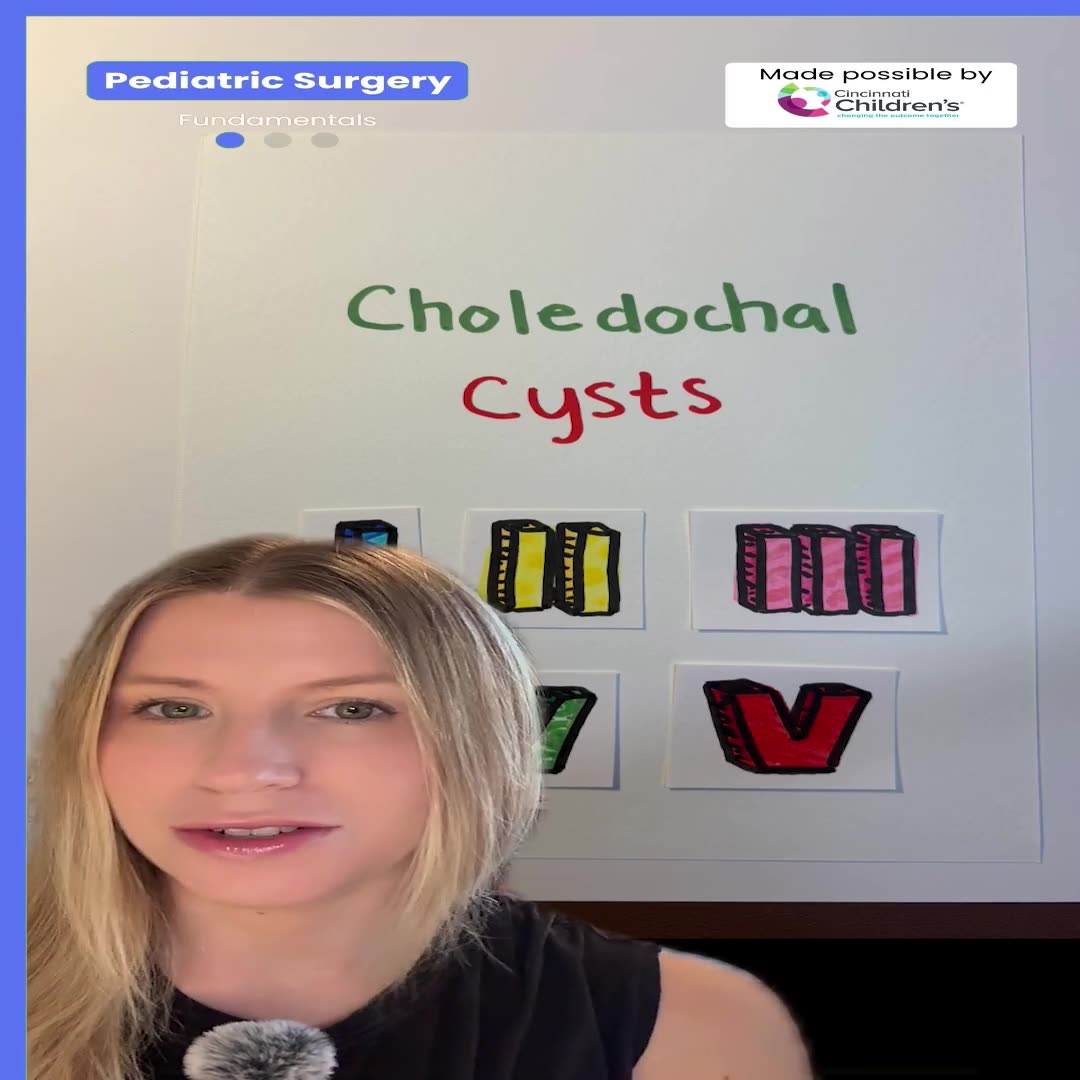
Choledochal Cyst Types Explained: Pediatric Surgery Fundamentals
1 min · Published Sep 2026
What the experts said
Pyloric stenosis presents with progressive nonbilious emesis and sometimes a palpable olive in the epigastrium.
Labs in pyloric stenosis most often demonstrate a hypochloremic, hypokalemic metabolic alkalosis.
Ultrasound criteria for pyloric stenosis are muscle width greater than 3 millimeters and length greater than 14 millimeters.
Maintenance IV fluid is started at one and a half times the maintenance rate in pyloric stenosis patients.
Potassium is added to IV fluids once urine output has been confirmed.
There is a trend in the literature that isotonic fluids should be used instead of hypotonic fluids in pediatric patients, though evidence is still developing in this age population.
Patients go to the OR for pyloromyotomy once their bicarb level is less than 30, their chloride is greater than 100, and their potassium is normal.
Postoperative management includes a short NPO period of around two hours followed by ad lib feeding with breast milk or formula.
The Dalton et al. framework from Kansas City predicts the number of fluid boluses needed based on the original chloride level, so labs do not need to be rechecked between each bolus in children likely to require two or three saline boluses.
Randomized controlled trials by Markel et al. and Adebe et al. found that ad lib feeding compared to protocolized feeding is associated with equivalent or shorter hospital stays.
Ad lib feeding may result in more emesis but there were no complications associated with that emesis in the Markel and Adebe trials.