

From
Live Event Content
Best of the Best Gen Surg - Age Exacerbates Inequity in Telemedicine Use Among GI Surgery Patients in the Deep South During the COVID-19 Pandemic - Dr. Shao
With Dr. Connie Shaw
Educational content from recorded physician discussions — not medical advice. Talk to your (or your child's) care team about your situation.
Video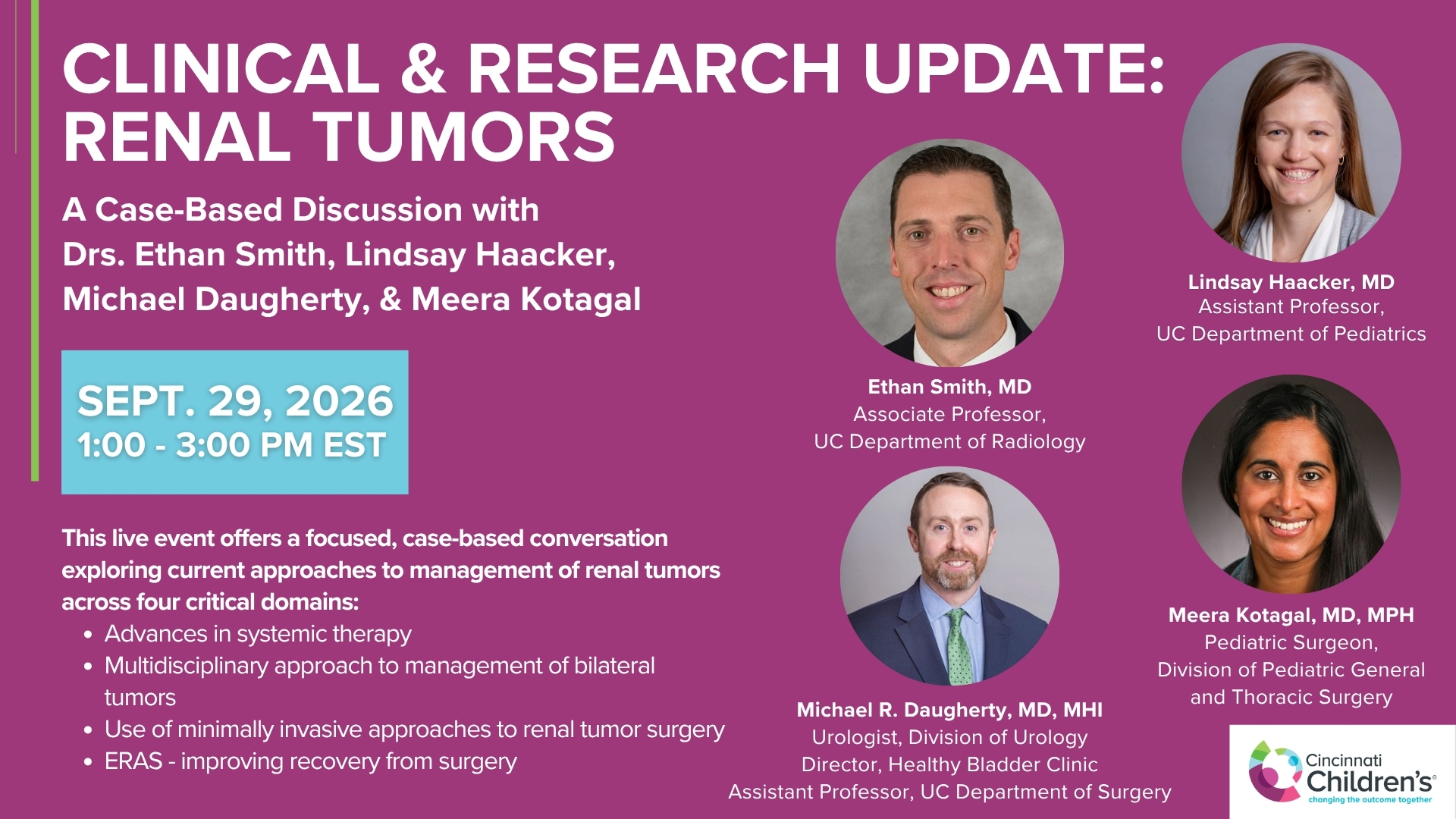
Clinical & Research Update: Renal Tumors with Drs. Ethan Smith, Lindsay Haacker, Michael Daugherty, and Meera Kotagal
71 min · Published Sep 2026
Video
Clinical & Research Update: Neuroblastoma with Drs. Katherine Somers, Cara Morin, Juan Gurria, and Meera Kotagal
67 min · Published Sep 2026
Video
Clinical & Research Update: Sarcoma w/ Drs. Roshni Dasgupta, Joseph Pressey, Arthur Meyer, Luke Pater
66 min · Published Sep 2026
Video
2026 Laparoscopic Pediatric Hernia Repair
123 min · Published Jun 2026
Video
Beyond the Spectrum: Diagnosis, Myths & Management - Caitlin Couch & Leslie Lopez - APP Conference 2026
50 min · Published May 2026
Video
Dysautonomia: Navigating the Journey - Martha Willis - APP Conference 2026
55 min · Published May 2026
What the experts said
Telemedicine visits at UAB started March 17, 2020
There were 2,580 GI surgery clinic visits at UAB from March 17 to September 30, 2020
Half of the 2,580 visits were in-person and half were via telemedicine
Of telemedicine visits, almost 60% were via phone rather than video
There were no significant differences in telemedicine use by sex or race overall
Among telemedicine users, Black patients were more likely to use phone compared to video visits
Telephone visit users were older with a mean age of 54 years compared to 50 years for video users
Age greater than 80 independently predicted telemedicine visit without video with an odds ratio of 0.37
Phone users came from zip codes with lower median income: mean of $49,000 for phone visits versus $51,000 for video visits
Patients using telemedicine were more likely to be privately insured
Among telemedicine users, phone call users were more likely to be publicly insured
Medicaid insurance was an independent predictor of having a telemedicine visit without video, with an odds ratio of 0.46
Patients who lived further from the hospital were 1.5 times as likely to use telemedicine
Among telemedicine users, those living further away were 2.3 times as likely to have a video visit
Local internet availability was not a significant factor in the study
Telemedicine use was predicted by median income of the patient's zip code and distance to the hospital
Phone use was predicted by age, Medicaid insurance, and distance to the hospital
Patient satisfaction is lower for phone visits than any other type of visit
Patient satisfaction decreases with age for phone calls but not for video calls
Satisfaction is lower for patients who must convert from a video to an audio-only call
Conversion rates from video to audio increase with age
Neither satisfaction nor conversion rates differ by race
UAB created a separate Wi-Fi network called UAB Telehealth specifically for physicians to use for reliable broadband during telemedicine visits
Phone calls are not reimbursed at the same rate as video-based telemedicine visits
FaceTime is not technically HIPAA compliant
UAB hospital system uses AW Touchpoint for telemedicine, which is integrated into the EMR
Doximity app is HIPAA-safe and does not connect to personal cell phones, can be used on computer or phone
Transportation is the number one reason why patients no-show to physician appointments
Having family members or caregivers help navigate telemedicine has been beneficial for older patients