

From
Live Event Content
BOB in Ped Surg 2023 - AAP Winner - Shelby Sferra, MD
With Dr. Shelby Sferra · hosted by Dr. Todd Ponsky
Educational content from recorded physician discussions — not medical advice. Talk to your (or your child's) care team about your situation.
Video
El momento de la reparación de la HDC en ECMO influye en el riesgo de hemorragia quirúrgica
Published Nov 2023
Video
Improving Outcomes for Congenital Diaphragmatic Hernia (CDH): Protocol Changes at Cincinnati Children's
5 min · Published Jun 2026
Video
Update Course Rewind: When & How to Operate CDH Patients on ECMO 2024 Part 2
4 min · Published Aug 2025
Video
Congenital Diaphragmatic Hernias (CDH): Improving Outcomes with Advanced Imaging & Nutrition
5 min · Published May 2026
Video
Dr. Adriana Dekirmendjian - Best of the Best in Pediatric Surgery 2025
Dr. Todd Ponsky · 9 min · Published Mar 2025
Video
EUPSA - Circular RNA profiles isolated from amniotic fluidscan distinguish between CDH survivors and non-survivers - Richard Wagner
9 min · Published May 2022
Video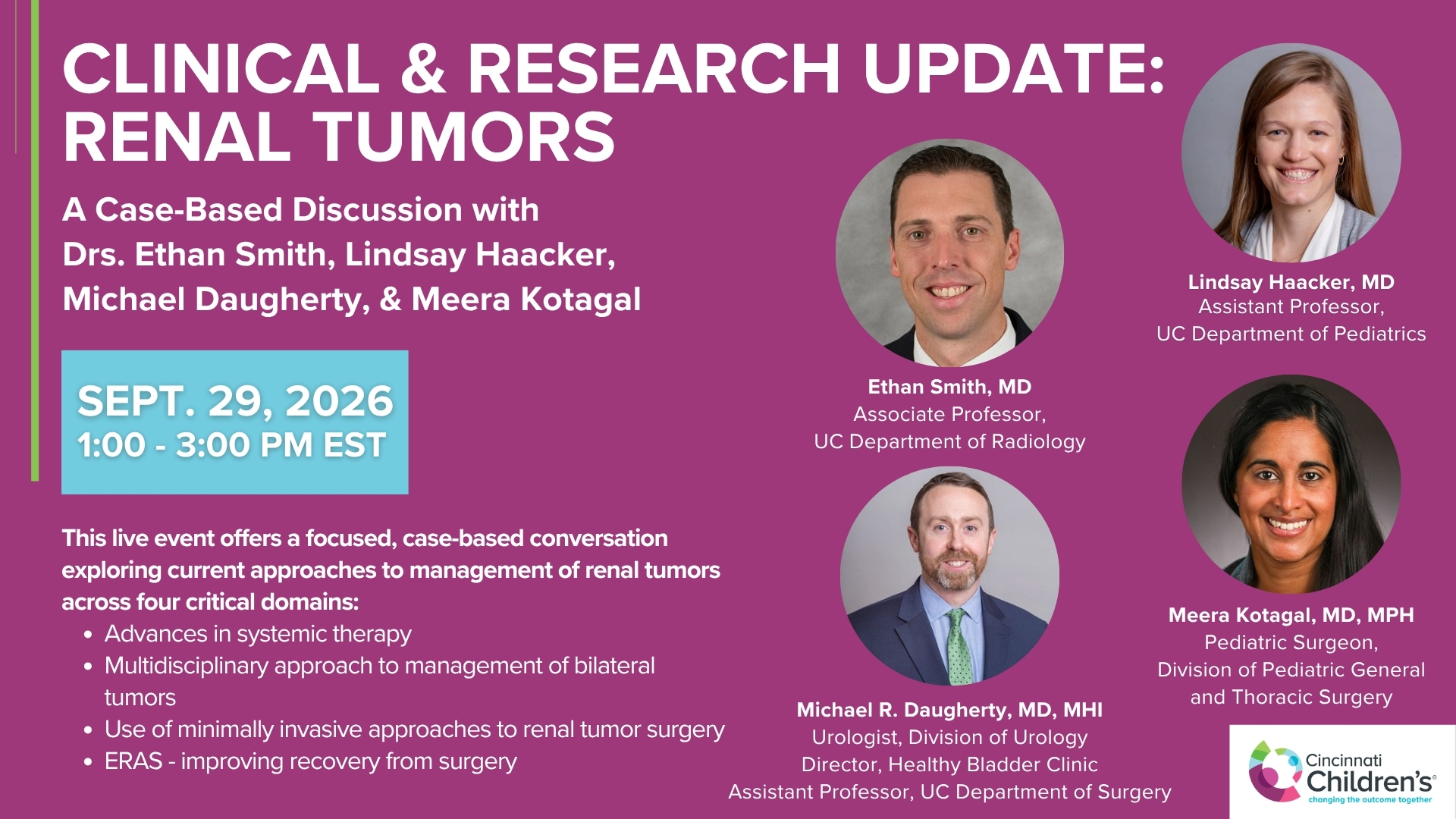
Clinical & Research Update: Renal Tumors with Drs. Ethan Smith, Lindsay Haacker, Michael Daugherty, and Meera Kotagal
71 min · Published Sep 2026
Video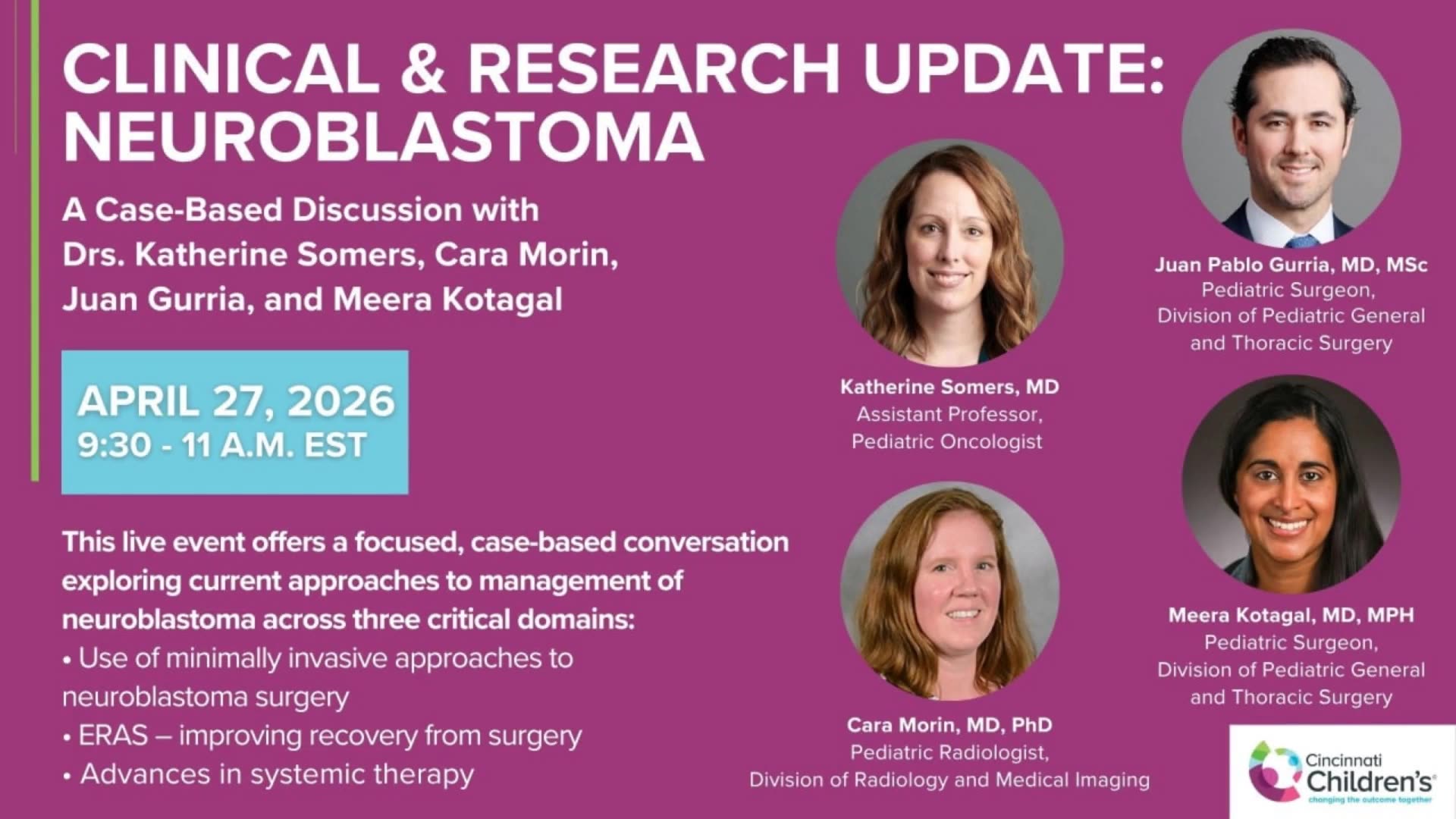
Clinical & Research Update: Neuroblastoma with Drs. Katherine Somers, Cara Morin, Juan Gurria, and Meera Kotagal
67 min · Published Sep 2026
Video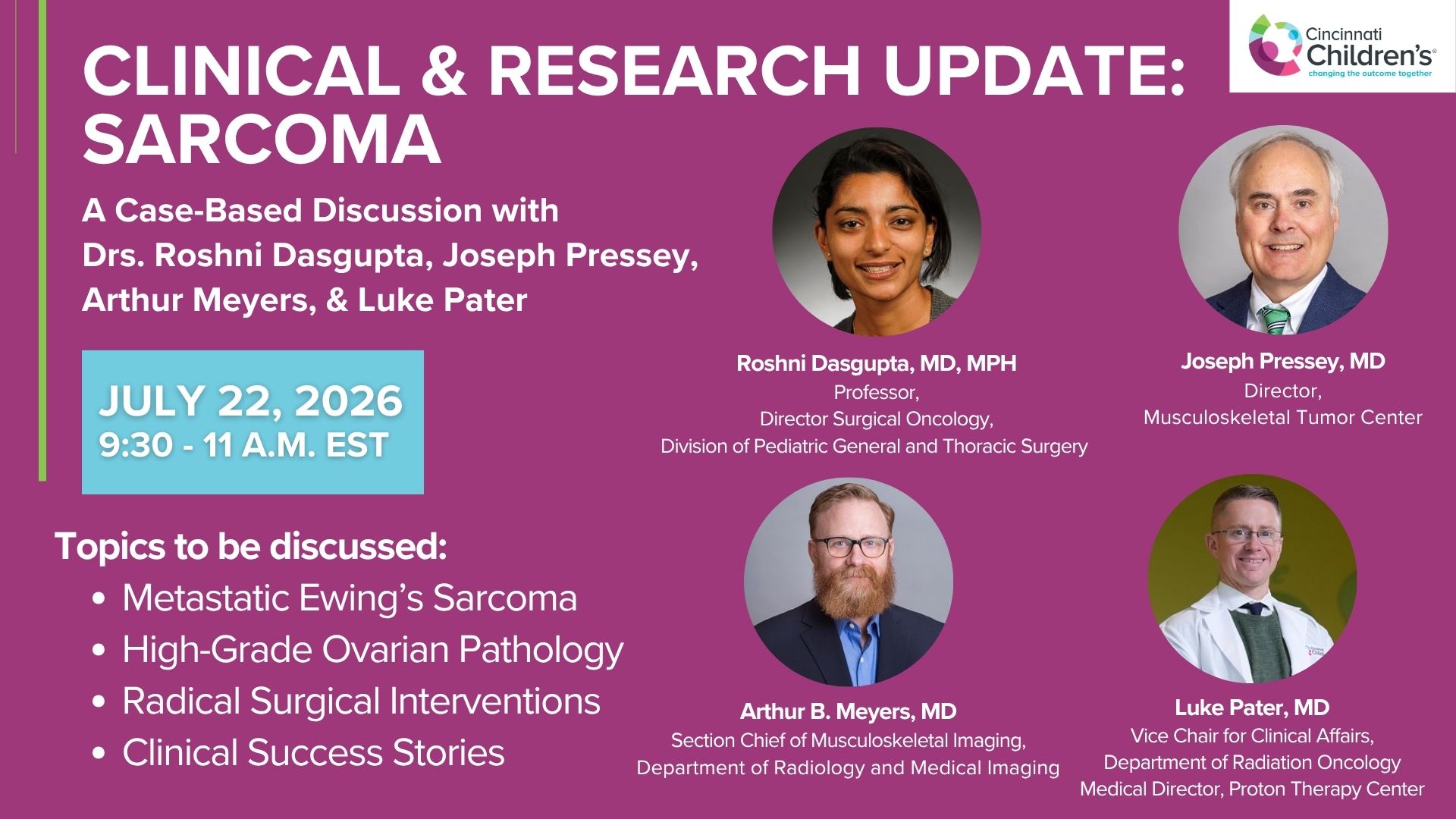
Clinical & Research Update: Sarcoma w/ Drs. Roshni Dasgupta, Joseph Pressey, Arthur Meyer, Luke Pater
66 min · Published Sep 2026
Video
2026 Laparoscopic Pediatric Hernia Repair
123 min · Published Jun 2026
Video
Beyond the Spectrum: Diagnosis, Myths & Management - Caitlin Couch & Leslie Lopez - APP Conference 2026
50 min · Published May 2026
Video
Dysautonomia: Navigating the Journey - Martha Willis - APP Conference 2026
55 min · Published May 2026
What the experts said
Health disparities driven by race and ethnicity are pervasive in healthcare and impact all aspects of pediatric care
In CDH, disparities affect care from prenatal diagnosis and surveillance through postnatal management
The study cohort included 1,625 CDH patients from PHIS database 2015-2020
Hospital volume was defined as less than 10 CDH cases per year as low volume and 10 or more cases as high volume
Institutional racial and ethnic diversity was defined as the percentage of black and/or Hispanic CDH patients treated at each institution, stratified from less than 20% to greater than 40%
Household incomes of black and Hispanic patients were significantly lower than that for white patients
White and Asian patients had primarily commercial insurance, whereas black and Hispanic patients had largely Medicaid payer status
Black patients were born at significantly lower gestational ages and were more likely to be born preterm
Black CDH patients had lower birth weights and lower Apgar scores compared to white patients
Black patients were cannulated to extracorporeal life support more often than white patients
Black CDH patients were mechanically ventilated for longer and required pulmonary anti-hypertensives for longer
These differences in disease severity were not seen in Hispanic and Asian patients when compared to white patients
Black CDH patients were admitted for significantly longer, discharged home less often, and were more likely to require a tracheostomy at discharge
Black patients had decreased in-hospital survival rates of 79% compared to 88% in white patients
Hispanic and Asian CDH patients had comparable survival rates to white patients at 88% and 92% respectively
Low institutional diversity levels (less than 20% minority patients) were associated with decreased survival in white, black, and Hispanic CDH patients
Higher levels of institutional diversity (between 31 and 40% minority patients) were associated with improved survival for white, black, and Hispanic CDH patients
Differences in survival based on institutional diversity were not observed in Asian patients
Cox regression analysis controlling for severity, socioeconomic status, and institutional covariants showed white patients had comparable outcomes regardless of institutional diversity
Institutions with greater than 30% diversity conferred a protective effect against mortality for black CDH patients treated there
Institutions with diversity greater than 20% conferred a protective effect for Hispanic CDH patients
Treating a more racially and ethnically diverse patient population improves outcomes for black and Hispanic CDH patients without negatively impacting white patients
Many of the disparities in CDH outcomes are related to socioeconomic and other issues
Existing studies show that black race is an independent risk factor for mortality in CDH and is further compounded by low socioeconomic status
Studies show that patient-physician concordance in race and ethnicity improves outcomes for minority patient populations
Patient-physician concordance has been shown to improve outcomes and survival in CDH cases