
From
Live Event Content
BOB Ped Surg 2023 - Maria Jose Rosell Echevarria, IBEROAMERICANA - Presentation
With Dr. Maria José Rossel
Educational content from recorded physician discussions — not medical advice. Talk to your (or your child's) care team about your situation.
Video
Clinical & Research Update: Renal Tumors with Drs. Ethan Smith, Lindsay Haacker, Michael Daugherty, and Meera Kotagal
71 min · Published Sep 2026
Video
Clinical & Research Update: Neuroblastoma with Drs. Katherine Somers, Cara Morin, Juan Gurria, and Meera Kotagal
67 min · Published Sep 2026
Video
Clinical & Research Update: Sarcoma w/ Drs. Roshni Dasgupta, Joseph Pressey, Arthur Meyer, Luke Pater
66 min · Published Sep 2026
Video
2026 Laparoscopic Pediatric Hernia Repair
123 min · Published Jun 2026
Video
Beyond the Spectrum: Diagnosis, Myths & Management - Caitlin Couch & Leslie Lopez - APP Conference 2026
50 min · Published May 2026
Video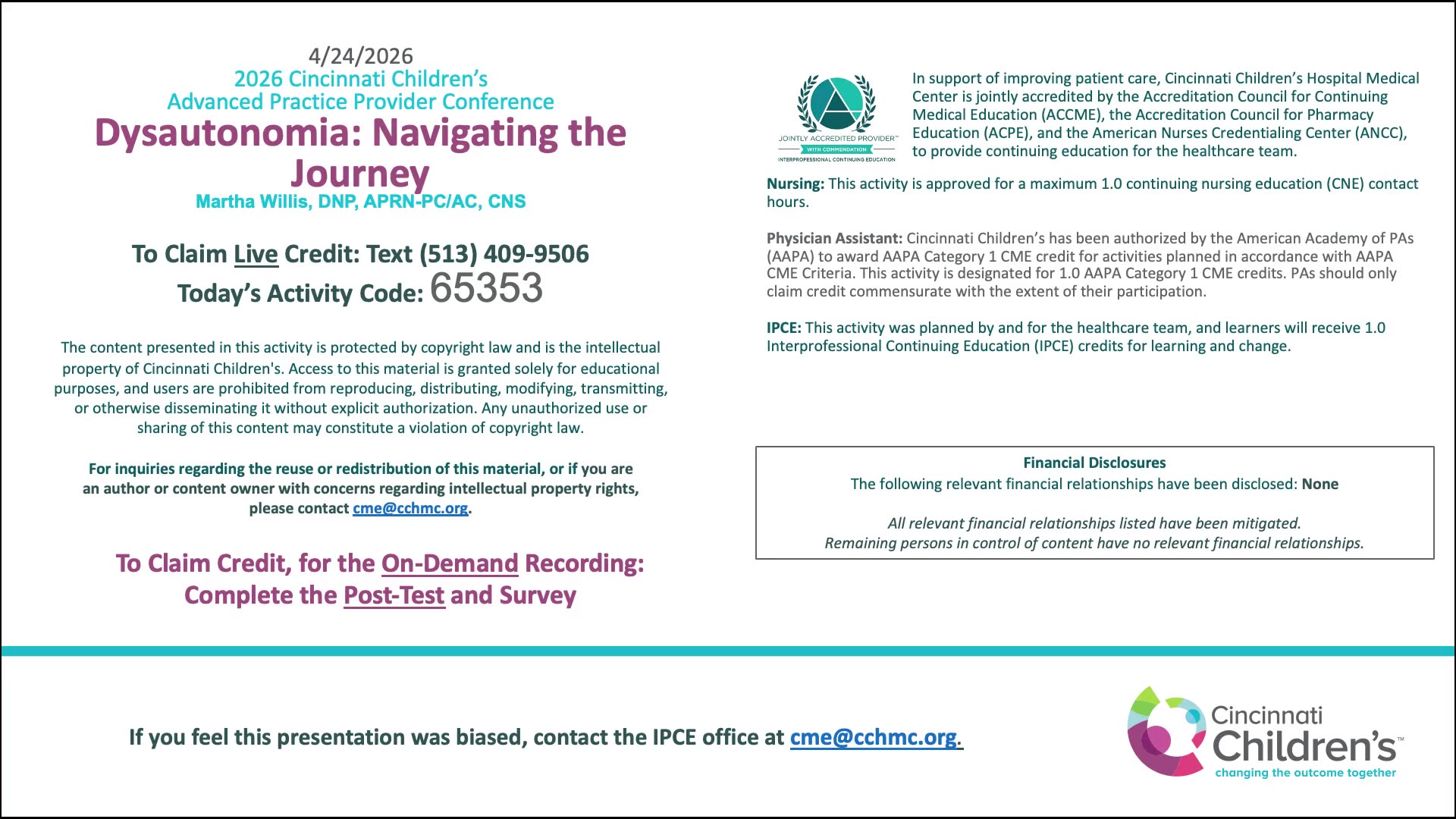
Dysautonomia: Navigating the Journey - Martha Willis - APP Conference 2026
55 min · Published May 2026
What the experts said
Ureteropelvic junction obstruction (UPJO) is a malformation of the urinary tract characterized by mechanical restriction of the physiological flow of urine from the renal pelvis to the ureter.
Persistent obstruction to urinary flow in UPJO can induce physiopathological changes on the pelvis and renal parenchyma secondary to hydrostatic hyperpressure of the urinary tract.
According to current guidelines, the preferred functional parameter of pediatric urologists in the evaluation of UPJO is the split renal function in a renogram.
The split renal function percentage in renogram does not reflect actual renal function.
The study included 71 patients with diagnosis of unilateral UPJO who underwent surgical intervention at Nuestra Señora de Candelaria University Hospital between 1980 and 2021.
Maximum urinary osmolality shows renal concentrating capacity and is dependent on hyperpressure.
Albumin-creatinine ratio shows failure of glomerular membrane selective permeability.
Increasing levels of NAG-creatinine ratio means that proximal tubule damage exists.
Maximum urinary osmolality was altered in 64% of patients at the moment of diagnosis.
Maximum urinary osmolality was altered in 53% of patients after surgery.
Maximum urinary osmolality was altered in 14% of patients at the end of follow-up.
The albumin-creatinine ratio maintained stable values throughout the study.
Compared to GFR and serum creatinine percentage, osmolality continued to be the most altered parameter.
The percentage of abnormal renal split function in renogram was lower than the alteration of renal concentrating capacity at the first and second stage of the study.
When comparing renogram split function versus renal concentrating capacity, maximum urinary osmolality remained the most altered parameter.
At the moment of diagnosis, there was a statistically significant direct correlation between maximum urinary osmolality and healthy kidney longitudinal diameter.
At diagnosis, an inverse correlation was found between maximum urinary osmolality and albumin-creatinine ratio.
At diagnosis, an inverse correlation was found between maximum urinary osmolality and NAG-creatinine ratio.
There was a significant direct correlation between maximum urinary osmolality at diagnosis and after surgery.
A significant inverse correlation was found between maximum urinary osmolality and NAG-creatinine ratio during the post-operative period.
There was a significant increase in maximum urinary osmolality values over the course of the study.
There was a significant increase in serum creatinine values over the course of the study.
There was a significant decrease in albumin-creatinine ratio along the study.
Maximum urinary osmolality is the parameter with higher sensitivity and negative predictive value for detection of impaired renal function in UPJO.
The use of basic renal function parameters avoids the inconvenience of the technique for diuretic renogram in the pediatric population.