

From
StayCurrentMD
Quick Literature Updates Episode 7
hosted by Dr. Em Tombash & Dr. Brittany Levy & Dr. Rod Gerardo
Educational content from recorded physician discussions — not medical advice. Talk to your (or your child's) care team about your situation.
Video
Does Delayed Diagnosis of Hirschsprung Disease Impact Post-operative and Functional Outcomes? A Multi-Center Review From the Pediatric Colorectal and Pelvic Learning Consortium
1 min · Published Oct 2024
Video
What is Hirschsprung's Disease? An ERNICA animation for parents and families
4 min · Published Dec 2023
Podcast
Update Course Rewind: Pediatric Colorectal Consortium 2021
14 min · Published Apr 2022
Video
Surgical treatment for Hirschsprung’s Disease: An ERNICA animation for parents and families
3 min · Published Dec 2023
Video
Quick Literature Updates Episode 17
4 min · Published Feb 2025
Podcast
The Colorectal Quiz Episode 22: Hirschsprung Disease - the Soiling Patient Part 1
19 min · Published Nov 2021
Video
Validation of an anorectal malformation trainer - Can a high-fidelity model simulate real life?
1 min · Published Jun 2026
Video
Complications and Long-Term Outcomes of Patients With Cloacal Malformation After Bowel Neovagina...
1 min · Published Jun 2026
Video
Safety and utility of long-acting steroid injection for management of post-operative stricture...
1 min · Published Jun 2026
Video
Association Between Social Determinants of Health and Choice of Urinary Reconstruction in Children
1 min · Published Jun 2026
Video
The Perineal Body Preserving PSARP (PPP)
11 min · Published Jun 2026
Video
Update Course Rewind 2025: Hirschsprung + ARM: Rare but Real
1 min · Published May 2026
Video
Intestinal Atresia Types Explained: Grossfeld Classification for Pediatric Surgery
1 min · Published Sep 2026
Video
Derivation and validation of the Pediatric Community-Acquired Pneumonia Severity (PedCAPS) score: A prospective cohort study
50 s · Published Sep 2026
Video
FETO for Late-Diagnosed Severe Congenital Diaphragmatic Hernia (CDH) at Cincinnati Children's with Dr. Beth Rymeski
4 min · Published Sep 2026
Video
Severe Congenital Diaphragmatic Hernia (CDH) Case: FETO Management & Unexpected Findings with Dr. Beth Rymeski
3 min · Published Sep 2026
Video
Fetoscopic Endoluminal Tracheal Occlusion (FETO) Procedure: Step-by-Step Guide with Dr. Beth Rymeski
4 min · Published Sep 2026
Video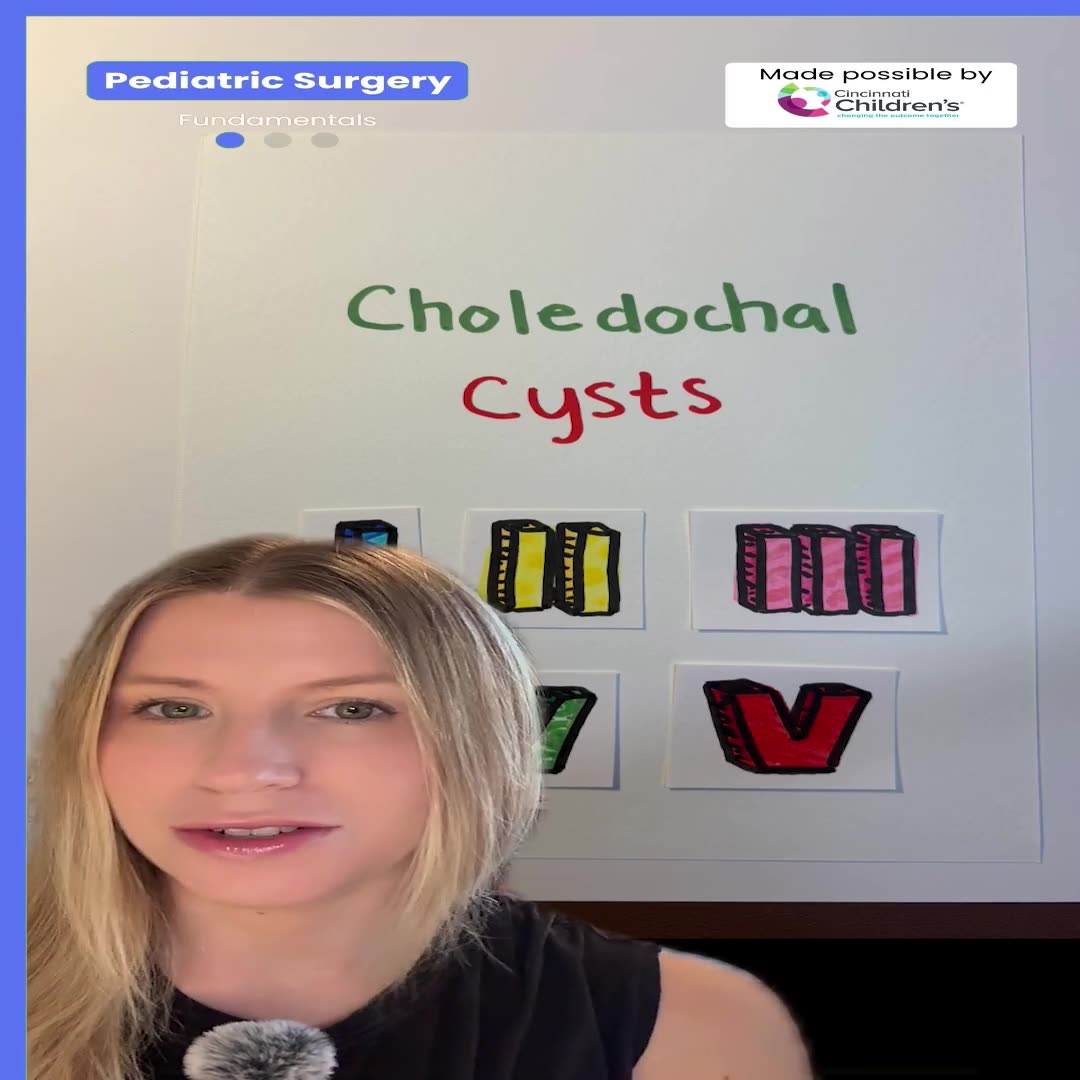
Choledochal Cyst Types Explained: Pediatric Surgery Fundamentals
1 min · Published Sep 2026
What the experts said
Allen et al. studied 277 children with Hirschsprung's disease, approximately half had Soave procedure, one-third had Duhamel, and the rest had Swenson procedure.
217 of the 277 Hirschsprung's disease patients had long-term outcome data available.
Duhamel procedure has the lowest risk of incontinence but the highest risk of constipation in school age children with Hirschsprung's disease.
Peters et al. retrospectively reviewed 55 pediatric patients with small bowel syndrome to examine whether presence or absence of ileocecal valve and/or colon can predict enteral autonomy.
Infants with an ileocecal valve had significantly shorter duration on parenteral nutrition.
Patients with less than 50% of their colon had significantly less time on parenteral nutrition as long as they had their ileocecal valve.
Olsen et al. systematic review analyzed 10 studies with 6,430 patients examining surgeon volume and pediatric thyroid surgery outcomes.
The definition of a high volume surgeon varies widely, ranging from 9 thyroidectomies per year to over 200 thyroidectomies with at least 30 being in pediatric patients.
Thyroidectomies performed by high volume surgeons show shorter length of stays.
Tendon et al. conducted a prospective randomized control trial between 2017 and 2018 comparing three skin closure methods: sutures with tissue adhesive, sutures with adhesive tape, and sutures alone.
Wounds were assessed at two weeks, six weeks, and more than six months after operation by surveying clinicians and parents.
Wounds with tissue adhesive had poorer cosmesis at six weeks compared to other closure methods.
The cosmesis difference between tissue adhesive and other closure methods disappears by six months.
At six months, there was no difference in wound outcomes between the three closure groups for either clinicians or parents.