

From
StayCurrentMD
Quick Literature Updates Episode 12
hosted by Dr. Em Tombash & Dr. Alex Halpern & Dr. Cecilia Hijena
Part of
Choledocholithiasis 7 items
Educational content from recorded physician discussions — not medical advice. Talk to your (or your child's) care team about your situation.
Video
Multi-Institutional Analysis of Choledocholithiasis in Pediatric vs Adult Patients
59 s · Published Mar 2025
Podcast
Choledocholithiasis with Drs. David Vitale & Lucas Neff
15 min · Published Jul 2024
Podcast
Case-Based Journal Review: Cholelithiasis 2024
18 min · Published Jul 2024
Video
Transcystic Laparoscopic Common Bile Duct Exploration for Pediatric Patients with Choledocholithiasis
1 min · Published May 2024
Video
Acute Cholecystitis
Todd Ponsky · 32 min · Published Jul 2026
Video
SAGES/ALACE Symposium: Integrating New Technologies, Old Tricks, and Operative Approaches
Jeffrey Ponsky · 12 min · Published Mar 2012
Video
Intestinal Atresia Types Explained: Grossfeld Classification for Pediatric Surgery
1 min · Published Sep 2026
Video
Derivation and validation of the Pediatric Community-Acquired Pneumonia Severity (PedCAPS) score: A prospective cohort study
50 s · Published Sep 2026
Video
FETO for Late-Diagnosed Severe Congenital Diaphragmatic Hernia (CDH) at Cincinnati Children's with Dr. Beth Rymeski
4 min · Published Sep 2026
Video
Severe Congenital Diaphragmatic Hernia (CDH) Case: FETO Management & Unexpected Findings with Dr. Beth Rymeski
3 min · Published Sep 2026
Video
Fetoscopic Endoluminal Tracheal Occlusion (FETO) Procedure: Step-by-Step Guide with Dr. Beth Rymeski
4 min · Published Sep 2026
Video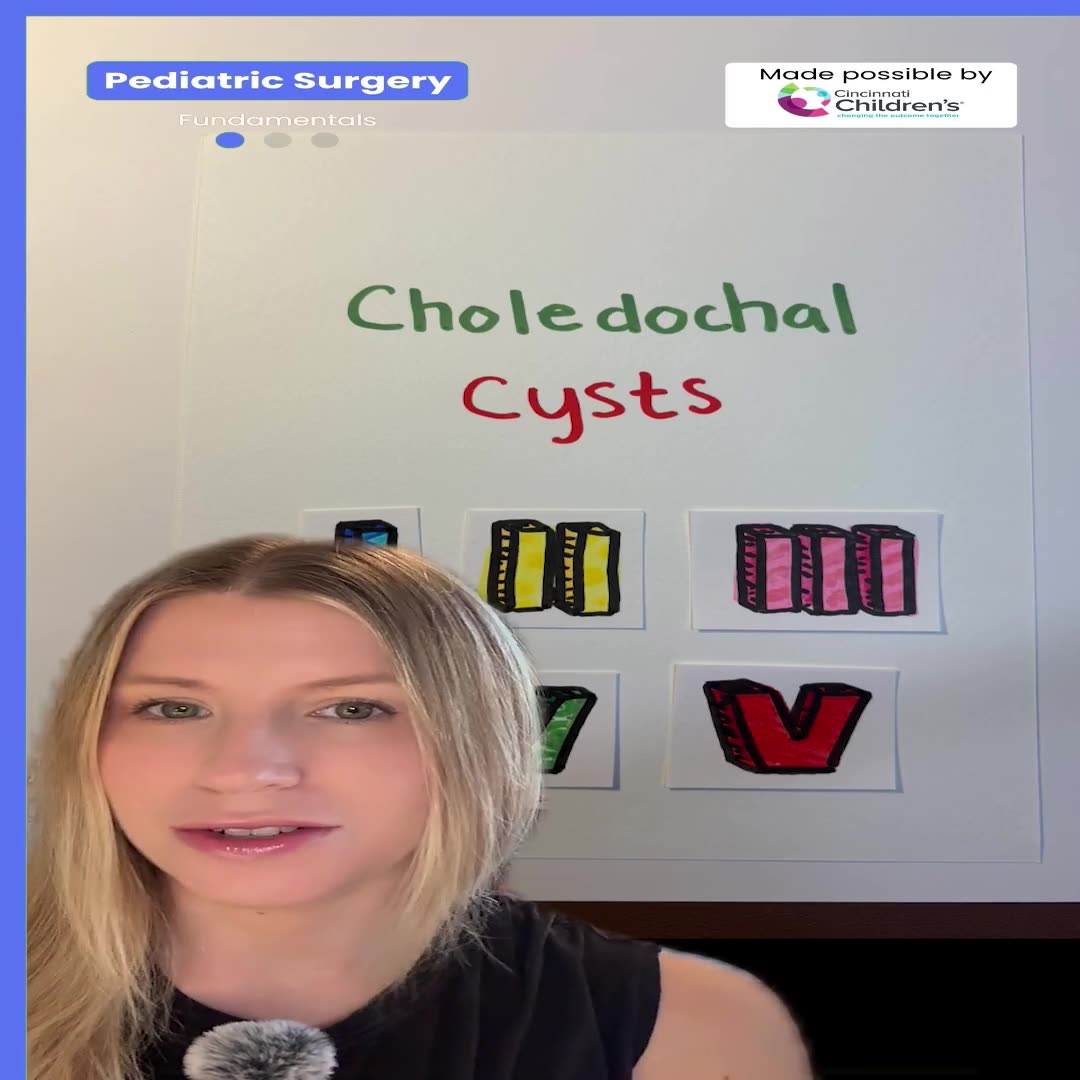
Choledochal Cyst Types Explained: Pediatric Surgery Fundamentals
1 min · Published Sep 2026
What the experts said
The Raugh et al. study reviewed laparoscopic common bile duct exploration with balloon sphincteroplasty for pediatric choledocholithiasis at their institution between 2018 and 2021.
Balloon sphincteroplasty was associated with increased operative time.
Balloon sphincteroplasty was associated with 100% success rate, meaning those patients didn't need an ERCP after the procedure.
Some patients who had laparoscopic common bile duct exploration with standard techniques (no balloon sphincteroplasty) did need an ERCP after the procedure.
Laparoscopic cholecystectomy with ERCP was associated with increased length of hospital stay and more complications like stent placements and stent migration.
For pediatric patients with choledocholithiasis, laparoscopic common bile duct exploration combined with balloon sphincteroplasty can be associated with decreased hospital length of stay and decreased complications.
There are no clear guidelines as to whether obtunded pediatric patients found down without a known traumatic mechanism of injury should be placed in a cervical collar.
C-collars don't come without risks.
The incidence of C-spine injury in obtunded pediatric patients without known traumatic mechanism is very low.
Dr. Grant and her team from Penn State performed a 10-year retrospective chart review of 464 obtunded pediatric patients without a known traumatic mechanism of injury who presented to their pediatric ICU.
8.4% of the 464 obtunded pediatric patients were placed in C-collars.
Kids placed in C-collars received significantly more imaging.
There was zero C-spine injuries in the entire patient cohort of 464 obtunded pediatric patients without known traumatic mechanism.
The Treider et al. study is a retrospective study done in Norway between 2003 and 2020 that analyzed 100 patients with congenital duodenal obstruction.
37% of the 100 patients received a transanastomotic feeding tube after congenital duodenal obstruction repair.
Patients with a transanastomotic feeding tube had two days less of TPN.
Patients with a transanastomotic feeding tube started oral feeding 1.5 days earlier.
Patients with a transanastomotic feeding tube got fewer central venous catheters.
Transanastomotic feeding tubes are beneficial in patients with congenital duodenal obstruction.