
From
EUPSA/ERNICA
Surgical treatment for Hirschsprung’s Disease: An ERNICA animation for parents and families
Educational content from recorded physician discussions — not medical advice. Talk to your (or your child's) care team about your situation.
Video
Panel Discussion and Case Presentation Part II: Pediatric Bowel Management 2013
Dr. Todd Ponsky · 33 min · Published May 2013
Podcast
Hirschsprung Disease Audience Q&A with Dr. Marc Levitt
12 min · Published Apr 2017
Podcast
The Colorectal Quiz Episode 20: Hirschsprung Disease Obstruction Part 2
21 min · Published Sep 2021
Podcast
Colorectal Quiz: Episode 46
Marc Levitt · 29 min · Published Apr 2025
Podcast
The Colorectal Quiz Episode 4
Marc Levitt · 19 min · Published Feb 2021
Podcast
Hirschsprung
Marc Levitt · 22 min · Published Jun 2019
Video
Validation of an anorectal malformation trainer - Can a high-fidelity model simulate real life?
1 min · Published Jun 2026
Video
Complications and Long-Term Outcomes of Patients With Cloacal Malformation After Bowel Neovagina...
1 min · Published Jun 2026
Video
Safety and utility of long-acting steroid injection for management of post-operative stricture...
1 min · Published Jun 2026
Video
Association Between Social Determinants of Health and Choice of Urinary Reconstruction in Children
1 min · Published Jun 2026
Video
The Perineal Body Preserving PSARP (PPP)
11 min · Published Jun 2026
Video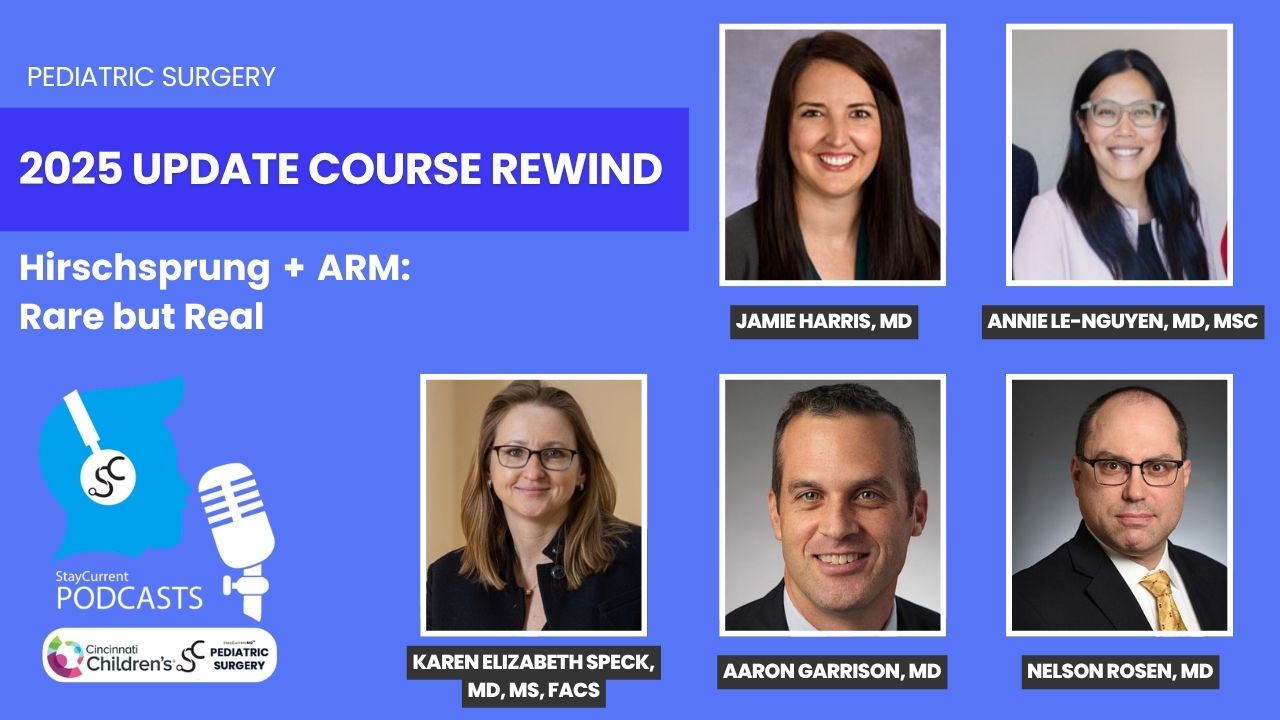
Update Course Rewind 2025: Hirschsprung + ARM: Rare but Real
1 min · Published May 2026
Video
What is Gastroschisis? An ERNICA animation for parents and families
2 min · Published Dec 2023
Video
What is Omphalocele? An ERNICA animation for parents and families
3 min · Published Dec 2023
Video
What is Congenital Diaphragmatic Hernia (CDH)? An ERNICA animation for parents and families
3 min · Published Dec 2023
Video
What is small bowel atresia?: An ERNICA animation for parents and families
4 min · Published Dec 2023
Video
Hirschsprung-associated enterocolitis in children: An ERNICA animation for parents and families
3 min · Published Dec 2023
Video
How is Hirschsprung's Disease diagnosed? An ERNICA animation for parents and families
3 min · Published Dec 2023
What the experts said
Hirschsprung's disease is also known as agangliosis of the colon
Surgical removal of the affected part is usually performed 2 to 3 months after diagnosis, when the baby is strong enough and growing well
Surgery is performed when there are no signs of enterocolitis (inflammation of the bowel)
The aim of surgery is to remove the aganglionic bowel, which is the affected part of the bowel with no ganglion cells present
The transition zone should be removed, which is the area of the bowel between the aganglionic part and the part containing a normal amount of ganglion cells (ganglionic bowel)
The remaining part of the bowel is connected to the anal canal in a pull-through procedure to restore the movement of feces
During the operation, tissue samples can be taken to confirm the presence of ganglion cells
The procedure used to be done by open surgery with a large incision in the outside skin
Nowadays, when possible, the procedure is done transanally (via the anal canal), sometimes assisted by laparoscopy
Different pull-through techniques include the transanal pull-through technique and the Swenson, Duhamel, and Soave procedures
The surgical techniques used depend on the child, the length of the affected bowel area, the surgeon's preference, and hospital resources
Preservation of the anal canal is crucial in order to maintain continence
After surgery, it is important that the new connection between the bowel and anal canal is unobstructed and that surgical wounds heal well
After surgery, developing babies may experience ongoing difficulties including constipation (difficulty passing feces) and lack of control over bowel movements
Sometimes support with bowel management is necessary after surgery
After surgery, individuals with Hirschsprung's disease may remain prone to bowel infections known as enterocolitis
Structured regular follow-up care by a multidisciplinary team (MDT) of different clinical specialists is essential for babies with Hirschsprung's disease
Identifying any complications or difficulties early is very important
Symptoms after corrective surgery can improve as children grow older