

From
Live Event Content
Preoperative Optimization and Management - Caren Mangarelli, MD - 2024 Pediatric Bariatric Surgery Update Course
With Dr. Karen Mangarelli
Part of
Obesity 30 items
Educational content from recorded physician discussions — not medical advice. Talk to your (or your child's) care team about your situation.
Video
Marc Michalsky, MD - 2024 Pediatric Bariatric Surgery Update Course
14 min · Published Feb 2024
Video
Stephanie Walsh, MD - 2024 Pediatric Bariatric Surgery Update Course
16 min · Published Feb 2024
Video
Bariatric surgery has improved remission of DMII and HTN when performed...
Published Aug 2019
Video
Justin Ryder, MD- 2024 Pediatric Bariatric Surgery Update Course
12 min · Published Feb 2024
Video
Wrap Up Discussions - 2024 Pediatric Bariatric Surgery Update Course
13 min · Published Feb 2024
Video
StayCurrent Forums - Obesity in Children
Dr. Todd Ponsky · Published Apr 2022
Only a few other public items share this expert — go deeper there →
Video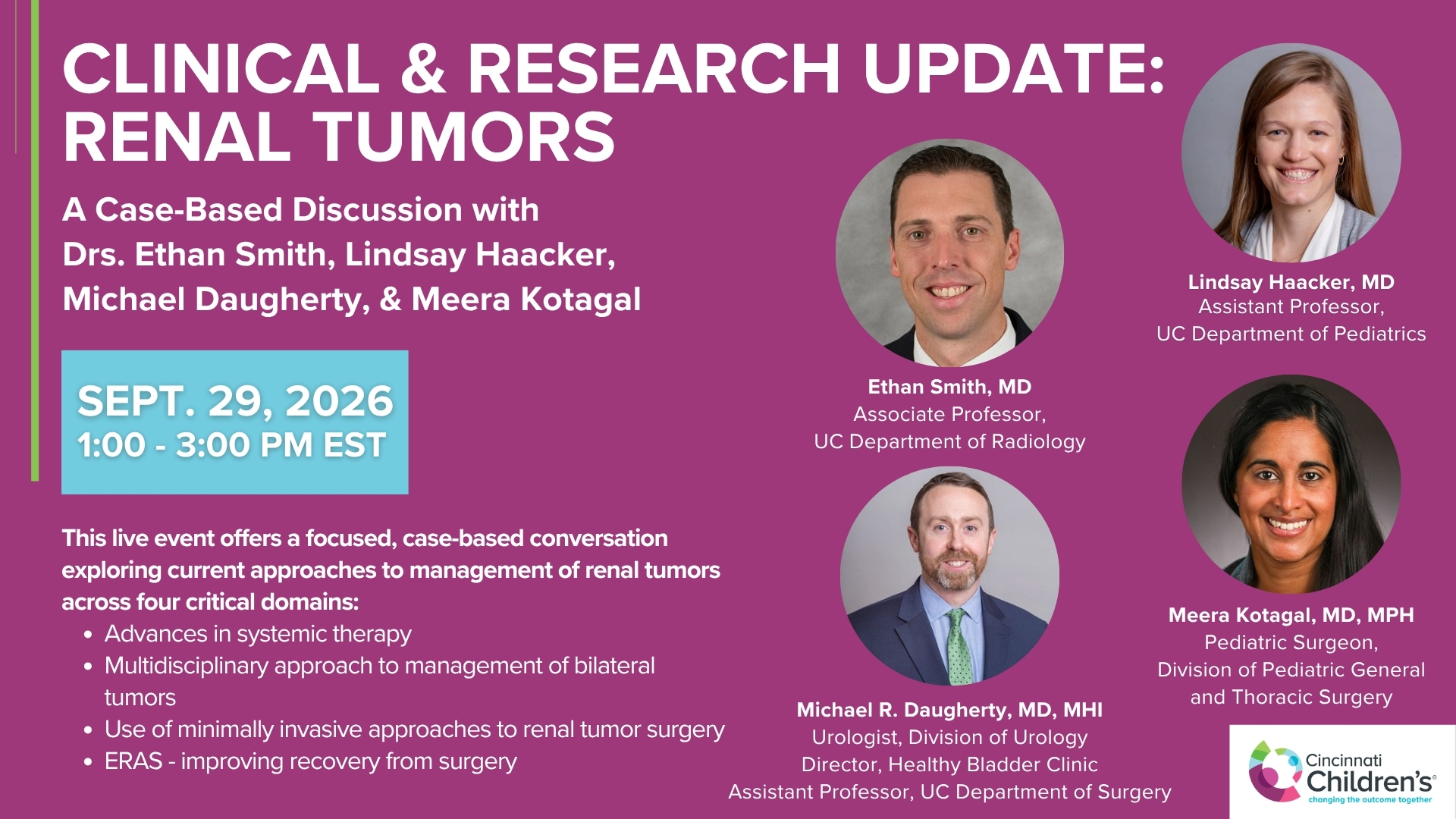
Clinical & Research Update: Renal Tumors with Drs. Ethan Smith, Lindsay Haacker, Michael Daugherty, and Meera Kotagal
71 min · Published Sep 2026
Video
Clinical & Research Update: Neuroblastoma with Drs. Katherine Somers, Cara Morin, Juan Gurria, and Meera Kotagal
67 min · Published Sep 2026
Video
Clinical & Research Update: Sarcoma w/ Drs. Roshni Dasgupta, Joseph Pressey, Arthur Meyer, Luke Pater
66 min · Published Sep 2026
Video
2026 Laparoscopic Pediatric Hernia Repair
123 min · Published Jun 2026
Video
Beyond the Spectrum: Diagnosis, Myths & Management - Caitlin Couch & Leslie Lopez - APP Conference 2026
50 min · Published May 2026
Video
Dysautonomia: Navigating the Journey - Martha Willis - APP Conference 2026
55 min · Published May 2026
What the experts said
The 2019 AAP technical report and policy statement on bariatric surgery established selection criteria that were less conservative than previous guidelines and more aligned with adult criteria.
Pediatric bariatric surgery candidates include patients with BMI ≥40 or ≥140% of the 95th percentile (whichever is lower), or BMI ≥35 or ≥120% of the 95th percentile (whichever is lower) with a comorbid condition.
The 2019 AAP guidelines removed a minimum age limit for bariatric surgery and recommended case-by-case consideration of special populations including those with developmental disability or cognitive impairment, rather than automatic exclusion.
Essential multidisciplinary team members for pediatric bariatric surgery are surgeon, medical specialist, behavioral/mental health specialist, and registered dietitian.
Since December 2020, the FDA has approved three new medications for obesity treatment in patients 12 years and older, including two GLP-1 agonists.
The American Society of Anesthesiologists recently issued consensus-based guidance recommending that daily GLP-1 medications be held on the day of procedure and weekly GLP-1 medications be held one week prior to procedure, regardless of whether used for diabetes or obesity.
GLP-1 medications work in part by slowing gastric emptying, raising theoretical and practical concerns about regurgitation and pulmonary aspiration of gastric contents perioperatively.
In the Teen-LABS 5-year data, micronutrient deficiencies occurred postoperatively, with iron being the most common deficiency both pre- and postoperatively, and the percentage of patients with deficiencies increased over time.
Dr. Mangarelli's program has screened preoperatively for iron and vitamin D specifically, but is considering expanding screening after encountering postoperative cases of thiamine (B1) and folate deficiency.
In Dr. Mangarelli's inner-city patient population in a state where marijuana is legal recreationally and medicinally, marijuana use is common among adolescent bariatric surgery candidates.
Some bariatric programs require complete abstinence from substances before proceeding with surgery, but Dr. Mangarelli's team has adopted a harm reduction approach rather than denying surgery to patients who may need it for medical reasons.
Short-term studies (up to 2 years) in adult populations have not shown that bariatric surgery outcomes differ in patients who disclosed marijuana use.
Two current patients in Dr. Mangarelli's program disclosed regular marijuana use for self-medicating anxiety disorders, and anxiety disorders have increased approximately fourfold pre- versus post-COVID.
Teen-LABS data show that alcohol use disorder is not uncommon postoperatively in pediatric bariatric surgery patients.
Some insurance companies, particularly CMS, require drug screens for bariatric surgery candidates and may deny coverage if results are positive.
At least one insurer has treated marijuana use similarly to nicotine smoking and requested ABG and pulmonary function tests for bariatric surgery candidates.
The adult bariatric establishment is more concerned about wound healing related to substance use than the pediatric bariatric community typically is.
Nicotine use leads to ulcers after gastric bypass, making it contraindicated in bypass patients, but this is less of a concern with sleeve gastrectomy.
Excess cannabis use can lead to cannabis hyperemesis syndrome, causing continuous vomiting.
A 2019 study published in Surgery for Obesity and Related Diseases examined phentermine and topiramate use before and after sleeve gastrectomy in adults with BMI >50 and found no negative signal; there was greater weight loss preoperatively and postoperatively when medications were continued.
Rapid gastric emptying induced by sleeve gastrectomy is believed to be part of the mechanism by which the sleeve increases GLP-1 levels.
There is theoretical concern that preoperative GLP-1 use, which slows gastric emptying, could cause receptor upregulation or downregulation that interferes with postoperative bariatric surgery outcomes, but no data currently exist on this question.
In the future, almost every patient will likely receive some combination of GLP-1 or multi-agonist medications and surgery, making the distinction between surgical versus medication-driven weight loss less clinically relevant if total health benefit is equivalent.