

From
Live Event Content
Toshio Harumatsu, MD, PhD - Best of the Best in Pediatric Surgery 2024
With Dr. Toshio Harumatsu
Part of
Persistent Cloaca 6 items
Educational content from recorded physician discussions — not medical advice. Talk to your (or your child's) care team about your situation.
Video
Heat 1 Winner: Dariusz Patkowski, MD, PhD - Best of the Best in Pediatric Surgery 2024
2 min · Published Feb 2024
Video
Cloacal Endoscopy
2 min · Published Feb 2020
Podcast
Gynecologic care in patients with anorectal malformations: A primer and call to action
18 min · Published Sep 2026
Podcast
Methods of gynecologic evaluation for patients with anorectal malformations
21 min · Published Sep 2026
Podcast
Pre-pubertal gynecologic evaluation and management of patients with anorectal malformations
23 min · Published Sep 2026
Only a few other public items share this expert — go deeper there →
Video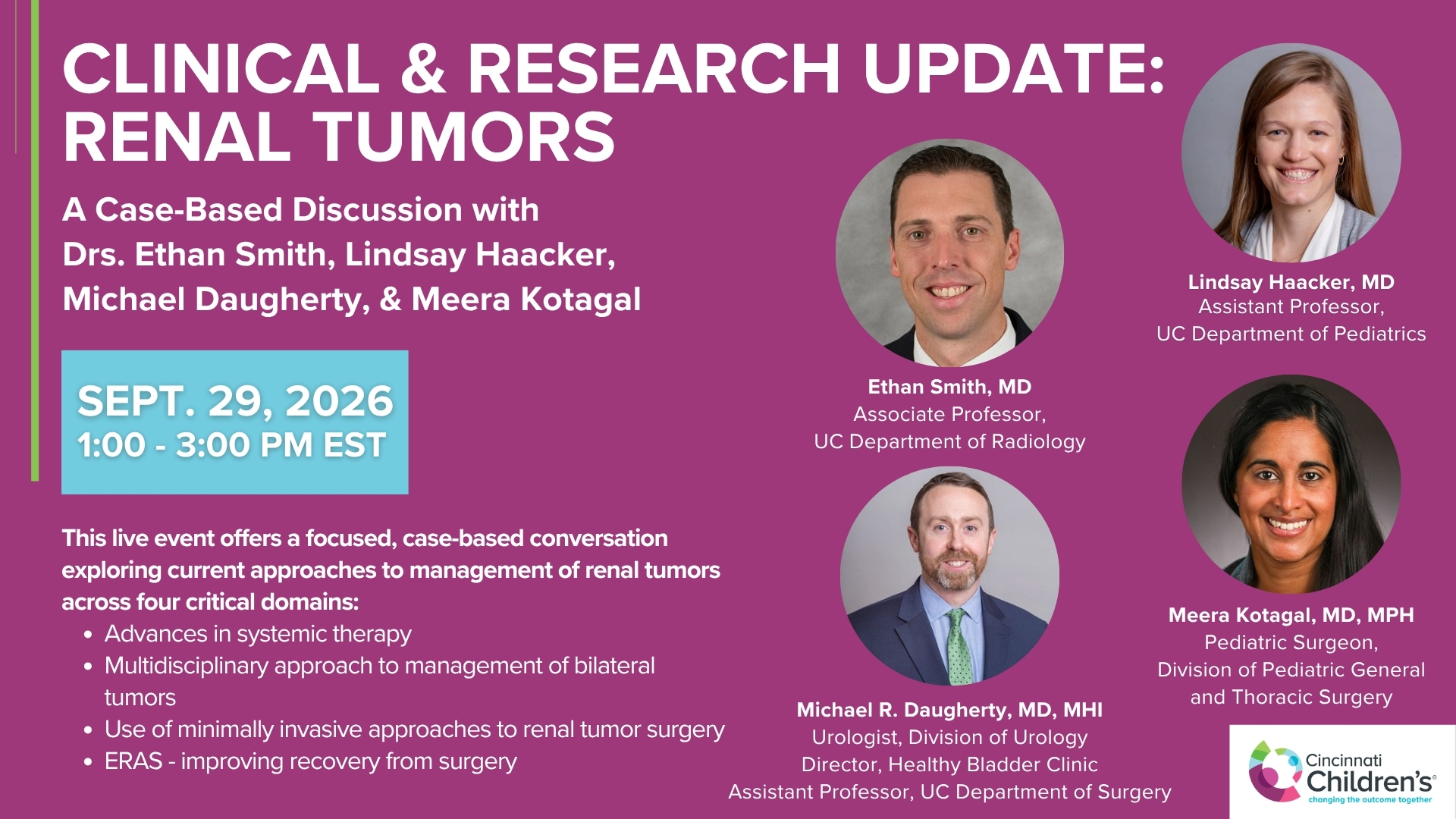
Clinical & Research Update: Renal Tumors with Drs. Ethan Smith, Lindsay Haacker, Michael Daugherty, and Meera Kotagal
71 min · Published Sep 2026
Video
Clinical & Research Update: Neuroblastoma with Drs. Katherine Somers, Cara Morin, Juan Gurria, and Meera Kotagal
67 min · Published Sep 2026
Video
Clinical & Research Update: Sarcoma w/ Drs. Roshni Dasgupta, Joseph Pressey, Arthur Meyer, Luke Pater
66 min · Published Sep 2026
Video
2026 Laparoscopic Pediatric Hernia Repair
123 min · Published Jun 2026
Video
Beyond the Spectrum: Diagnosis, Myths & Management - Caitlin Couch & Leslie Lopez - APP Conference 2026
50 min · Published May 2026
Video
Dysautonomia: Navigating the Journey - Martha Willis - APP Conference 2026
55 min · Published May 2026
What the experts said
213 persistent cloaca patients who responded to a questionnaire were enrolled in the study
The age at anorectoplasty of patients with defecation problems was significantly younger compared to patients without defecation problems
Multivariable logistic analysis shows that sacral agenesis independently increases the risk of defecation problems in persistent cloaca patients
Persistent cloaca patients who underwent oral administration of laxatives and antegrade continence enema independently had defecation problems
24% of persistent cloaca patients had sacral agenesis in the study
Regular laxatives and regular enema are good ways to achieve good bowel function in persistent cloaca patients with sacral agenesis
Sacral agenesis has been reported as an anomaly associated with bowel function, and in cases with imperforate anus, bowel management was less effective
Understanding sacral agenesis as a risk factor helps clinicians anticipate defecation problems in persistent cloaca patients