

From
StayCurrentMD
QUAD #7 Anesthesia for Thoracoscopic Techniques with Dr. Nathaniel Tighe
With Dr. Nathan Tighe · hosted by Dr. Em Gootee
Educational content from recorded physician discussions — not medical advice. Talk to your (or your child's) care team about your situation.
Video
Posterior Tracheopexy during Primary Esophageal Atresia Repair
Published Sep 2018
Video
Quick Literature Updates Ep 27
4 min · Published Feb 2026
Podcast
IFMSS 2019 Clinical Studies
19 min · Published Nov 2022
Video
Finnish Pediatric Surgery Hub - From Centralization to Collective Learning and Sharing of Expertise
48 s · Published Feb 2025
Video
Prophylactic Acid-suppression Medication to Prevent Anastomotic Strictures After Oesophageal Atresia Surgery
Published Dec 2023
Video
Esophageal Surveillance Practices in Esophageal Atresia Patients
Published Jul 2023
Video
Surgeon annual volume impacts recurrence rates of pediatric inguinal hernia repairs: A multi-institutional study
54 s · Published Feb 2026
Podcast
Journal of Pediatric Surgery Article Review: 2nd Quarter (Apr-Jun) 2025
16 min · Published Aug 2025
Video
Tracheobronchopexy to Avoid Tracheostomy in Esophageal Atresia Patients With Severe Life-Threatening Tracheobronchomalacia
50 s · Published Apr 2025
Video
QUAD #27 - Multidisciplinary - How Do Teams Enhance Outcomes by the CCHMC ADEC Team
CCHMC Pediatric Surgery · 10 min · Published Apr 2025
Video
QUAD #25: Medical Management of Minor Laryngeal Clefts with Dr. Greg Burg
CCHMC Pediatric Surgery · 7 min · Published Feb 2025
Video
QUAD #22: What is CHARGE syndrome? with Dr. Catherine Hart
CCHMC Pediatric Surgery · 59 s · Published Dec 2024
Only a few other public items share this expert — go deeper there →
Video
Intestinal Atresia Types Explained: Grossfeld Classification for Pediatric Surgery
1 min · Published Sep 2026
Video
Derivation and validation of the Pediatric Community-Acquired Pneumonia Severity (PedCAPS) score: A prospective cohort study
50 s · Published Sep 2026
Video
FETO for Late-Diagnosed Severe Congenital Diaphragmatic Hernia (CDH) at Cincinnati Children's with Dr. Beth Rymeski
4 min · Published Sep 2026
Video
Severe Congenital Diaphragmatic Hernia (CDH) Case: FETO Management & Unexpected Findings with Dr. Beth Rymeski
3 min · Published Sep 2026
Video
Fetoscopic Endoluminal Tracheal Occlusion (FETO) Procedure: Step-by-Step Guide with Dr. Beth Rymeski
4 min · Published Sep 2026
Video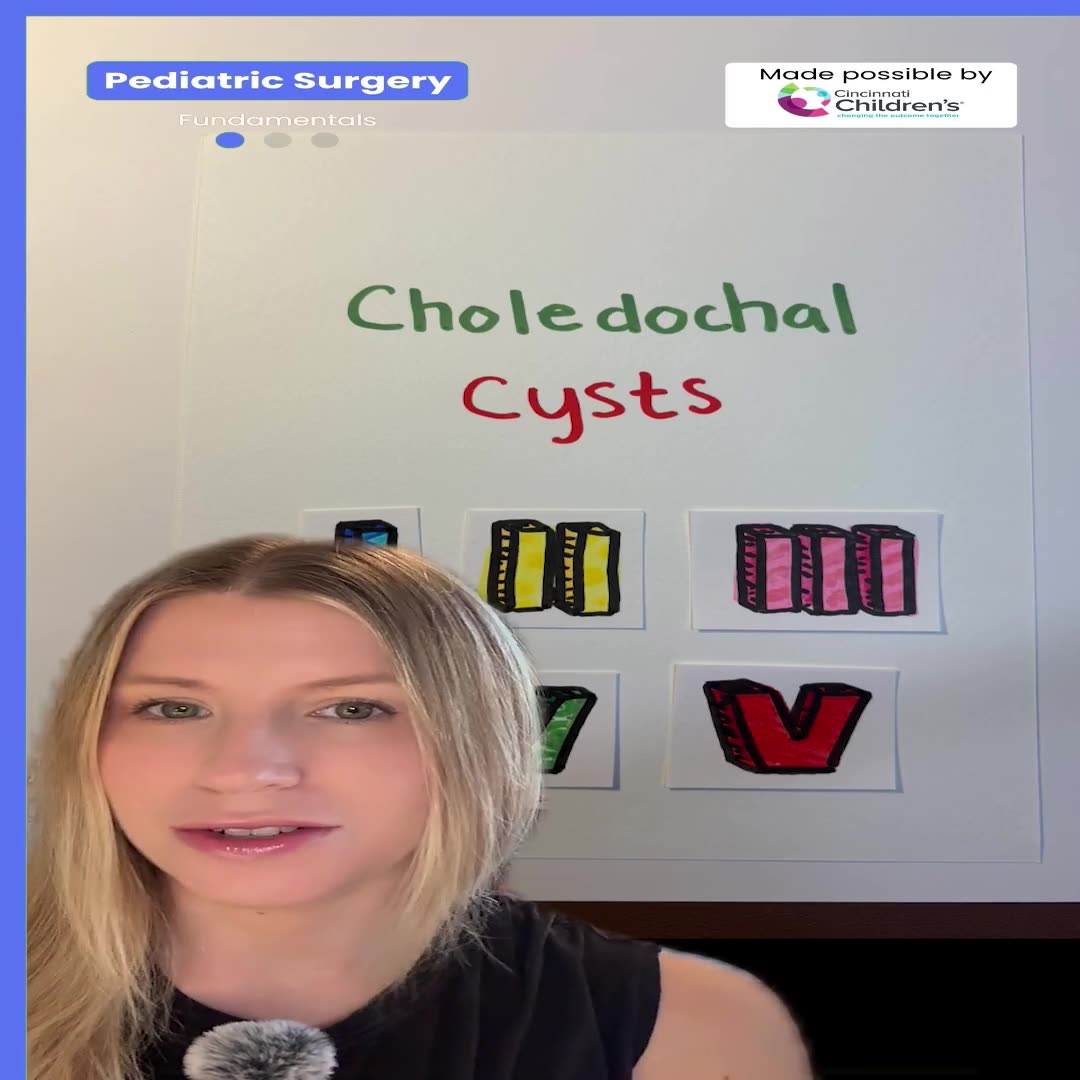
Choledochal Cyst Types Explained: Pediatric Surgery Fundamentals
1 min · Published Sep 2026
What the experts said
Birth history and patient size are important preoperative considerations for esophageal atresia repair.
Physiologic status from ventilation and cardiac standpoints is particularly important in preoperative assessment.
Preoperative visualization of the child's airway allows better decision-making and potentially less time under anesthesia.
Akinesis (keeping children still) can be very challenging in small children, especially when intraoperative neuromonitoring is involved.
Intraoperative neuromonitoring precludes the use of neuromuscular blocking drugs like rocuronium and vecuronium.
Patients with compliance abnormalities often require higher peak inspiratory or mean airway pressures, resulting in the need for very high insufflation pressures.
Lung isolation utility is restricted by patient size and airway anatomy and requires expertise and specialized equipment.
Three dimensions are important for lung isolation: tracheal diameter (particularly AP diameter), bronchial diameters, and the length of the right main stem bronchus between carina and right upper lobe takeoff.
Regular endotracheal tube is the most common device for lung isolation in neonates because it is relatively straightforward to mainstem into the left bronchus, which has a good landing zone for the balloon.
Bronchial blockers or Fogarty catheters require enough space between the carina and right upper lobe takeoff for balloon placement.
In kids with a pig bronchus, bronchial blocker placement becomes very difficult and may require selective lobar blockade.
Bronchial blockers can be helpful in kids with abnormal parenchyma when higher ventilatory pressures are needed but higher insufflation pressures should be avoided.
Unrepaired single ventricle patients are sensitive to changes in ventilation because they can have swings in circulation direction based on pulmonary vascular resistance.
Insufflation causes changes in preload, and patients with passive pulmonary circulations are particularly sensitive to this insufflation.
The association between esophageal atresia and cardiac abnormalities is particularly relevant to anesthetic technique.
The most common technique for maintaining stillness is short-acting opioid infusions, which result in relatively little hemodynamic instability.
Volatile anesthetics are especially useful when preservation of spontaneous ventilation is desired.
Insufflation using pneumothorax created by trocar placement can facilitate surgical exposure by overcoming peak inspiratory pressures to allow lung collapse.
Insufflation is useful for small kids with good lung compliance but not effective in kids with severe bronchopulmonary dysplasia or other compliance abnormalities.
Endotracheal tube placement is technically easier than placement of other lung isolation devices.
A tracheal bronchus (pig bronchus) is an anatomical variant where an accessory bronchus originates directly from the supracarinal trachea.
In larger kids (usually 8 years or above) with recurrent fistulas, double-lumen tubes can be used and are the easiest device for lung isolation because they allow independent ventilation of the two lungs.
Early conversations between anesthesiologists and surgeons about patient specifics are part of deciding the best modality for each individual patient.
Single ventricle patients may be candidates for open repair or ECMO support to ensure good outcomes.