

From
StayCurrentMD
Update Course Rewind: Management of Recurrent Pancreatitis
With Dr. Juan Gurria · hosted by Dr. Cecilia Gigena
Educational content from recorded physician discussions — not medical advice. Talk to your (or your child's) care team about your situation.
Podcast
Acute Pancreatitis
45 min · Published Jul 2017
Video
Chronic Pancreatitis, Function Tests, & Pain Management: Pancreatic Disease
51 min · Published Sep 2016
Video
ERCP: Pancreatic Disease
CCHMC Pediatric Surgery · 9 min · Published Sep 2016
Video
Update Course 2023 - Updates in Pancreatitis
32 min · Published Aug 2023
Video
Pancreas Care Updates 2020 - FULL SHOW
124 min · Published Dec 2020
Video
Acute and Acute Recurrent Pancreatitis: Pancreatic Disease
56 min · Published Sep 2016
Video
Pancreatitis in pediatric patients with pancreatic solid pseudopapillary neoplasms- a single center experience
59 s · Published Apr 2026
Podcast
Update Course Rewind: Pediatric Biliary Stones - Preventing Gallstone Pancreatitis 2024
Jeffrey Ponsky · 3 min · Published Aug 2025
Video
Update Course Rewind: Pediatric Biliary Stones - Surgery First Mindset 2024
Dr. Todd Ponsky · 7 min · Published Jul 2025
Video
Multi-Institutional Analysis of Choledocholithiasis in Pediatric vs Adult Patients
59 s · Published Mar 2025
Video
Chronic Pancreatitis - Pancreatic Pathologies by Cincinnati Children's Pancreas Care Center
CCHMC Pediatric Surgery · 8 min · Published Nov 2024
Video
Exploración laparoscópica trancística del conducto biliar común en pacientes pediátricos con coledocolitiasis
1 min · Published Jul 2024
Podcast
Update Course Rewind 2025: Robotics in Pediatric Surgery: Which indications benefit the most?
Juan Pablo Gurria · 4 min · Published Jun 2026
Video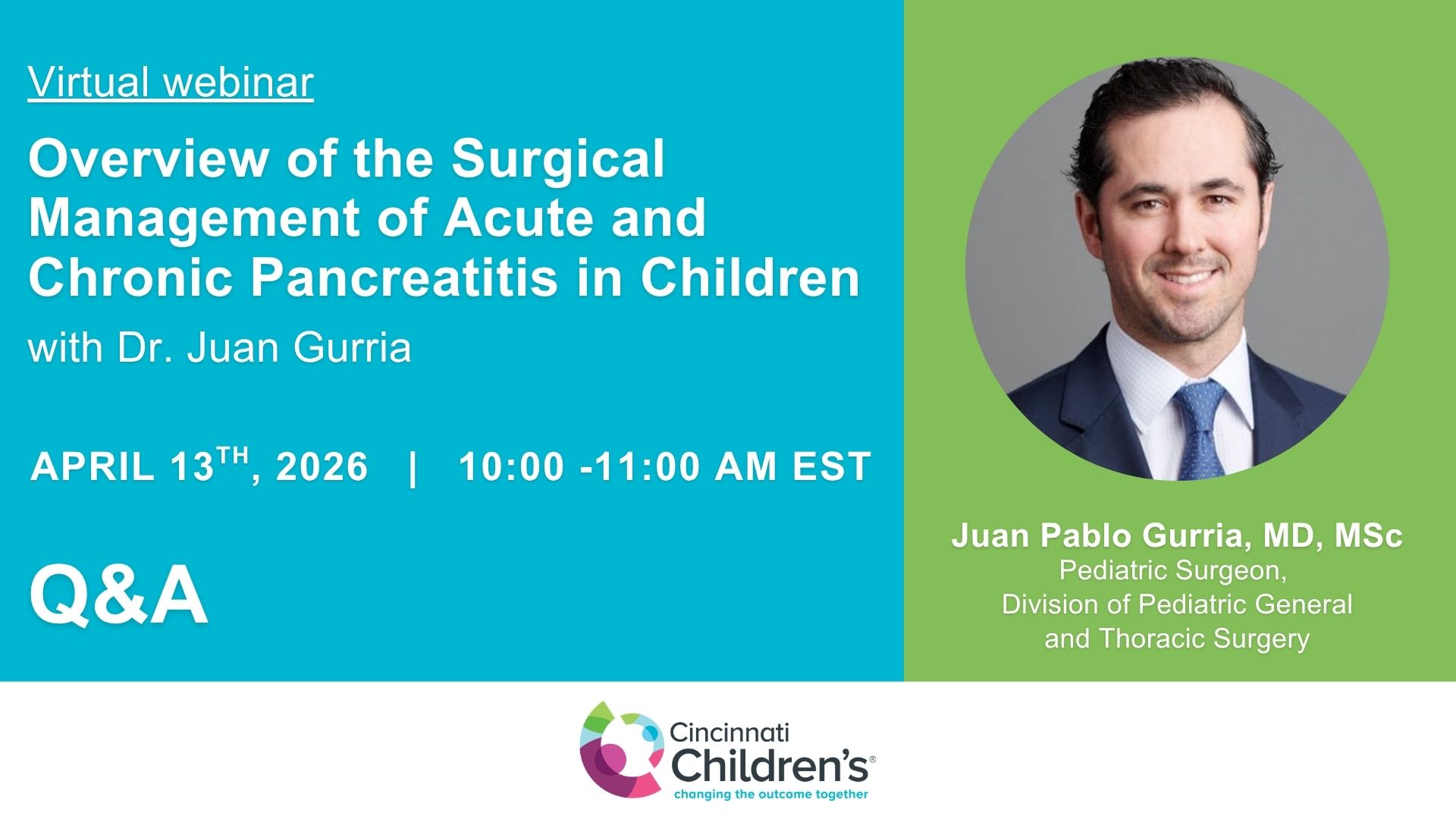
Overview of the Surgical Management of Acute and Chronic Pancreatitis in Children with Dr. Juan Gurria
66 min · Published Apr 2026
Video
Total pancreatectomy with islet autotransplantation (TPIAT) - Cincinnati Children's Pancreas Care Center
CCHMC Pediatric Surgery · 10 min · Published Dec 2024
Video
Acute Pancreatitis - Pancreatic Pathologies by the Pancreas Care Center at CCHMC
CCHMC Pediatric Surgery · 4 min · Published Sep 2024
Video
Update Course Rewind: 2023 Top Ten Key Takeaways
16 min · Published Jun 2024
Video
Update Course Rewind: Management of Chronic Pancreatitis 2023
8 min · Published Apr 2024
Video
Intestinal Atresia Types Explained: Grossfeld Classification for Pediatric Surgery
1 min · Published Sep 2026
Video
Derivation and validation of the Pediatric Community-Acquired Pneumonia Severity (PedCAPS) score: A prospective cohort study
50 s · Published Sep 2026
Video
FETO for Late-Diagnosed Severe Congenital Diaphragmatic Hernia (CDH) at Cincinnati Children's with Dr. Beth Rymeski
4 min · Published Sep 2026
Video
Severe Congenital Diaphragmatic Hernia (CDH) Case: FETO Management & Unexpected Findings with Dr. Beth Rymeski
3 min · Published Sep 2026
Video
Fetoscopic Endoluminal Tracheal Occlusion (FETO) Procedure: Step-by-Step Guide with Dr. Beth Rymeski
4 min · Published Sep 2026
Video
Choledochal Cyst Types Explained: Pediatric Surgery Fundamentals
1 min · Published Sep 2026
What the experts said
Every ERCP carries a risk of post-ERCP pancreatitis, and with every pancreatitis attack, islet cells are lost.
PRSS1 is the most common genetic mutation in recurrent pancreatitis and is a trypsinogen activator that activates trypsin inside the pancreas.
The genetic panel at Cincinnati Children's tests 10 different genetic markers for pancreatitis (including PRSS1, CTRC, CFTR, CPA1).
Genetic factors are changing the approach to pediatric chronic pancreatitis treatment.
There is currently no medication to mitigate trypsin activation in genetic pancreatitis mutations.
In a Frey procedure (partial head pancreatectomy with pancreaticojejunostomy), the top half of the pancreas is removed to open the duct, which results in loss of islet cells.
In patients with PRSS1 mutation, draining the duct (e.g., via Frey) temporizes attacks but does not fix the problem, as the parenchyma continues to be attacked by the mutation and pancreatitis will likely recur.
There is no set number of ERCPs that defines when to escalate care; the sooner the referral for evaluation, the better.
Surgical management of the pancreas is not offered unless medical and endoscopic management have been maximized.
If the endoscopist has no further options (nothing to balloon dilate, open, or drain) and the patient continues to have pancreatitis despite stenting, there is no reason to continue ERCPs.
MRCP is the best non-invasive imaging study for the pancreas, particularly with T2 sequences.
ERCP is more therapeutic than diagnostic.
Pancreatic fluid collections should be drained once the wall is mature (4 to 6 weeks) only if the patient is symptomatic (e.g., gastric outlet obstruction or pain); asymptomatic collections will self-resolve and do not require drainage or antibiotics.
If a patient has more than one episode of acute pancreatitis or a first severe episode, an MRCP and genetic panel should be performed to rule out genetic anomalies.
Genetics are very important before any resection procedure to avoid losing pancreatic cells in pathologies that will not benefit from resection and drainage but instead from islet cell transplant.
Endoscopic treatment should be attempted first, but if it fails, transfer to a specialized center that performs TPIAT (total pancreatectomy with islet autotransplantation).
For pancreatic imaging, start with ultrasound, then CT, and for better visualization of pancreatic anatomy, use MRCP with T2 sequences.
Recurrent pancreatitis is a rare pathology that can lead to chronic pancreatitis and is associated with genetic mutations.
If genetic mutations are confirmed, partial resection (e.g., Frey procedure) should be avoided to preserve pancreatic cells, and TPIAT should be considered sooner rather than later if endoscopic treatment fails.