

From
StayCurrentMD
Intestinal Rehabilitation Webinar 2023 - Top 5 Key Takeaways
With Dr. Paul Well & Dr. Michael Helmrath
Educational content from recorded physician discussions — not medical advice. Talk to your (or your child's) care team about your situation.
Video
Impact of social determinants of health on outcomes in pediatric short bowel syndrome...
43 s · Published Aug 2026
Podcast
Intestinal Rehabilitation, Episode 2: Overwhelming intestinal damage, Part 2
17 min · Published Feb 2022
Video
Advancements in Pediatric Intestinal Failure: Innovative Therapies and Improved Outcomes
17 min · Published Aug 2026
Podcast
Intestinal Rehabilitation, Episode 7: Refeeding in a neonatal patient
16 min · Published Sep 2023
Podcast
Biliary Atresia, Appendicitis, Intestinal Failure, and Anesthetic...
44 min · Published May 2017
Video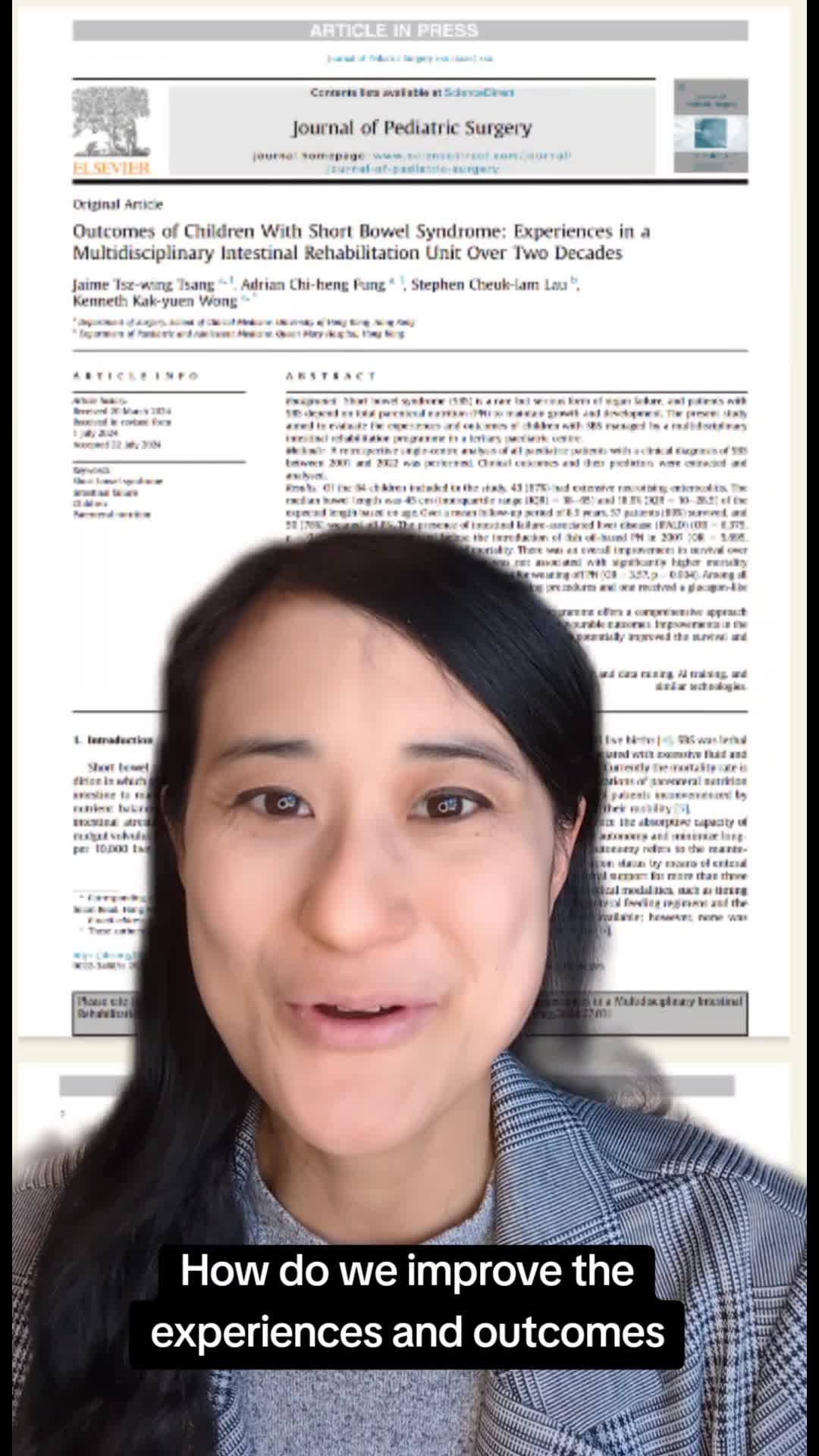
Outcomes of Children With Short Bowel Syndrome: Experiences in a Multidisciplinary Intestinal Rehabilitation Unit Over Two Decades
45 s · Published Mar 2025
Podcast
Update Course Rewind: Omphalocele & Gastroschisis 2020
Miguel Guelfand · 15 min · Published Jul 2026
Video
Update Course Rewind 2025: Updates in NEC Management
11 min · Published Jul 2026
Video
Availability, utilization, and barriers to bowel ultrasound for necrotizing enterocolitis...
55 s · Published Jul 2026
Video
Malrotation and Volvulus with Trinity
Dr. Steve Rothenberg · 8 min · Published May 2026
Video
Malrotation Infant
Dr. Steve Rothenberg · 9 min · Published May 2026
Video
Care transition from a pediatric intestinal rehabilitation program to adult care and the risk of all-cause mortality: A retrospective cohort study
1 min · Published May 2026
Only a few other public items share this expert — go deeper there →
Video
Intestinal Atresia Types Explained: Grossfeld Classification for Pediatric Surgery
1 min · Published Sep 2026
Video
Derivation and validation of the Pediatric Community-Acquired Pneumonia Severity (PedCAPS) score: A prospective cohort study
50 s · Published Sep 2026
Video
FETO for Late-Diagnosed Severe Congenital Diaphragmatic Hernia (CDH) at Cincinnati Children's with Dr. Beth Rymeski
4 min · Published Sep 2026
Video
Severe Congenital Diaphragmatic Hernia (CDH) Case: FETO Management & Unexpected Findings with Dr. Beth Rymeski
3 min · Published Sep 2026
Video
Fetoscopic Endoluminal Tracheal Occlusion (FETO) Procedure: Step-by-Step Guide with Dr. Beth Rymeski
4 min · Published Sep 2026
Video
Choledochal Cyst Types Explained: Pediatric Surgery Fundamentals
1 min · Published Sep 2026
What the experts said
Young infants, babies, and young children have tremendous gut growth potential, with the gut growing for the first several years of life.
Residual bowel should be discussed as a percentage of what is normal for a child of that age, not in absolute centimeters.
A term baby will have 160 centimeters of small bowel, and by age 5 years it almost triples to about 425 to 450 centimeters.
You can have as low as 10% expected gut length and still achieve enteral autonomy if you have the majority of your colon in continuity.
The more important factor than the ileocecal valve is the presence or absence of the distal small bowel (ileum) and right colon that can act as a site for bile reclamation and enterohepatic circulation.
The distal ileum produces hormones and incretins including GLP-2, GLP-1, and PYY.
The surgical strategy at the first operation should provide a pathway forward that allows early interval feeding.
It is sometimes better to stage reconstruction with the plan to restore bowel continuity under more controlled conditions.
In situations of overwhelming intestinal loss, the strategy is to provide proximal control that allows feeding to occur without the enteral stream going through, and to leave questionable bowel segments that have potential to heal and can make a huge difference in the child's lifetime.
As long as you can divert proximally and the baby is stable, you can leave questionable bowel for potential use at later secondary reconstructive procedures.
The overarching principle is to deliver adequate nutrition to have normal growth within normal parameters, ideally enterally.
As much as possible, the goal is to establish normal feeding behavior, recognizing that enteral nutrition is more than just nutrition.
If a patient needs tube support from the beginning, bolus feeding should be tried rather than defaulting to continuous feeding.
If the child fails a gastric approach (both bolus and continuous), the strategy is to feed beyond the stomach and decompress the stomach through an NG tube.
Breast milk is the formula of choice, not only for its nutritional benefits but for all the other beneficial components within breast milk.
Starting at the single amino acid level for protein is the generalized preference, ensuring patients are not having high stool output, high fluid losses, wound breakdown, rashes, or emesis.
Long-chain fat is the preferred fat module rather than MCT fat, especially in the setting of short bowel syndrome.
Long-chain fat is a much stronger stimulus for GLP-2 release compared to MCT, which is important when trying to drive intestinal adaptation.
Not every child needs to be on SMOF lipids.
For preterm babies, SMOF is not the ideal lipid emulsion but is the best currently available.
SMOF lipids do not have enough arachidonic acid, which is important for brain development.
Two strategies exist to treat cholestasis: reduce the total amount of fat, or change the composition to introduce SMOF lipids or Omegaven.
Lipid restrictions that reduce lipid dose to 1 g per kg per day can reverse cholestasis but result in reduced calorie delivery that can impair growth and potentially impact neurocognitive development.
Omegaven is essentially pure fish oil with omega-3 and is dosed at 1 g/kg, so babies take a calorie hit.
SMOF lipids are a better choice as they are a more well-balanced emulsion with an omega-3 and omega-6 ratio of 2.5 to 1, are less inflammatory than Intralipid, and promote bile flow.
SMOF lipids should not be restricted and can be given at no less than 2 or 2.5 g per kg per day.
The importance is not the ileocecal valve itself but the distal ileum and proximal colon where bilioenteric circulation occurs and where hormones and peptides that help intestinal growth and absorption are produced.