

From
StayCurrentMD
Transplantation and Ventricular Assist Devices: New Horizons in Medical and...
With Dr. Andrew Lotz
Part of
Single Ventricle / HLHS 14 items
Educational content from recorded physician discussions — not medical advice. Talk to your (or your child's) care team about your situation.
Video
Surgical and Catheter-Based Intervention in Pediatric Pulmonary Vein Stenosis
57 s · Published Jul 2026
Video
Outcomes of Fontan Patients Undergoing Combined Heart - Liver Transplantation in Pediatric Hospitals Across the U.S.
59 s · Published Dec 2025
Video
Pyloric Stenosis
CCHMC Pediatric Surgery · 12 min · Published May 2020
Video
How do we manage thrombogenicity and thrombosis in the Fontan? New Horizons...
CCHMC Pediatric Surgery · 16 min · Published Jul 2017
Video
Pregnancy in a Fontan Patient: New Horizons in Medical and Surgical Fontan...
CCHMC Pediatric Surgery · 18 min · Published Jul 2017
Video
Psychosocial Outcomes: New Horizons in Medical and Surgical Fontan Management...
CCHMC Pediatric Surgery · 22 min · Published Jul 2017
Only a few other public items share this expert — go deeper there →
Video
Intestinal Atresia Types Explained: Grossfeld Classification for Pediatric Surgery
1 min · Published Sep 2026
Video
Derivation and validation of the Pediatric Community-Acquired Pneumonia Severity (PedCAPS) score: A prospective cohort study
50 s · Published Sep 2026
Video
FETO for Late-Diagnosed Severe Congenital Diaphragmatic Hernia (CDH) at Cincinnati Children's with Dr. Beth Rymeski
4 min · Published Sep 2026
Video
Severe Congenital Diaphragmatic Hernia (CDH) Case: FETO Management & Unexpected Findings with Dr. Beth Rymeski
3 min · Published Sep 2026
Video
Fetoscopic Endoluminal Tracheal Occlusion (FETO) Procedure: Step-by-Step Guide with Dr. Beth Rymeski
4 min · Published Sep 2026
Video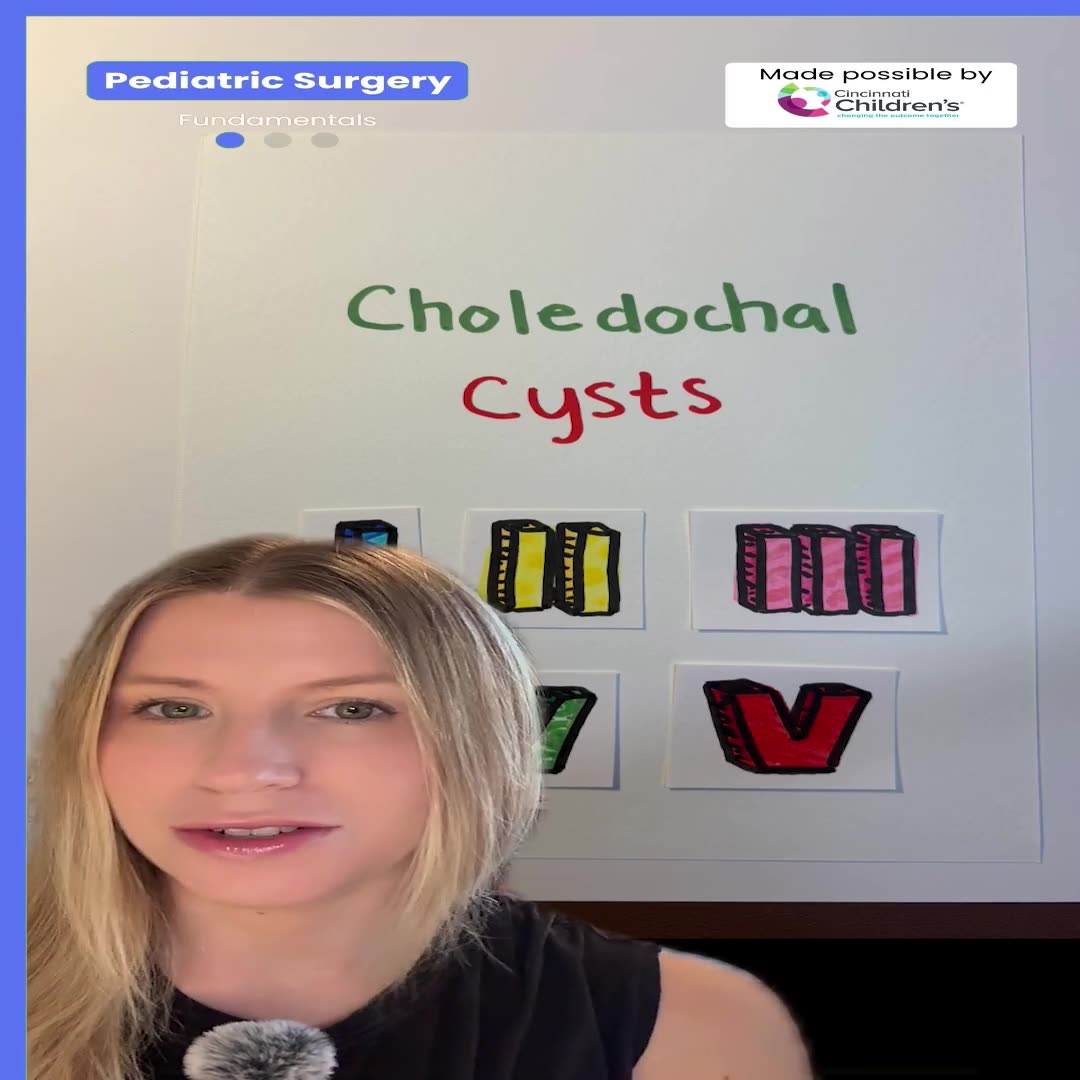
Choledochal Cyst Types Explained: Pediatric Surgery Fundamentals
1 min · Published Sep 2026
What the experts said
Protein-losing enteropathy causes accumulating risk factors including edema, low albumin, poor nutrition, electrolyte disturbances, low IgG with increased infections, malnutrition, and prothrombotic state.
A patient with PLE for 5 years becomes very prothrombotic, which is important for VAD outcomes, and becomes malnourished, making them a poor transplant or VAD candidate.
Plastic bronchitis patients who go through to transplant do very well post-transplant.
Under recent pediatric allocation system changes, congenital patients on one inotrope can be status 1A only if they are in the hospital; Fontan patients with PLE or plastic bronchitis who are not on inotropes will be status 2.
Approximately one year ago, patients could be sent home on low-dose dopamine or milrinone and remain status 1A; this is no longer the case under current allocation rules.
For urgent VAD placement at Cincinnati Children's, continuous-flow short-term devices (CentriMag in particular, some institutions use Rotaflow) are used to support patients for weeks to months to transplantation.
The Berlin Heart is still available for small children, but most Fontans are bigger, so HVAD is increasingly used.
HVAD can be safely placed in 25 kg single-ventricle patients, and many institutions (including Cincinnati) may push down to 15 kg.
Continuous-flow devices for single-ventricle physiology seem to be working very well compared to Berlin Heart data.
For patients over approximately 35 kg, SynCardia total artificial heart is an option, removing all ventricular mass and supporting the patient.
If a patient does not need respiratory support, supporting an organ that doesn't need support should probably be avoided, which is why ECMO is not the preferred option when lungs are functioning well.
Only 2 SynCardia devices have been placed in single-ventricle patients in the US.
For SynCardia placement in single-ventricle patients, a capacitant chamber must be built because two AV valves are needed or the anatomy must be addressed in some fashion.
A smaller 50 cc SynCardia device is now available, making it an option for smaller Fontan patients.
The advanced cardiomyopathy learning network is now operational and working to share experiences with Fontan and VAD to understand which patients benefit from VAD and what the best support strategy is.
The upcoming adult allocation system changes will be more favorable for Fontan patients, but the recent pediatric allocation changes were not favorable for Fontan PLE or plastic bronchitis patients.
In pediatric VAD practice, 'destination therapy' has been reframed as 'chronic therapy,' with the concept that patients can transition in and out of transplant candidacy status.
If a patient is not labeled as destination therapy, the goal remains getting them to transplant candidacy, which may result in longer life and probably better quality of life, although that is yet to be determined.
There are only about 20 Fontans in all of Intermacs and Pedimacs (the two VAD registries) available to study.
A handful of Fontan patients have been successfully supported with atrial cannulation.
Atrial cannulation allows flow into the VAD where a restrictive or small-cavity ventricle sometimes clamps around the cannula and does not allow flow; this phenomenon has been observed.
In the Bernstein 2006 pediatric heart transplant study group multi-center analysis, risk factors for poor Fontan transplant outcomes included mechanical ventilation at listing, younger age (0-4 years), status 1 listing, and shorter time interval from Fontan (less than 6 months).
If Fontan patients are selected appropriately, they do just as well as dilated cardiomyopathy patients post-heart transplant.
The 1998 Mertens study showed approximately 50% survival at 5 years after PLE diagnosis.
A 2014 paper showed 85% survival five years after PLE diagnosis.
Schumacher from Michigan showed 50% freedom from death or transplant at 5 years in patients diagnosed with plastic bronchitis.
Current pediatric transplant survival across all centers is 92% at 1 year and 86% at 5 years.
Fontan transplant survival, aggregating available data, is approximately 80% at 1 year and 75% at 5 years.
Multi-center Fontan post-transplant studies show higher waitlist time and mortality compared to dilated cardiomyopathy.
Standard listing criteria underestimate the degree of illness in Fontan patients.
Fontan transplant patients have increased risk for early graft failure post-transplant.
Death from sepsis is more common in Fontan transplant patients.
Bleeding is more common in Fontan transplant patients since they are multiple-time redo surgeries.
PLE resolves in Fontan transplant survivors.
In the Excor (Berlin Heart) registry, there were only 5 stage 3 (Fontan) patients, with 3 survivors; days on support were 1, 3, and 229 days, representing a very limited dataset.
The Intermacs adult registry shows only 17 single-ventricle patients, and the device type used is not clear in the registry.
Among all adults listed as status 2 (where PLE adult Fontan patients would be), only 30-40% get transplanted within one year.
Among congenital heart disease patients on medical therapy (not all Fontans), one-third would be transplanted at 1 year.
In restrictive cardiomyopathy, Berlin Heart data shows that atrial cannulation does not perform as well as ventricular cannulation.