

From
StayCurrentMD
Panel Discussion: Pediatric Thoracic Surgery Part 1-Lung Lesions 2012
With Dr. Steven Rothenberg · hosted by Dr. Todd Ponsky
Educational content from recorded physician discussions — not medical advice. Talk to your (or your child's) care team about your situation.
Podcast
Case Based Journal Review - CPAM in 2022
12 min · Published Apr 2022
Video
Postnatal Management of Lung Lesions Part II: Pediatric Thoracic Surgery...
Dr. Todd Ponsky · 25 min · Published Aug 2017
Video
Should We Resect Asymptomatic CPAM Flake vs Langer
Dr. Steve Rothenberg · 14 min · Published May 2019
Video
Thoracoscopic Right Lower Lobe Cystic Lesion Excision: Update Course 2014
Dr. Steve Rothenberg · 11 min · Published Sep 2014
Video
Clinical Symptoms Affect Treatment and Prognosis in Pediatric Patients with Congenital Pulmonary Airway Malformation
55 s · Published Dec 2023
Video
Congenital Lung Malformations: CPAM, BPS, CLE, and Bronchogenic Cyst Explained
3 min · Published Oct 2026
Video
Quick Literature Updates Episode 18
4 min · Published Mar 2025
Podcast
Journal of Pediatric Surgery Article Review: October 2023
12 min · Published Apr 2024
Video
Update Course Rewind: Congenital Lung Lesions 2022
4 min · Published Aug 2023
Video
Update Course 2022 - APSA PDC UPDATES - Mary Edwards, Paul Jeziorczak, Craig Lillehei, and Charles Snyder,
64 min · Published Sep 2022
Podcast
Journal of Pediatric Surgery Article Review: November 2021
11 min · Published Dec 2021
Podcast
The Full Story on CPAMs
56 min · Published Sep 2021
Video
Ladd Medal Award Presentation Honoring Dr. Steven Rothenberg's Pioneering Minimally Invasive Pediatric Surgery
Dr. Steve Rothenberg · 33 min · Published May 2026
Video
PDA ligation by Dr. Steven Rothenberg
Dr. Steve Rothenberg · 6 min · Published Jun 2023
Video
Update Course Rewind: Pectus Excavatum 2021
Dr. Todd Ponsky · 11 min · Published Aug 2022
Podcast
Update Course Rewind: Magnet Therapy for Esophageal Atresia
10 min · Published Dec 2021
Video
Update Course Rewind: Thoracotomy vs VATS for Lung Metastases
Dr. Todd Ponsky · 9 min · Published Dec 2021
Video
Thoracoscopic TEF Repair, Is It Really Better Than Open? Update Course 2018
18 min · Published Aug 2018
Video
Intestinal Atresia Types Explained: Grossfeld Classification for Pediatric Surgery
1 min · Published Sep 2026
Video
Derivation and validation of the Pediatric Community-Acquired Pneumonia Severity (PedCAPS) score: A prospective cohort study
50 s · Published Sep 2026
Video
FETO for Late-Diagnosed Severe Congenital Diaphragmatic Hernia (CDH) at Cincinnati Children's with Dr. Beth Rymeski
4 min · Published Sep 2026
Video
Severe Congenital Diaphragmatic Hernia (CDH) Case: FETO Management & Unexpected Findings with Dr. Beth Rymeski
3 min · Published Sep 2026
Video
Fetoscopic Endoluminal Tracheal Occlusion (FETO) Procedure: Step-by-Step Guide with Dr. Beth Rymeski
4 min · Published Sep 2026
Video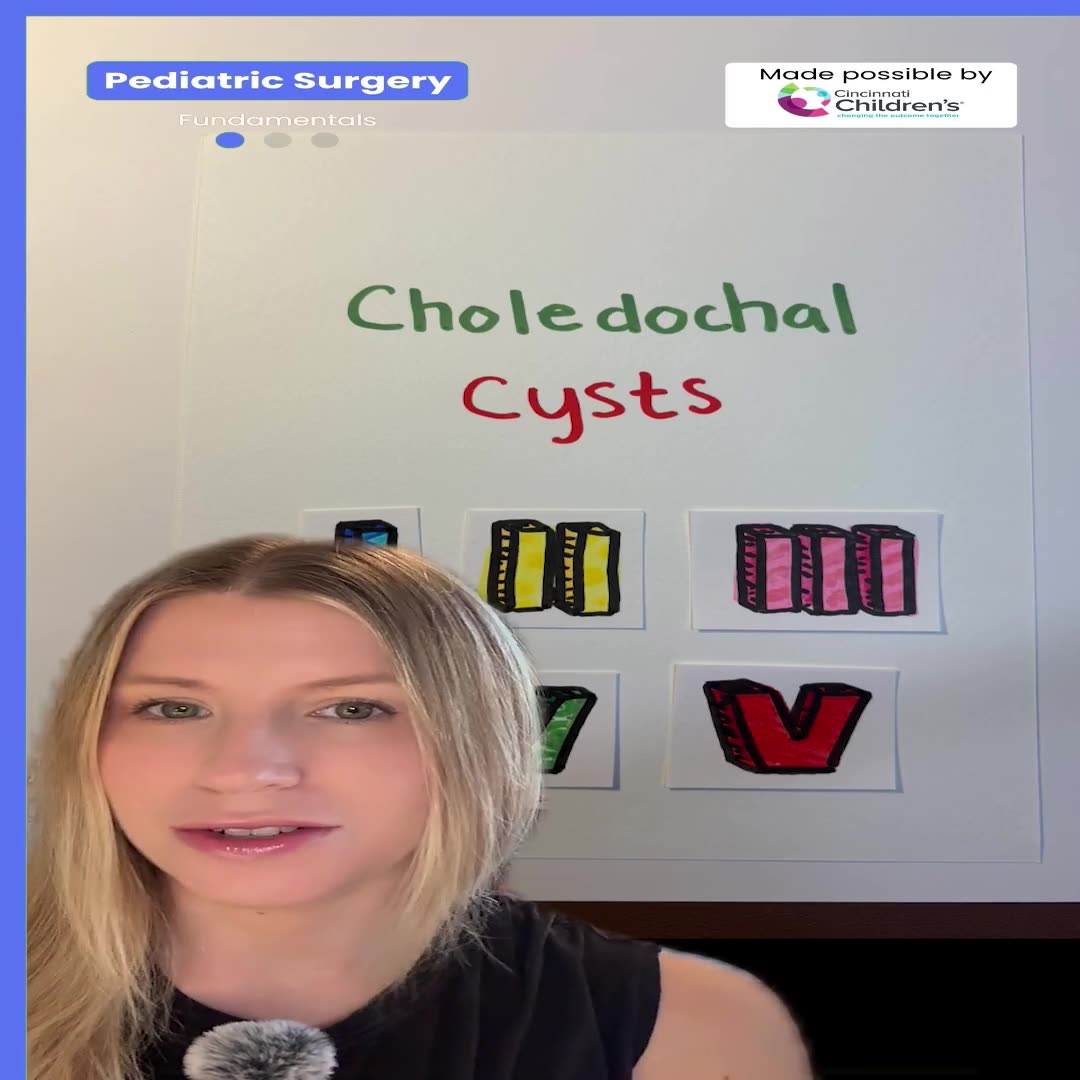
Choledochal Cyst Types Explained: Pediatric Surgery Fundamentals
1 min · Published Sep 2026
What the experts said
Taking a lobectomy from an infant gives normal pulmonary function when the child is older.
The risk of leaving CPAM disease behind by segmentectomy is relatively high.
Segmentectomy of segment 6 and segment 10 is very difficult to perform thoracoscopically.
For a superior-segment lower-lobe CPAM, the morbidity of segmentectomy is extremely low.
If you do 100 segmentectomy cases, the likelihood of missing disease is significantly higher than with lobectomy, and the likelihood of complications is higher.
Patients with spontaneous pneumothorax who undergo simple chest-tube placement have an upwards of 50% recurrence rate if they have bleb disease.
There is no study separating patients with blebs versus no blebs on first pneumothorax event to determine differential recurrence risk.
Almost all kids with spontaneous pneumothorax have some degree of bleb disease whether we define it early or not.
Bleb disease does not necessarily mean recurrence of pneumothorax.
Treating every kid with blebs on first pneumothorax results in a 50% rate of unnecessary pleurodesis.
For bilateral bleb disease, performing bilateral surgery prevents contralateral recurrence in the immediate postoperative period.
Performing apical pleurectomy limited to the third interspace avoids whole-chest adhesions, unlike talc pleurodesis.
Hydrostatic pleurectomy involves injecting saline under the pleura to dissect it off the chest wall, allowing removal of a larger area than apical pleurectomy alone.
Talc pleurodesis causes solid adhesions throughout the pleural space, making future thoracotomy difficult.
In hydatid cyst surgery, there is a good plane between the lung and the parasitic membrane, making thoracoscopic removal feasible before adhesions form.
Once the parasitic membrane is removed in hydatid cyst surgery, the patient is cured; subsequent bronchial fistulas are a mechanical closure problem.
Intracavitary thoracoscopic suturing of bronchial fistulas may work for small fistulas but is not appropriate for large fistulas.
Hem-o-lok clips are more reliable than metal clips for vascular and bronchial control.
Large-size Hem-o-lok clips (10 mm diameter) can be used for very wide and large bronchi, even in patients over 7 years old undergoing lobectomy.
Persistent air leak has not been a problem in infant lobectomies with incomplete fissures, even without tissue sealant.
A recent study from Saint Peter's in Kansas City found CT scan is very poor at defining bleb disease compared to subsequent thoracoscopy.