

From
Live Event Content
2024 Fetal Care Center Frontiers in Fetal Neurology Day 1 - Dr. Jesse Skoch
With Dr. Jesse Skoch · hosted by Dr. Venkatessen
Educational content from recorded physician discussions — not medical advice. Talk to your (or your child's) care team about your situation.
Video
2024 Fetal Care Center Frontiers in Fetal Neurology Day 1 - Hour 1 Q&A
9 min · Published Oct 2024
Video
2024 Fetal Care Center Frontiers in Fetal Neurology Day 1 - Dr. Charu Venkatesen
12 min · Published Oct 2024
Video
2024 Fetal Care Center Frontiers in Fetal Neurology Day 1 - Introduction
2 min · Published Oct 2024
Only a few other public items share this expert — go deeper there →
Video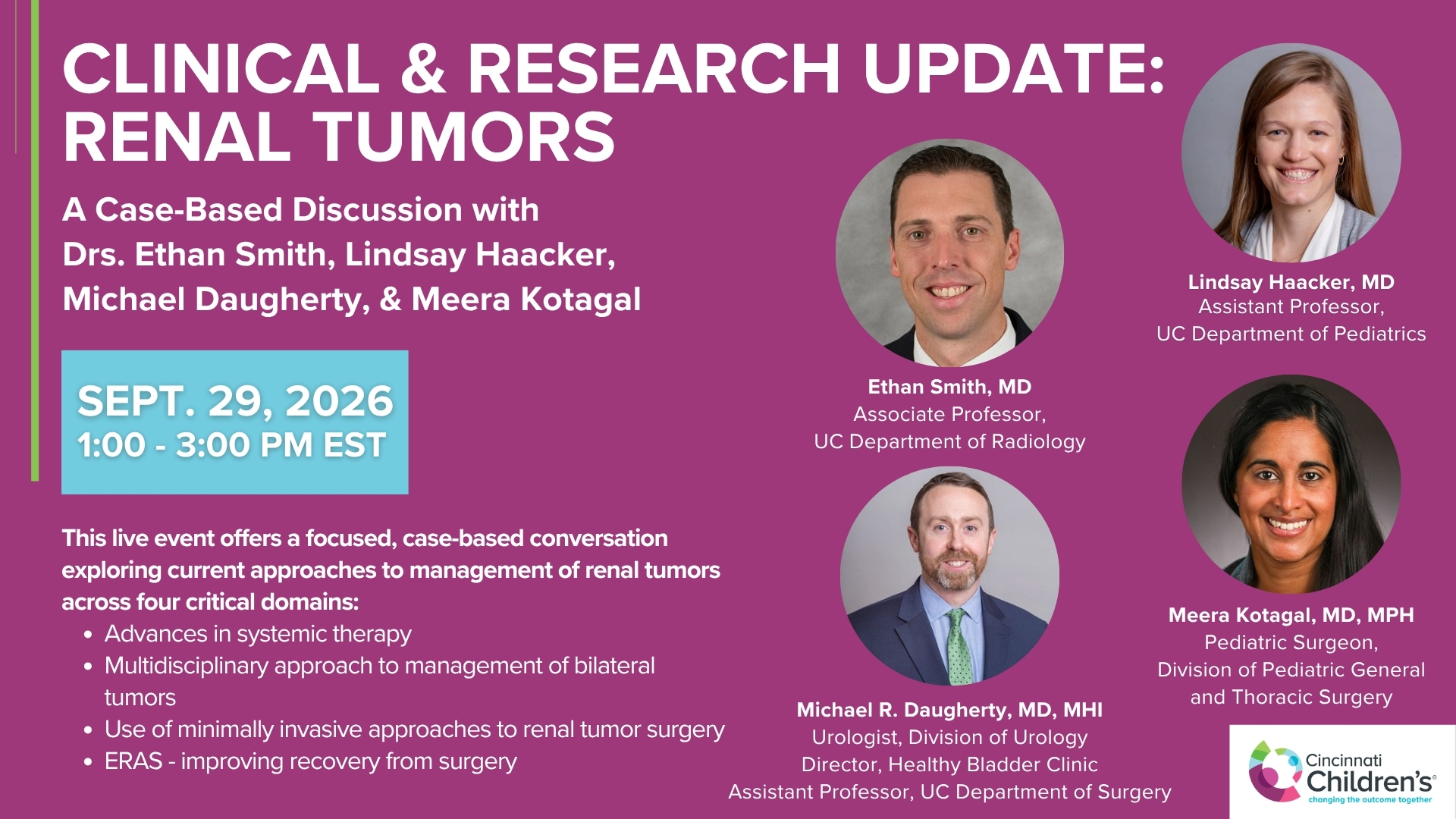
Clinical & Research Update: Renal Tumors with Drs. Ethan Smith, Lindsay Haacker, Michael Daugherty, and Meera Kotagal
71 min · Published Sep 2026
Video
Clinical & Research Update: Neuroblastoma with Drs. Katherine Somers, Cara Morin, Juan Gurria, and Meera Kotagal
67 min · Published Sep 2026
Video
Clinical & Research Update: Sarcoma w/ Drs. Roshni Dasgupta, Joseph Pressey, Arthur Meyer, Luke Pater
66 min · Published Sep 2026
Video
2026 Laparoscopic Pediatric Hernia Repair
123 min · Published Jun 2026
Video
Beyond the Spectrum: Diagnosis, Myths & Management - Caitlin Couch & Leslie Lopez - APP Conference 2026
50 min · Published May 2026
Video
Dysautonomia: Navigating the Journey - Martha Willis - APP Conference 2026
55 min · Published May 2026
What the experts said
Congenital aqueductal stenosis accounts for 5-20% of congenital hydrocephalus etiology, with approximately 600-1500 cases per year in the United States.
Walter Dandy in the 1920s used a crude cystoscope to burn choroid plexus in hydrocephalic patients, with 24 out of 25 patients dying of complications.
Dr. Mixer in 1923 is credited with the modern version of ETV involving fenestration of the floor of the third ventricle using a urethroscope.
Scarf et al. in 1936 published a series of 20 ETV cases with 10 showing long-term improvement, 7 failures, and 3 immediate post-surgical deaths.
ETV technology reached its modern form in the 1980s with advances in camera and endoscope technology, after being relatively quiescent from the mid-1930s due to the invention of VP shunt pressure-regulated valves in the 1950s.
Serial slow dilation with balloon catheters (such as 3 French Fogarty catheters) can successfully open the majority of the accessible floor of the third ventricle, even in patients with narrow third ventricles.
Making the ETV ostomy as large as possible is important in young children because it helps fight against closure in the growing infant brain.
The ETV Success Score assigns 30 points for aqueductal stenosis etiology and 50 points for age greater than 10 years, with points translating directly to percentage success rates.
Patients with aqueductal stenosis who are greater than 10 years old have an 80% chance of ETV success, while those less than 1 month old have success rates in the 30-50% range.
ETV procedures carry risks including hemorrhage, injury to the basilar artery, damage to the fornix (which can cause memory loss), and procedure failure.
Successful ETV patients typically do not show the same degree of ventricular reduction as shunted patients, but developmental outcomes can be very good.
A visible CSF jet stream (appearing black on sagittal MRI) through the ETV ostomy is a reassuring sign of patency, though not required for success.
ETV failures occur through four mechanisms: ostomy closure, ostomy narrowing, patent ostomy with membrane formation elsewhere in the third ventricle or basilar cisterns, or insufficient CSF diversion possibly due to mixed communicating hydrocephalus.
If an ETV works and shows success at 6 months to 1 year, very few patients will have long-term delayed complications, unlike the constantly ticking time bomb of shunt dependency.
If a clinician is not comfortable letting a patient go for two weeks without follow-up ultrasound or examination, that is a red flag warning sign that the patient needs shunting rather than continued observation.
Stented ETV using hardware to hold the ostomy open has not panned out well because foreign body reactions can occur at any time in the patient's life, similar to shunt failures.
The Toronto group's large study showed that infants less than 1 month old fare poorly with ETV outcomes over time, with a big improvement in success rates at the 6-month age mark.
Mohammadi et al. showed that pre-term versus post-term status makes a significant difference in ETV outcomes, with corrected age being important to consider in premature babies.
According to Rhodes et al., congenital acute aqueductal stenosis (big ventricles from birth with progression) has better neurologic outcomes with shunting than with ETV, while chronic slowly progressive hydrocephalus shows no difference between procedures.
A 2011 meta-analysis showed ETV has a permanent morbidity rate of 2.4% and mortality of 0.21%.
Shunting has an in-hospital mortality of 0.3-0.8%, but Norwegian longitudinal studies over 40 years showed 48% overall mortality with 8% attributed to shunt failures and shunt-related issues.
Dr. Warf's sub-Saharan African study showed a 30% improvement in ETV success when combined with choroid plexus cauterization, but meta-analysis of other published studies has not replicated those numbers in larger datasets.