

From
StayCurrentMD
Minimally Disruptive Subcortical Neurosurgery in Children - Concepts of the...
With Dr. Erin Keena
Educational content from recorded physician discussions — not medical advice. Talk to your (or your child's) care team about your situation.
Video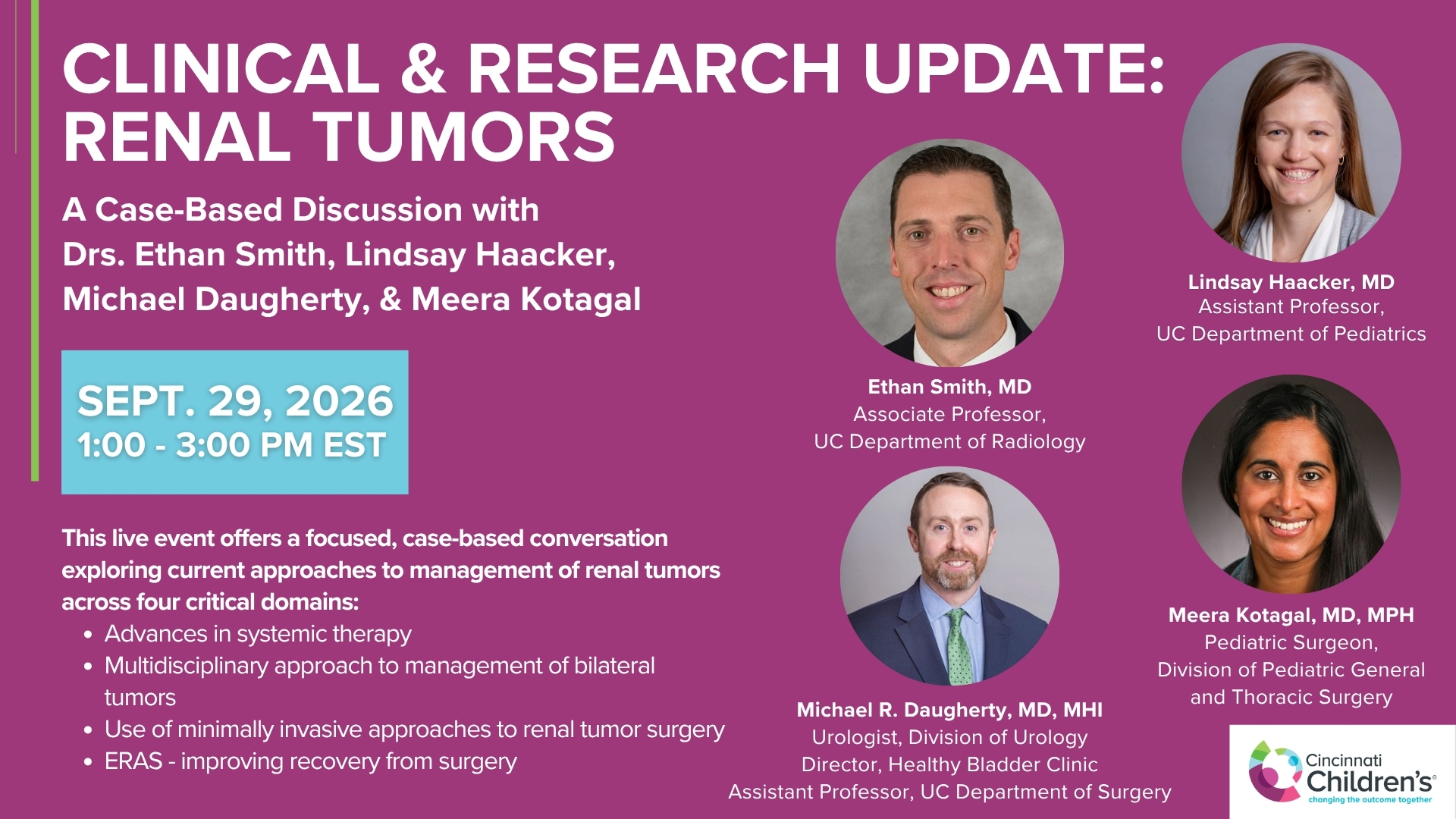
Clinical & Research Update: Renal Tumors with Drs. Ethan Smith, Lindsay Haacker, Michael Daugherty, and Meera Kotagal
71 min · Published Sep 2026
Video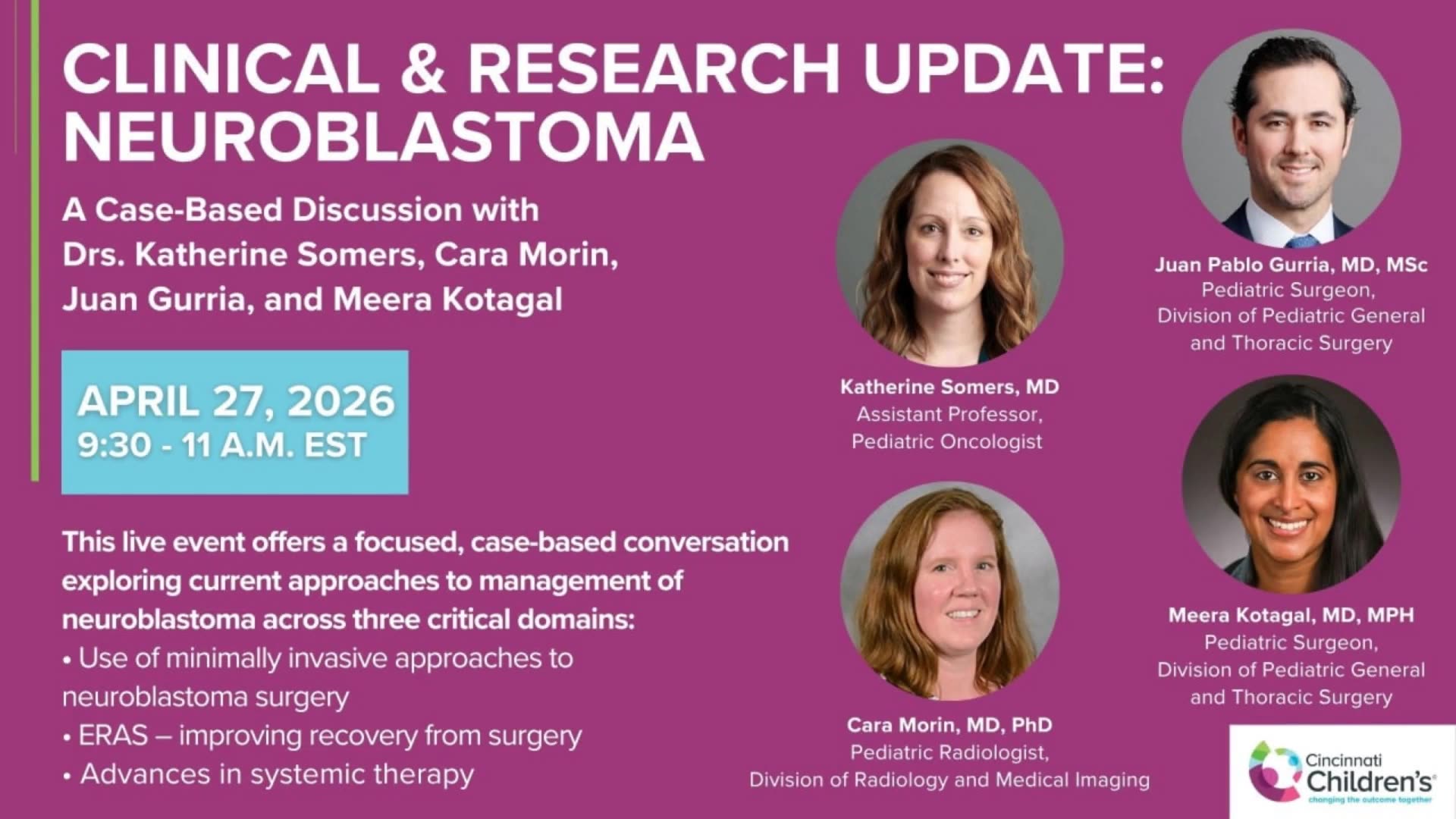
Clinical & Research Update: Neuroblastoma with Drs. Katherine Somers, Cara Morin, Juan Gurria, and Meera Kotagal
67 min · Published Sep 2026
Video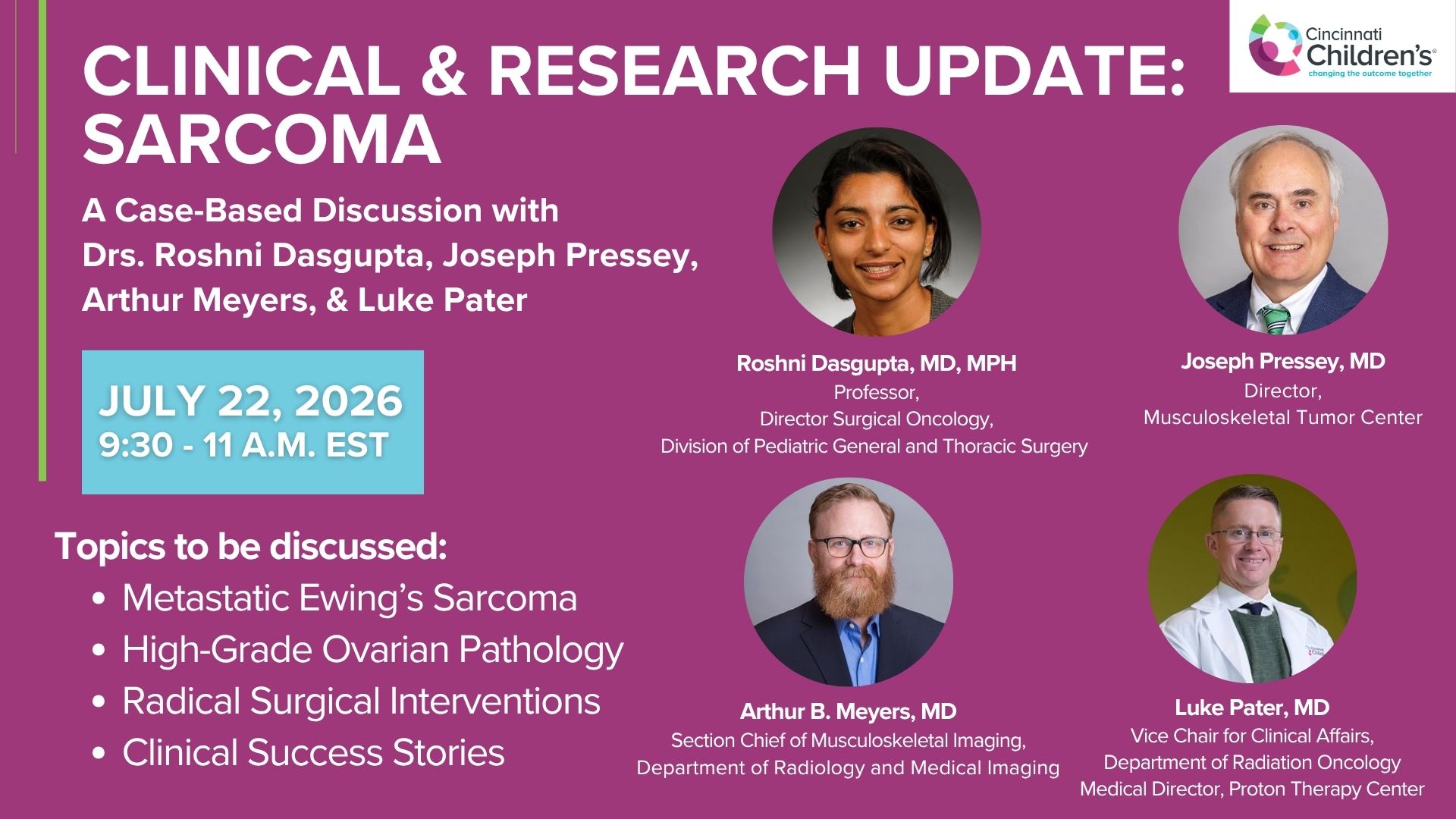
Clinical & Research Update: Sarcoma w/ Drs. Roshni Dasgupta, Joseph Pressey, Arthur Meyer, Luke Pater
66 min · Published Sep 2026
Video
Update Course Rewind 2025: Nerve Monitoring in Pediatric Thyroid Surgery
6 min · Published Jul 2026
Video
Journal of Pediatric Surgery Article Review: June 2023, AAP Issue
Todd Ponsky · 13 min · Published Jul 2026
Video
Pediatric Surgical Oncology Research Collaborative (PSORC): Studying Rare Pediatric Tumors
56 s · Published May 2026
Only a few other public items share this expert — go deeper there →
Video
Intestinal Atresia Types Explained: Grossfeld Classification for Pediatric Surgery
1 min · Published Sep 2026
Video
Derivation and validation of the Pediatric Community-Acquired Pneumonia Severity (PedCAPS) score: A prospective cohort study
50 s · Published Sep 2026
Video
FETO for Late-Diagnosed Severe Congenital Diaphragmatic Hernia (CDH) at Cincinnati Children's with Dr. Beth Rymeski
4 min · Published Sep 2026
Video
Severe Congenital Diaphragmatic Hernia (CDH) Case: FETO Management & Unexpected Findings with Dr. Beth Rymeski
3 min · Published Sep 2026
Video
Fetoscopic Endoluminal Tracheal Occlusion (FETO) Procedure: Step-by-Step Guide with Dr. Beth Rymeski
4 min · Published Sep 2026
Video
Choledochal Cyst Types Explained: Pediatric Surgery Fundamentals
1 min · Published Sep 2026
What the experts said
Over 80% of pediatric brain tumors are curable, including both benign and malignant tumors.
The immature pediatric brain is still undergoing myelination, and while cells may be more vulnerable to injury, there is ongoing neuroplasticity, synaptogenesis, and synaptic pruning allowing for unique recovery from surgery.
Modern WHO guidelines now include genomic and molecular analysis requirements for multiple tumor types, necessitating adequate tissue preservation.
All brain tissue is relevant; there is not just eloquent and non-eloquent cortex, and all fiber tracts en route to lesions must be preserved regardless of corridor.
From awake craniotomy data, 90% of new intraoperative neurological deficits occur during subcortical dissection.
A parafascicular trajectory minimizes shear forces applied to white matter tracts by running parallel to the main white matter tracts.
A trans-sulcal route with parafascicular trajectory reduces the amount of brain traversed en route to reach lesions.
Using a tubular retractor distributes forces radially, thereby protecting displaced tissue rather than simply retracting with malleable retractors.
Traditional craniotomies can cause brain collapse in children with large ventricles after corpus callosotomy, leading to CSF egress into subdural space, pseudomeningocele development, and prolonged recoveries.
Pure endoscopic resection is limited by inability to achieve simultaneous hemostasis, restriction to one-handed technique, poor retraction capability, and requirement to remove tumor in very small pieces or morsellate with devices.
BrainPath approach requires a small craniotomy 2.5 to 3 centimeters in diameter and has a slightly restrictive field requiring extra-long keyhole instruments.
The port cannot be moved around significantly once in place or it will disrupt fiber tracts.
Ideal BrainPath cases are lesions less than 4 centimeters that can be accessed down the long axis through a parafascicular corridor, including subcortical, deep, or metastatic lesions.
Removing choroid plexus tumors en bloc with BrainPath preserves the architecture for pathologists to make critical diagnoses, unlike morsellation into small pieces.
In Dr. Keena's personal series, mean operative time was 3 hours and 11 minutes with median length of stay of 48 hours.
In Dr. Keena's personal series, extent of resection matched intended resection in every case.
In Dr. Keena's personal series, all patients were neurologically intact with the exception of one pre-existing visual field deficit.
The broader BrainPath series includes over 200 cases used throughout the brain, predominantly for supratentorial indications including primary tumors and metastases.
BrainPath resection is safe and efficacious with similar or improved outcomes and shorter lengths of stay compared to traditional approaches.
The Nico Myriad preserves tissue architecture by morsellating tissue and provides the smallest obstruction in the surgical view due to its streamlined handpiece.
The exoscope provides more options for patient head positioning and approach angle compared to the microscope, which requires careful positioning so the port is as superior as possible for ergonomic downward viewing.
For trans-sulcal BrainPath passage, the arachnoid is opened up to about 2 centimeters (though only 15mm is needed), then the patient is placed under Valsalva without mannitol or CSF pressure relief, the opening is widened with bipolar tips, and the blunt trocar is passed under navigation.
The blunt tip of the BrainPath trocar allows vessels to roll off radially, and Dr. Keena has not ruptured any veins or arteries using this technique.