

From
StayCurrentMD
Update Course Rewind: Thoracotomy vs VATS for Lung Metastases
With Dr. Roshni Dasgupta & Dr. Steven Rothenberg · hosted by Dr. Ellen Encisco & Dr. Rod Gerardo & Dr. Todd Ponsky
Educational content from recorded physician discussions — not medical advice. Talk to your (or your child's) care team about your situation.
Video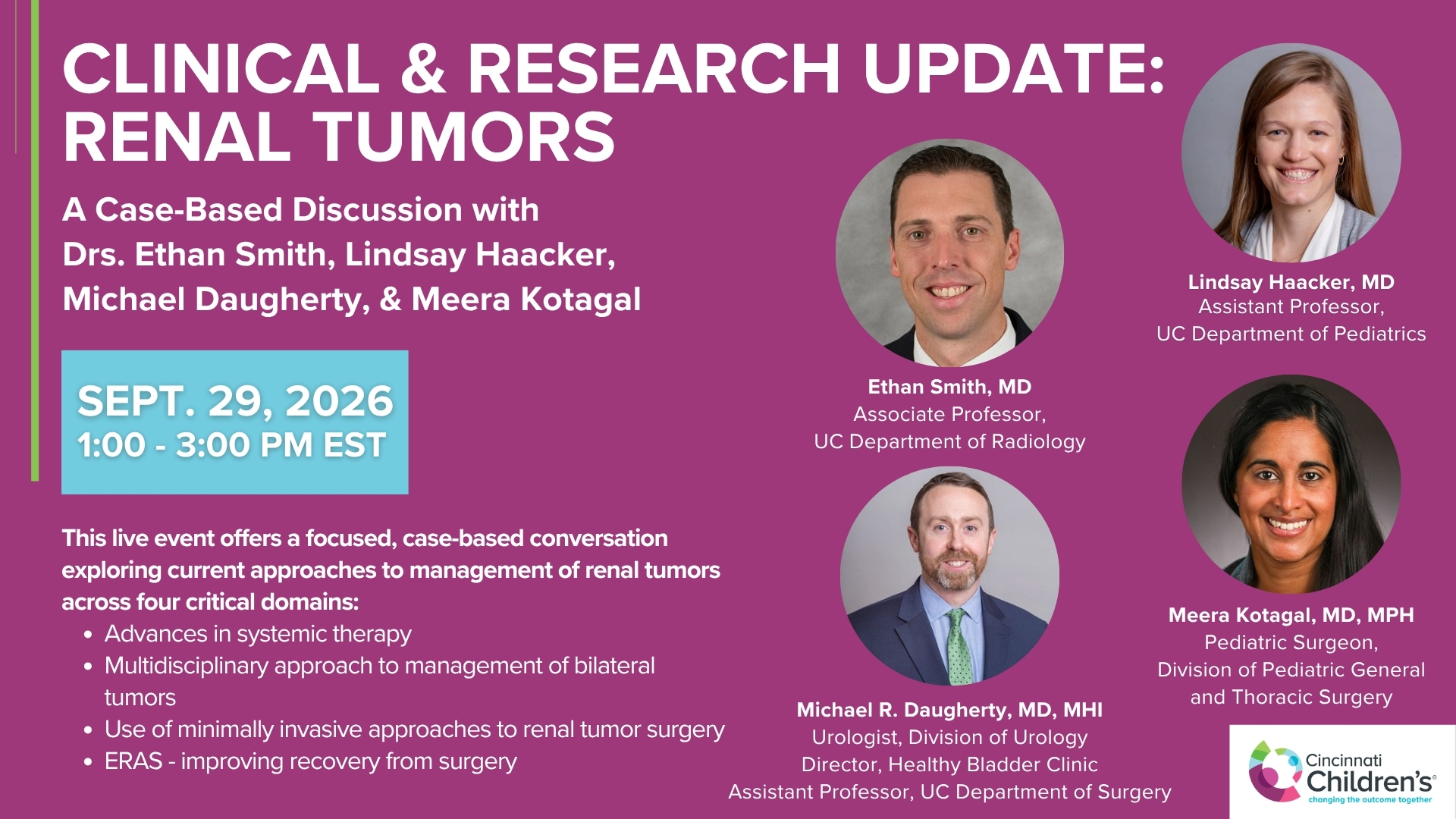
Clinical & Research Update: Renal Tumors with Drs. Ethan Smith, Lindsay Haacker, Michael Daugherty, and Meera Kotagal
71 min · Published Sep 2026
Video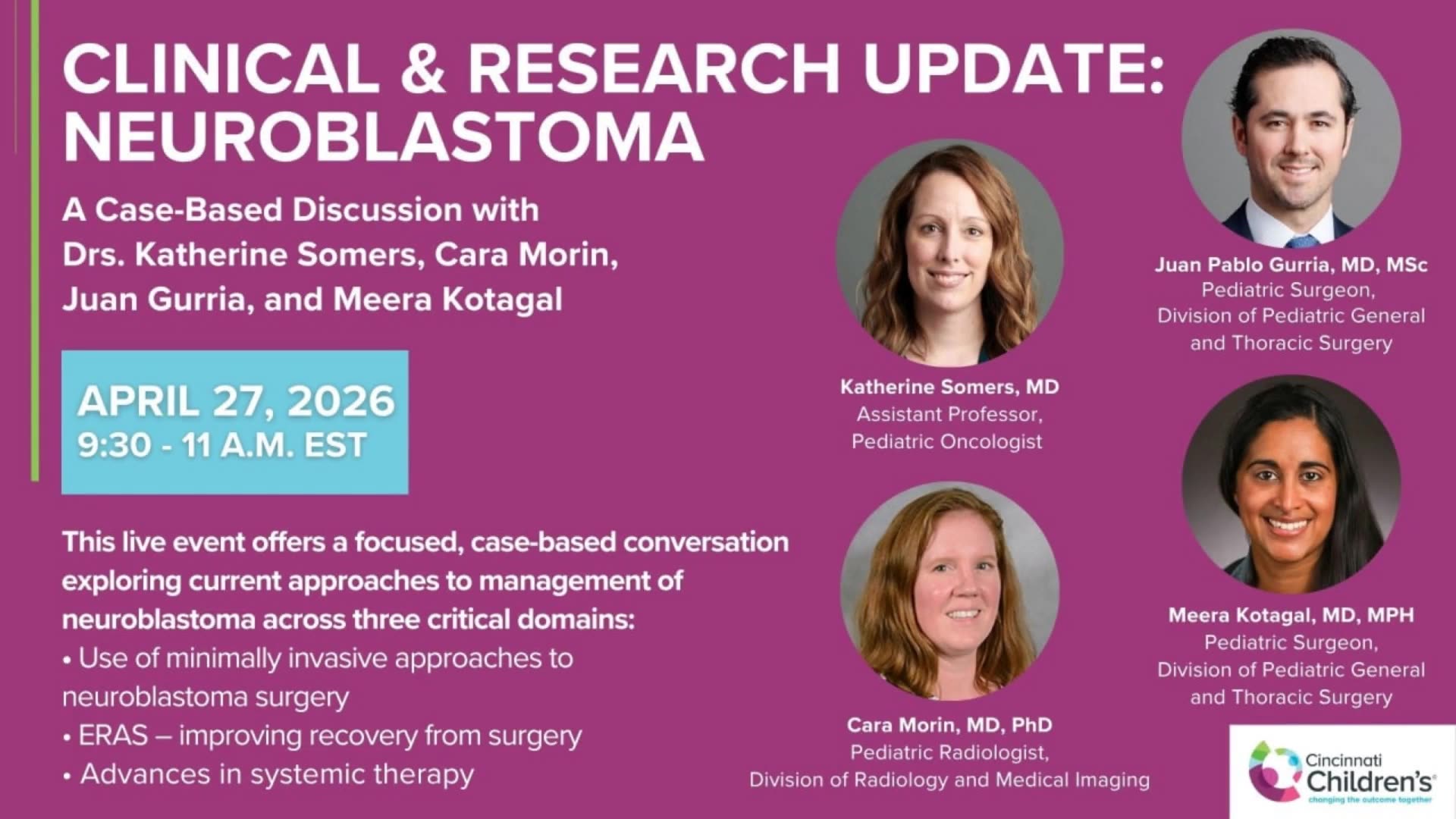
Clinical & Research Update: Neuroblastoma with Drs. Katherine Somers, Cara Morin, Juan Gurria, and Meera Kotagal
67 min · Published Sep 2026
Video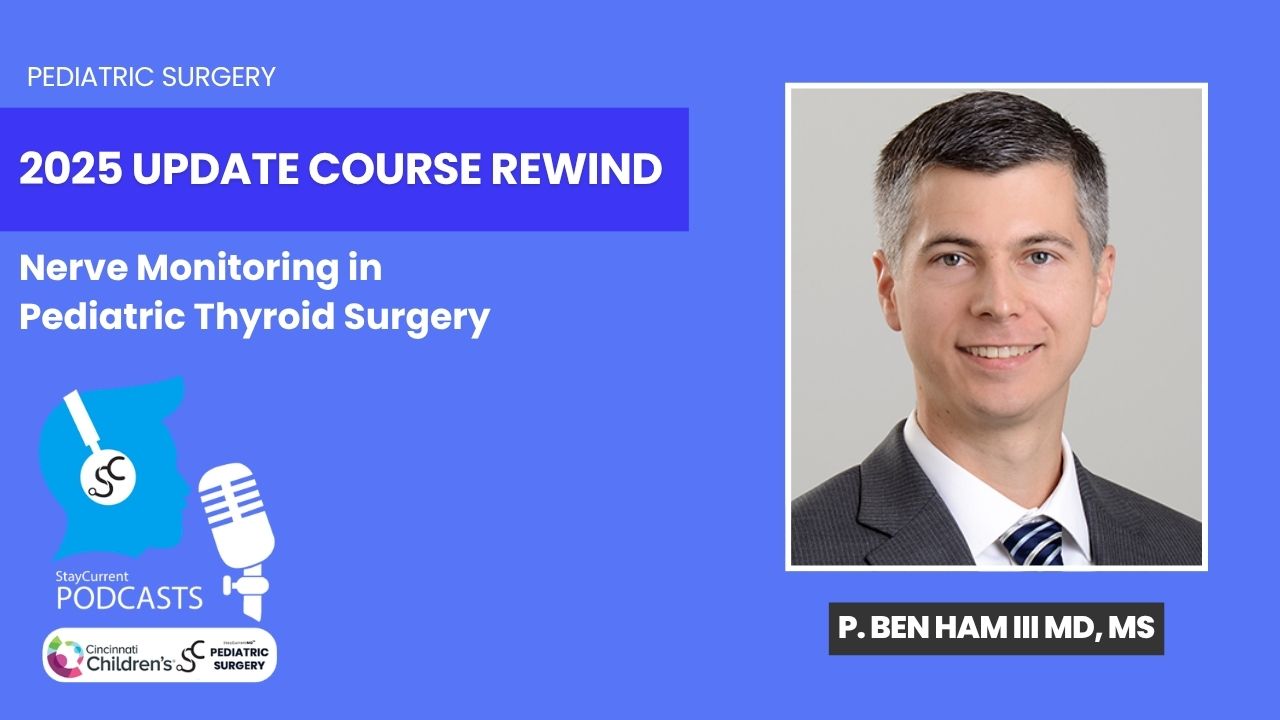
Update Course Rewind 2025: Nerve Monitoring in Pediatric Thyroid Surgery
6 min · Published Jul 2026
Video
Journal of Pediatric Surgery Article Review: June 2023, AAP Issue
Todd Ponsky · 13 min · Published Jul 2026
Video
Pediatric Surgical Oncology Research Collaborative (PSORC): Studying Rare Pediatric Tumors
56 s · Published May 2026
Video
Pooling Patients to Study Rare Pediatric Tumors: An Introduction to PSORC
56 s · Published May 2026
Video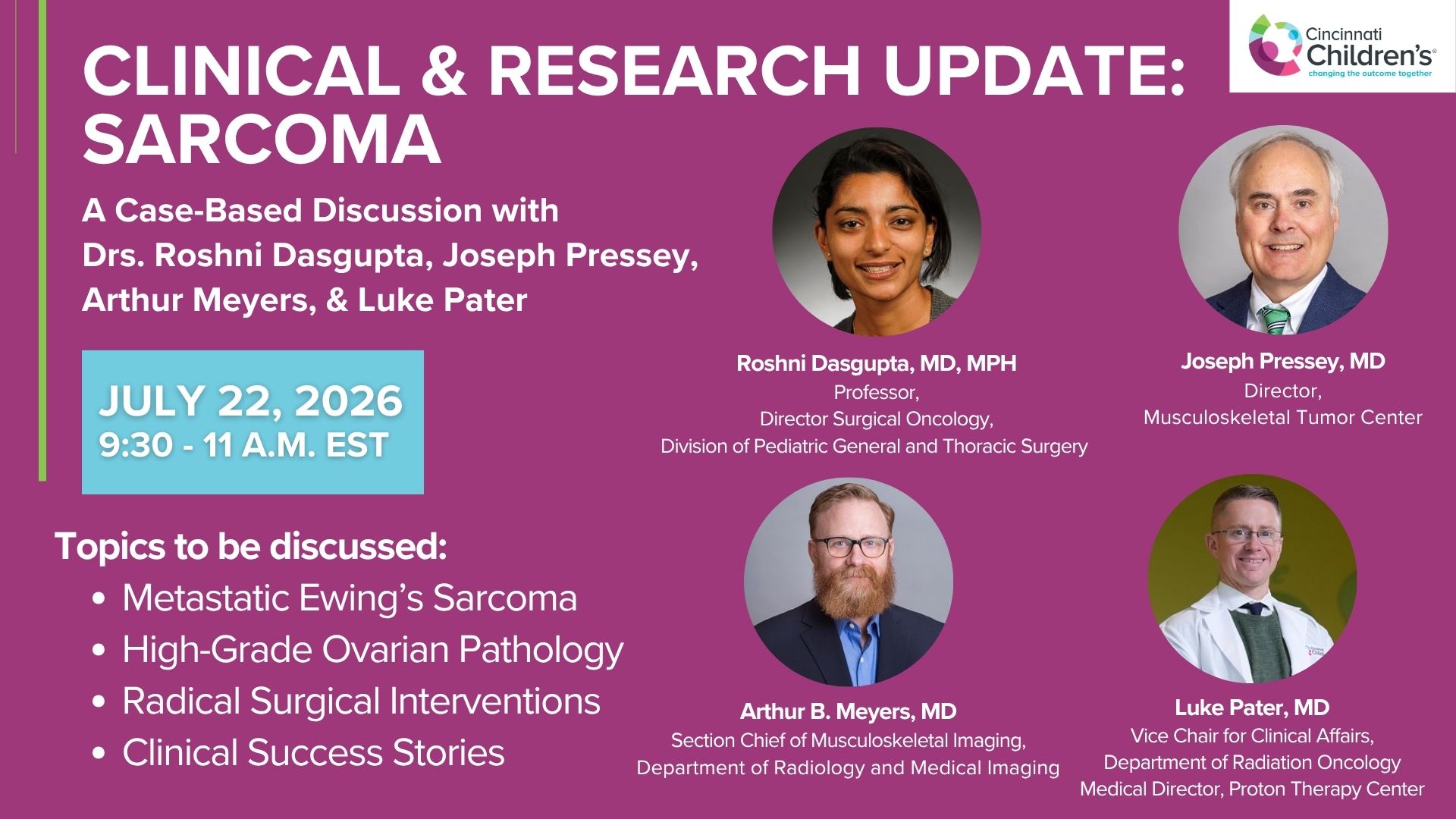
Clinical & Research Update: Sarcoma w/ Drs. Roshni Dasgupta, Joseph Pressey, Arthur Meyer, Luke Pater
66 min · Published Sep 2026
Video
Ovarian Torsion with Dr. Dasgupta
Published Sep 2022
Video
Ovarian Tumors with Dr. Roshni Dasgupta
CCHMC Pediatric Surgery · Published Sep 2022
Video
Ovarian Cysts with Dr. Roshni Dasgupta
Published Aug 2022
Video
Intestinal Atresia Types Explained: Grossfeld Classification for Pediatric Surgery
1 min · Published Sep 2026
Video
Derivation and validation of the Pediatric Community-Acquired Pneumonia Severity (PedCAPS) score: A prospective cohort study
50 s · Published Sep 2026
Video
FETO for Late-Diagnosed Severe Congenital Diaphragmatic Hernia (CDH) at Cincinnati Children's with Dr. Beth Rymeski
4 min · Published Sep 2026
Video
Severe Congenital Diaphragmatic Hernia (CDH) Case: FETO Management & Unexpected Findings with Dr. Beth Rymeski
3 min · Published Sep 2026
Video
Fetoscopic Endoluminal Tracheal Occlusion (FETO) Procedure: Step-by-Step Guide with Dr. Beth Rymeski
4 min · Published Sep 2026
Video
Choledochal Cyst Types Explained: Pediatric Surgery Fundamentals
1 min · Published Sep 2026
What the experts said
About 40% of patients can achieve a durable cure response after 5 years with complete metastatic site clearance.
Complete surgical resection of all metastatic tumor sites is an independent positive prognostic factor and affects overall survival, not just disease recurrence.
In patients with metastatic osteosarcoma, even 1-millimeter nodules can contain malignant disease in about 60% of cases.
The bigger the nodule is, the more likely it contains malignancy, but all the way down to 1 millimeter, tumor can be found.
Thoracotomy has historically been standard of care because surgeons can use fingers and hands to feel tiny nodules.
Manual palpation during thoracotomy finds about 30 to 40% more lung nodules than are detected on CT scan, even with thin-cut CT scans.
ICG can be used with thoracotomy to find deeper nodules, though depth of penetration is a limitation.
It is uncertain whether removing tiny 1-millimeter nodules actually provides a survival advantage.
VATS is minimally invasive with shorter length of stay, and repeat thoracoscopy typically encounters fewer adhesions compared to repeat thoracotomy.
VATS often requires some sort of localization process and good interventional radiology support.
In oligometastatic disease (patients with fewer than 4 nodules on each side), there was no difference in mortality between open resection and thoracoscopy.
The survival curves for thoracotomy and thoracoscopy in oligometastatic disease are essentially identical, meaning the optimal operation is unknown.
The multi-institution study had significant selection bias and institutional selection bias, with patients unlikely to receive thoracoscopy if they had many nodules.
Metastatic disease is typically addressed after 4 cycles of chemotherapy, and residual nodules at that point are unlikely to change with additional chemotherapy.
Practice for bilateral lung metastases is highly varied, with options including median sternotomy, staged thoracotomies, or bilateral thoracoscopies.
Most practitioners perform staged procedures for bilateral disease, particularly with thoracotomy, typically 4 to 6 weeks apart to allow a cycle of chemotherapy in between.
Dr. Rothenberg's institution reported almost 20 years ago that survival didn't change when there were only 3 to 4 nodules per side.
Because osteosarcoma is a systemic disease, the argument that manual palpation is necessary would logically require bilateral thoracotomy, not unilateral.
Even with the best CTs, only 1 to 2 millimeter nodules can be visualized, and some are still missed.
There are nodules that can be felt but not seen, and nodules that cannot be felt at all.
Dr. Rothenberg's practice is to use thoracoscopy when there are only 3 to 4 nodules per side that are amenable to thoracoscopic resection, in order to reduce morbidity.
For bilateral oligometastatic disease, Dr. Rothenberg performs bilateral thoracoscopy.
Non-surgical methods such as CyberKnife using fiducials to localize and ablate lesions may be a future approach for lung metastases.
The Children's Oncology Group is starting a study to answer the question of thoracotomy versus VATS, with enrollment expected to begin late 2021 or early 2022.
About 20% of osteosarcoma patients already have lung metastases by the time of diagnosis, usually picked up on staging chest CT.
With thoracotomy, surgeons can typically remove 15 to 20 nodules, but with thoracoscopy the number is more limited.
A multi-institution study of 200 patients with metastatic osteosarcoma—the largest study ever done—compared outcomes between open resection and thoracoscopy.